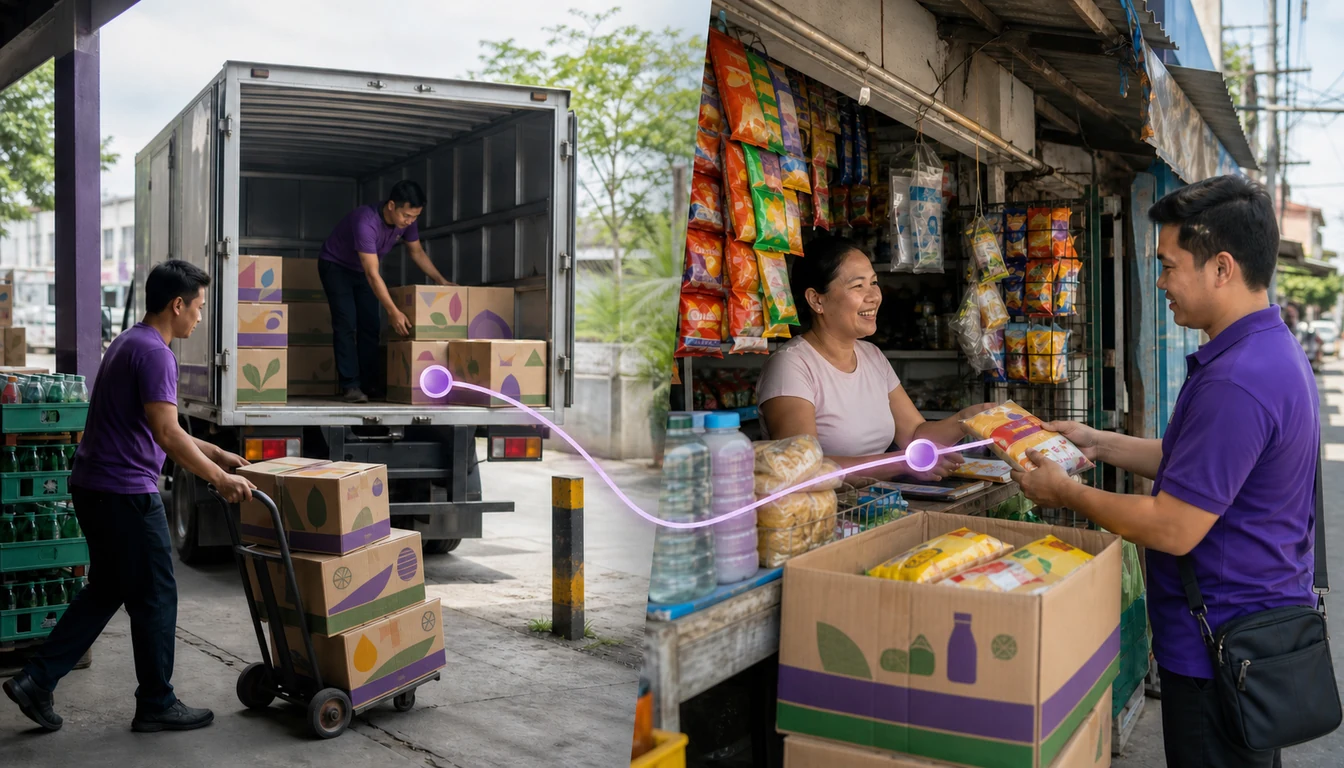
Trade schemes and promotional spend are one of the largest controllable costs for an FMCG, pharma or consumer durables company operating in the Philippines, and one of the hardest to see clearly once it leaves head office. A single national scheme might run at the same time across a handful of negotiated modern trade accounts and several thousand sari-sari stores spread across Luzon, the Visayas and Mindanao, each one redeeming the offer on its own schedule through its own sub-distributor or wholesaler. Keeping an accurate, current picture of what has been promised, what has actually been executed on the shelf and what has been paid out is a genuinely difficult coordination problem at that scale.
For most distributors and brand teams, that picture is still assembled by hand. Scheme terms live in a memo or a spreadsheet, field claims arrive as photos sent over a messaging app or as a paper form collected at month end, and reconciliation happens well after the promotional window has already closed. With thousands of small accounts in play, a scheme owner rarely has field-level proof that a promotion was actually displayed, that stock actually moved through the outlet, or that the account claiming the payout is the account that genuinely earned it.
That gap is where money quietly disappears. Scheme leakage, claims paid against stock that was never sold through, discounts applied twice across overlapping offers, and outright fraudulent claims filed by accounts that never ran the promotion at all, are common outcomes when payout decisions rely on self-reported paperwork instead of verified field data. None of this is unique to the Philippines, but the sheer number of sari-sari accounts in play alongside the parallel demands of negotiated modern trade terms make it a more pressing problem here than in markets with fewer, larger accounts to manage.

The Trade Schemes Commonly Run in the Philippine Market
Most brands and distributors are not running one scheme at a time. They are running several, layered on top of each other and aimed at different parts of the trade, and each type carries its own tracking requirement.
Volume and Slab-Based Schemes
The most familiar structure ties a rebate or discount to a volume threshold reached within a defined period, commonly agreed at the distributor or sub-distributor level rather than store by store. These schemes are relatively straightforward to administer when the counterparty is a single wholesaler moving predictable volume, but they still require a reliable, current count of what has actually shipped and sold through before a payout is authorised, rather than a projection of what should have moved.
Bundled and Tingi-Linked Offers
Case-sized volume slabs that work for a wholesaler rarely translate cleanly to the sari-sari counter, where the typical basket is a handful of sachets rather than a carton. Schemes aimed at this channel tend to be built around bundled or tingi-sized offers instead, a free sachet with a multi-pack purchase, or a small cash-back on a defined combination of fast-moving lines. Because a sari-sari store commonly stocks up to around 200 SKUs in a tiny footprint, these schemes only work if the underlying catalogue is tracked at the individual pack level. Blending sachet-sized promotional variants into the same listing as full-size stock, rather than treating them as their own tracked units through SKU management, is one of the more common reasons a tingi-scale scheme becomes impossible to reconcile later.
Visibility and Merchandising Incentives
A third category pays for shelf presence rather than volume: a fixed amount or a small margin bump for correct point-of-sale material placement, a defined facing, or a secondary display for a limited period. These schemes are only as good as the proof behind them, since visibility can be displaced within days by a competing merchandiser or simply by the physical churn of a small shop, which is why they depend on consistent point-of-sale material tracking rather than a rep's word that the display went up.
Tying Payouts to Verified Secondary Sales, Not Self-Reported Claims
The most reliable safeguard against paying for a scheme that did not work is to base the payout on secondary sales, what actually moved out of the outlet, rather than on sell-in figures alone.
Why Sell-In Alone Is Not Proof
Stock leaving a distributor's warehouse for a sub-distributor is not evidence that a scheme performed at the sari-sari shelf. It only confirms that inventory changed hands one tier up the chain. A scheme built to reward volume shipped rather than volume sold through creates an incentive to over-order at the wholesale tier without any guarantee the stock ever reached the intended outlets on the intended terms, which is precisely how a promotional budget gets spent without moving the number it was meant to move.
Photo Proof and Geotagged Visit Data
The more defensible approach ties a claim to a specific, verifiable field visit: a timestamped, geotagged photo captured at the outlet at the moment of execution, whether that is a display going up, a bundled offer being sold, or a stock count confirming the promotional SKU actually moved. A field app built for this kind of capture, rather than a rep collecting photos separately and forwarding them later, gives a scheme owner a direct, auditable link between a claim and the visit that generated it, run through the same field activity management workflow already used for coverage and journey tracking. Because this data includes location and outlet-level information, handling it in a way that supports, rather than sidesteps, the Data Privacy Act of 2012 is worth building into the process from the start rather than treating as an afterthought.
Closing the Gaps Where Scheme Leakage and Fraud Happen
Leakage rarely announces itself. It accumulates quietly across thousands of small claims, which is exactly why it survives so long in manual processes.
Common Leakage Patterns
The recurring patterns are fairly consistent across markets: the same claim submitted against two overlapping schemes, a claim filed for an outlet that has closed or changed hands, stock diverted to a different route than the one it was priced for, and claims filed well after a promotional window has technically closed but before anyone has checked the dates. None of these require deliberate fraud to cost real money. Most start as ordinary administrative gaps that simply never get caught because no one is checking claims against verified execution data before approving payment.
Controls That Close the Gap
Closing these gaps means moving scheme approval away from a manual sign-off and into a rules-based workflow: a claim is checked automatically against the scheme's own terms, against the field visit or photo evidence attached to it, and against whether that outlet or that scheme window has already been paid, before it is queued for payout. Sales scheme management built to enforce these checks at the point of claim, rather than during a reconciliation exercise weeks later, is what turns scheme control from a monthly audit exercise into a standing, everyday safeguard.
Running Different Scheme Rules for Sari-Sari and Modern Trade
Treating every account on a single scheme calendar, with a single set of rules, tends to under-serve both ends of the trade.
Scheme Design for Sari-Sari Scale
Schemes aimed at sari-sari stores need to be simple enough for a sub-distributor's or wholesaler's own sales team to explain and execute consistently across a large number of small, frequent visits. A scheme with too many conditions or exceptions tends to break down in the field long before it becomes a fraud problem, because reps either apply it incorrectly or stop bothering to apply it at all. Simplicity, paired with reliable field-level verification, does more to protect a promotional budget at this scale than a more elaborate set of rules ever will.
Negotiated Modern Trade Schemes
Modern trade groups, supermarket and hypermarket chains, convenience formats and pharmacy and health-and-beauty chains among them, typically negotiate promotional terms centrally, with listing arrangements, promotional calendars and reporting formats agreed at head-office level well ahead of execution. These schemes are fewer in number but larger in individual value, and they carry their own reporting cadence that rarely matches the store-by-store rhythm of a sari-sari programme. Naming the format is only meant to illustrate the contrast in scale and process, not to suggest any particular chain runs a 1Channel-powered promotion today. A scheme platform that can hold both rule sets, simple and high-frequency for general trade, structured and negotiated for modern trade, without forcing one calendar onto the other, avoids the common failure of either over-complicating sari-sari schemes or under-tracking the larger negotiated ones.
Timing and Coordinating Scheme Rollouts Across the Islands
A promotional calendar that assumes uniform, simultaneous rollout across the country tends to run into the Philippines' geography fairly quickly. Getting new scheme materials, updated pricing and briefing information to a field team spread across Luzon, the Visayas and Mindanao means coordinating with a workforce that also moves across regional languages, Tagalog in Luzon and Cebuano across much of the Visayas and Mindanao among them, so consistent briefing matters as much as consistent terms. Typhoon season adds a further, genuinely local wrinkle: a scheme launch date that assumes uninterrupted connectivity and open ports can slip in exactly the provinces where a storm has knocked out mobile coverage for a few days. Building a small buffer into scheme rollout timing, and giving field teams an offline-capable way to keep capturing claims through a signal outage, keeps a national promotional calendar realistic rather than aspirational.
Measuring Scheme ROI Beyond Redemption Counts
A redemption count on its own answers the wrong question. It confirms a scheme was claimed, not that it was worth running. Measuring return properly means comparing the cost of a scheme against the incremental secondary sales it actually generated at the outlets that ran it, against a comparable set of outlets that did not, over the same period.
That comparison only works if claim data, field execution evidence and underlying sales figures sit close enough together to be analysed as one dataset rather than reconciled by hand across separate spreadsheets. Sales analytics built to connect scheme spend to secondary sales performance, alongside distributor analytics covering the wholesale tier a scheme runs through, gives a brand or distribution team a genuine read on which scheme structures earn their budget and which quietly do not, well before the next promotional calendar is planned.
How 1Channel Brings Trade Schemes Under Control
Every problem covered above, scheme design that fits both sari-sari and modern trade, payouts tied to verified secondary sales rather than self-reported claims, leakage and fraud controls, and honest ROI measurement, comes down to the same underlying requirement: field execution data and scheme rules need to sit in one connected system rather than living apart. 1Channel brings these together in a single platform used by FMCG, pharma and distribution businesses across 40-plus countries and by more than 200,000 end users.
In practice, that means scheme rules configured once and applied consistently whether an account is a wholesaler running a volume slab or a sari-sari store redeeming a tingi-sized bundle, field capture that ties every claim to a timestamped, geotagged visit rather than a photo forwarded after the fact, an approval workflow that checks claims automatically against scheme terms and prior payouts before money moves, and analytics that connect scheme spend directly to the secondary sales it was meant to drive. The result is a promotional budget a team can actually account for, rather than one it has to trust.
Stop Paying for Schemes You Cannot Verify
1Channel ties every scheme claim to verified field execution and secondary sales, across sari-sari accounts and modern trade chains alike, so payouts match what actually happened on the shelf.
Explore Trade Promotion Management →Key Takeaways
Trade schemes are one of the largest and least visible costs in Philippine FMCG and pharma distribution, and the fix is less about running fewer schemes than about proving what each one actually delivered. A few points are worth carrying forward:
- Scale is the core tracking problem. Thousands of sari-sari accounts alongside a smaller number of negotiated modern trade chains make manual scheme tracking impractical well before anyone tries to commit fraud.
- Different scheme types need different proof. Volume-slab, tingi-linked bundle and visibility-based schemes each require their own evidence, not a single generic claim form.
- Sell-in is not proof of performance. Payouts tied to verified secondary sales and geotagged, timestamped field evidence close the gap that self-reported claims leave open.
- Leakage is usually administrative before it is fraudulent. Duplicate claims, closed outlets and missed scheme-window dates account for much of the loss, and rules-based approval catches them automatically.
- Sari-sari and modern trade need separate scheme logic. Simple, field-executable rules suit high-frequency general trade; structured, centrally negotiated terms suit modern trade chains, and one calendar should not force the other's shape.
- ROI only means something when it is measured against incremental sales. Redemption counts confirm a scheme was claimed; connecting spend to actual secondary sales lift confirms it was worth running.