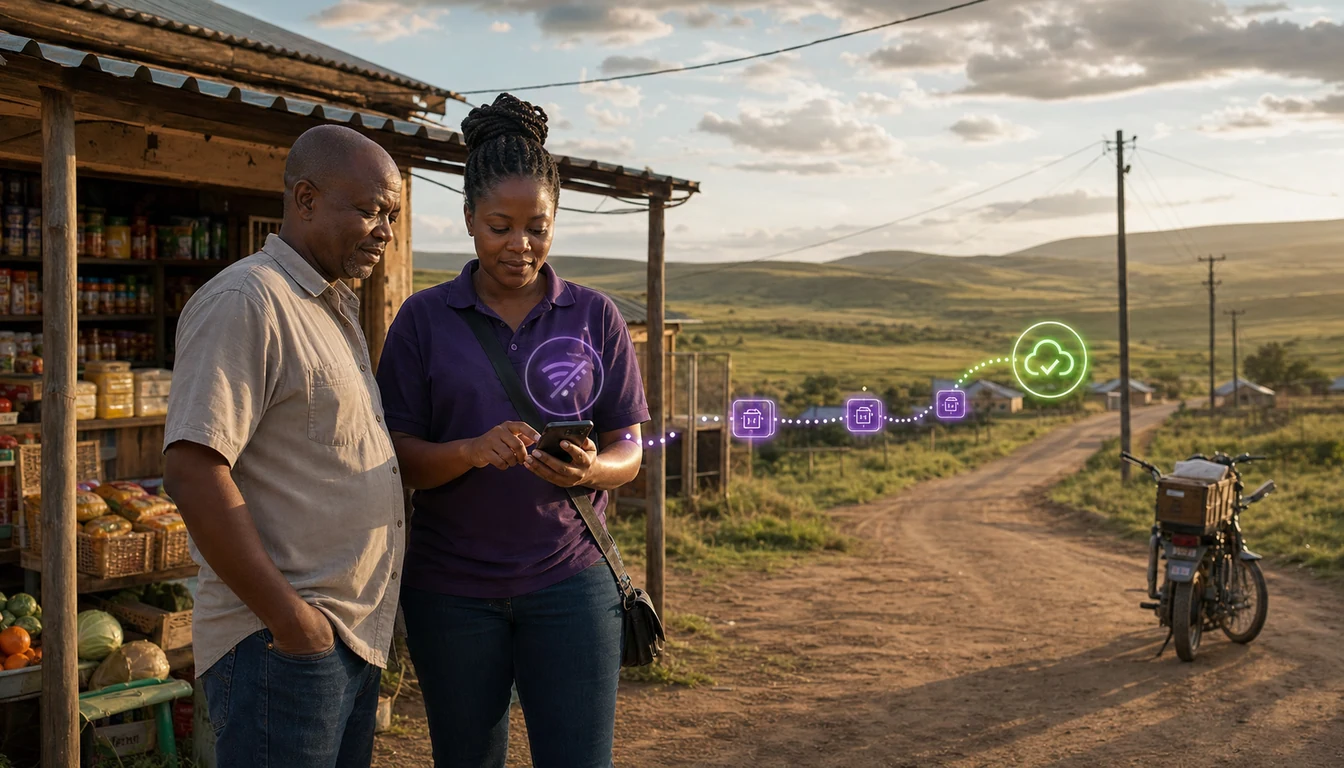
Ask a field rep in Soweto where an outlet sits and you rarely get a street name. You get a landmark: the spaza shop two doors up from the taxi stop, the one with the red shopfront, opposite the church hall.
Plenty of the outlets moving South Africa's fast-moving consumer goods sit where street addressing is inconsistent, or where the number painted on the wall matches nothing on the delivery note. Spaza shops, tuck shops, taverns and forecourt stores carry real FMCG volume through the distributor, independent wholesaler and retailer chain.
Building a township beat plan that survives contact with the route is one of the hardest and most valuable things a South African distribution business can get right. This guide sets out how field teams plan beats through Soweto, Khayelitsha, Umlazi and the townships ringing every metro, and how the same discipline carries over to the national chains sitting on the formal side of the same territory.

Why Street Addresses Break Down on a Township Beat
Addressing in township trade works differently from what most routing software assumes. A distributor covering the trading streets fanning out from Warwick Junction in Durban, or the stretch around the Bree taxi rank in the Johannesburg CBD, cannot hand a new rep a spreadsheet of numbered addresses and expect the visits to land.
Four things get in the way at once:
- Street naming is inconsistent. A back street is often known by the family that has traded on it for thirty years rather than by any signboard. Two reps will record the same spot two different ways.
- Outlets carry no dependable number. A tuck shop trading out of a converted garage is described only by whatever stands next to it.
- Trading strips rearrange themselves. Stands shift between seasons, so a stall in the third row this month sits in the fourth row next quarter.
- One description covers several outlets. "The shop by the taxi stop" can point to five spaza shops on the same corner.
The result is address-based routing that produces plans nobody can follow and coverage reports nobody believes. The answer is not a smarter address field. It is recording where an outlet physically stands, once, and reusing that for good.
Pin the Outlet, Not the Address
The single most valuable step is to onboard every outlet with a GPS pin dropped on site. When a rep first calls on a spaza shop, the app stores its coordinates together with a short landmark note written in whichever language that team actually works in, whether English, isiZulu, isiXhosa, Afrikaans or Sesotho.
From that point the outlet is found by its pin and its landmark, never by an address that was never dependable in the first place.
What a Rep Should Capture at Onboarding
- GPS coordinates dropped while standing at the shopfront, so the pin sits on the outlet and not on a road two streets over.
- A landmark note a stranger could follow: the nearest taxi rank, forecourt, school gate, clinic or church hall.
- A storefront photo so the next rep recognises the place at a glance, even when the owner is out.
- Channel and category tags, for example spaza shop, tuck shop, tavern, forecourt, independent wholesaler, or a national-chain store where the territory carries one.
- The distributor or cash-and-carry the outlet buys through, so primary and secondary flow stay connected.
Once outlets carry accurate pins you can cluster them geographically and hand each rep a beat that runs as a tight loop instead of a scattered chase across the metro. Geofencing then confirms that a visit happened at the outlet rather than somewhere near it, which is what makes a compliance figure worth reading.
Building a Beat Plan That Survives a Real Route
A workable beat plan balances two forces pulling against each other. Township clusters pack dozens of outlets into a few minutes on foot. Rural and peri-urban routes send a rep driving between towns for an hour at a stretch. Both sit inside the same territory, so the plan has to carry both.
Cluster First, Sequence Second
Start by grouping outlets that stand physically close together, using their pins, into a single day's beat. Inside a dense trading area such as the one around Warwick Junction, order the stops so the rep walks one sensible loop and never doubles back through the same crowded lane.
On rural and peri-urban routes in Limpopo, Mpumalanga or the Eastern Cape, sequence by driving order instead, so fuel and travel time stay under control, because logistics cost bites straight into margin.
Match Visit Frequency to Throughput
| Outlet type | Suggested call cycle |
|---|---|
| Cash-and-carry accounts and high-turnover spaza shops | Weekly or twice weekly |
| Smaller tuck shops and street vendors | Fortnightly or monthly |
| Newly onboarded or reactivated outlets | Tighter cycle until they settle |
Assign beats by rep, territory and weekday, so a Monday run through Katlehong and a Thursday run do not overlap and no outlet quietly falls off the plan. Where two distributors share geography, map each outlet to the servicing party so coverage credit is never counted twice.
Offline-First, Because Coverage Runs Thin Where the Outlets Are
Any routing approach that assumes a live connection will fail on a real South African beat. Mobile signal thins out in pockets of dense township housing, inside large market buildings and along rural stretches of the N1 and N2, and a rep who has to wait for a screen to load simply stops recording visits properly.
Beat planning has to be designed for those conditions instead of arguing with them.
Build for the Weakest Signal on the Route
- Reps must see the whole beat and outlet list offline. The plan belongs on the handset before the rep leaves the depot, not fetched on demand halfway down a street.
- Visits are captured offline with GPS coordinates, timestamp and photos, then synced the moment the handset finds signal again.
- The app should run on entry-level Android handsets and stay light on both battery and mobile data, because a flat phone at midday costs you an entire afternoon of coverage.
When capture works offline you avoid the two failures that quietly wreck coverage data: visits that never happened, and visits that did happen but were never written down. The GPS stamp taken at the shopfront is what makes the report believable weeks later, even though it was recorded where there was no signal at all.
What to Measure, and What Hides Inside the Numbers
A beat plan is only as good as the numbers you trust. A short set of measures, read together rather than one at a time, tells you whether coverage is real.
The Numbers Worth Watching
- Beat compliance: planned calls that actually happened, per rep per day. It is the headline coverage number and the one everybody quotes.
- Visit productivity: how many outlets a rep works in a day, how far apart the stops are, and when the first and last activity of the day were logged. Late starts and one-hour routes show up here immediately.
- New outlet additions: how many previously unmapped spaza shops and tuck shops were onboarded with a proper pin and a storefront photo.
- Geofence pass rate: how many check-ins landed inside the outlet geofence, and how many sat an unexplained distance from it.
Where Coverage Reports Go Wrong
- Vanity coverage. A rep ticks every outlet and sells nothing. Read beat compliance next to visit duration and order capture so a tick has to mean work.
- Pin drift. A pin dropped from a moving bakkie lands on the road rather than the shop. Insist that pins are taken at the shopfront, and review the outliers.
- Ghost outlets. The same shop recorded twice quietly inflates your outlet base. Merge duplicates using pin proximity together with the storefront photo.
- Frequency mismatch. Putting a busy cash-and-carry account and a quiet tuck shop on the same cycle wastes a rep on one and starves the other. Tune the cycle to throughput.
- Stale territories. When a rep resigns, their outlets have to be reassigned deliberately, or an entire cluster goes unserved for weeks.
Township counters are still largely cash, but instant EFT, PayShap and card are moving in fast. Linking a confirmed, geotagged visit to its order and its payment reference gives you one clean end-to-end view of what actually happened on the beat.
A Rollout You Can Run in a Single Quarter
There is no need to start everywhere at once. A focused rollout in one strong territory proves the model before you take it across all nine provinces. Work through these steps in order:
- Pick one territory, for example a distributor's coverage across a single township cluster in Gauteng or KwaZulu-Natal.
- Onboard outlets with pins and landmark notes across the first call cycle, capturing storefront photos as you go.
- Cluster and sequence the beats from those pins, then assign each one by rep and weekday.
- Run offline capture for a full month, then read beat compliance, visit productivity and geofence pass rate together.
- Clean the base, merge ghost outlets and correct any pins that have drifted.
- Extend the same discipline to Cape Town, Gqeberha, Bloemfontein and Polokwane and the routes between them, keeping territories tidy as the base grows.
How 1Channel Supports Township Route Planning
Township route planning is not about forcing South African trade into an address system it never needed. It is about respecting how reps already navigate, by landmark and by memory, and turning that knowledge into structured, measurable coverage.
1Channel is built for exactly these conditions. It geotags the outlet rather than leaning on a street address, so beats stay accurate wherever street addressing is inconsistent.
For South African FMCG and distribution teams, the platform helps you:
- Onboard every spaza shop, tuck shop and tavern with a GPS pin, landmark note and storefront photo
- Cluster outlets from their pins and sequence each beat, then assign it by rep, territory and weekday
- Record visits offline with GPS, timestamp and photos, then sync the moment signal returns
- Confirm each visit against the outlet geofence, then track compliance, productivity and pass rate
- Hand territories over cleanly when a rep moves on, so no cluster is left unserved
Explore 1Channel Route Planning for South Africa
See how 1Channel's route planning and beat management software helps South African teams pin outlets, build township beats from GPS clusters, and confirm every visit with offline-first check-ins.
Explore Route Planning Software →Key Takeaways
- Route to pins, not addresses. Township outlets sit where street addressing is inconsistent, so capture coordinates and a landmark note once, then reuse them for good.
- Cluster before you sequence. Group nearby outlets into one beat, then order the stops as a walking loop in a trading strip or a driving order on a rural route.
- Match frequency to throughput. Cash-and-carry accounts and high-turnover spaza shops earn weekly calls; quieter tuck shops sit on a longer cycle.
- Build offline-first. Plans and capture have to work through weak mobile coverage and sync once the handset finds signal again.
- Measure honestly. Read beat compliance next to visit duration and geofence pass rate, and keep an eye out for vanity coverage, pin drift and ghost outlets.