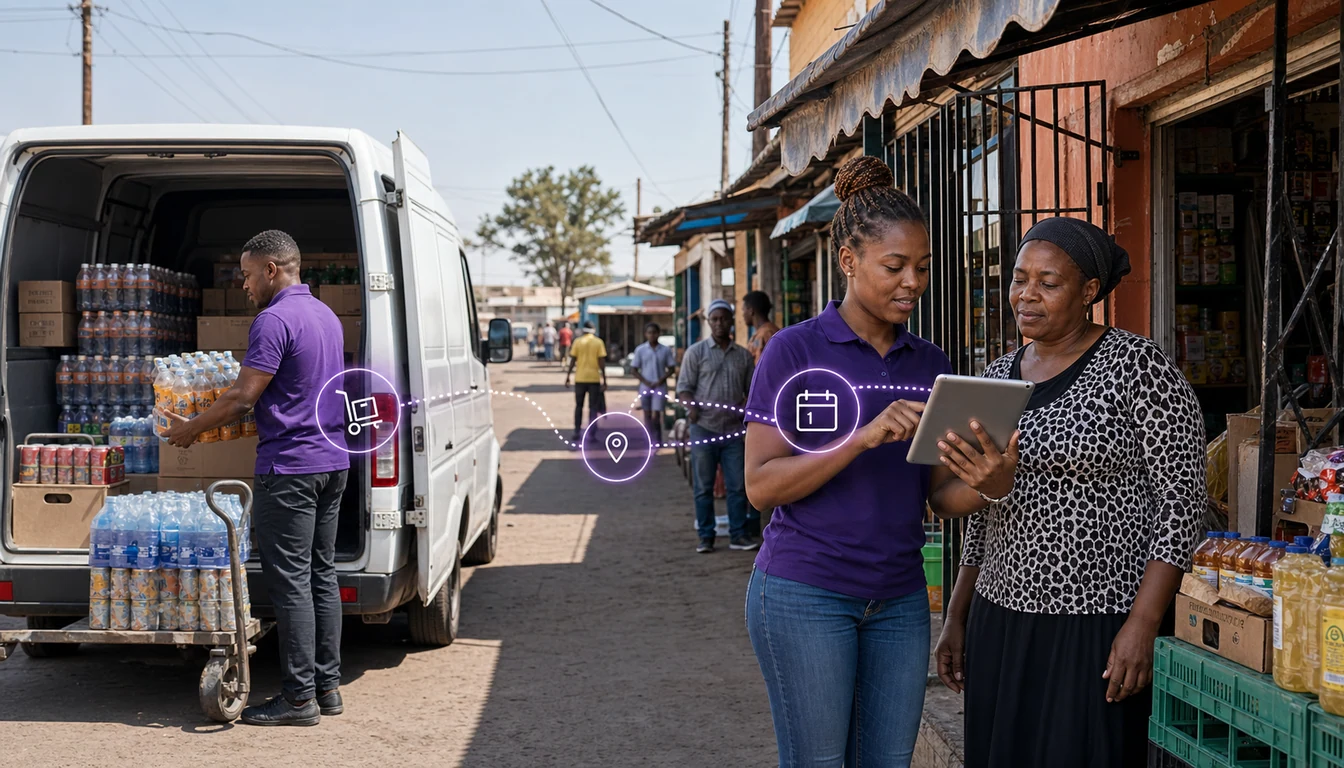
Municipal registration turned the spaza shop from a name in a rep's notebook into a business with a record attached to it. For brands and distributors selling into township trade, that changes what an outlet is long before it changes anything about the sale.
Onboarding used to end at a shop name, a mobile number and a rough sense of where the place stood. The same call now has to produce a permit reference, an owner on record and a location anyone can find again, because the shop itself is being asked for exactly that.
None of this is a legal exercise to be admired from head office. It lands at the counter, on the day a rep opens the outlet, on whatever handset that rep happens to be carrying.

What Registration Changed at the Counter
The requirement is easy to state and awkward to run. A spaza shop, like any other food-handling business, is expected to be registered with the municipality it trades in, and the person trading there is expected to be able to show it.
For the shop owner that is a queue and a form. For the brand supplying that shop it is something else entirely: every outlet on the route now carries a status, and that status is either something your data knows or something it guesses at.
The practical effect turns up in three places on a route:
- A new outlet takes longer to open. The rep is no longer simply agreeing a first order; the call has to gather documents and detail the shop may not have to hand that day.
- Every existing outlet has to be back-filled. Shops that were on route lists long before any of this sit in records that were never built to hold a permit reference or a document image.
- The owner on paper and the person behind the counter can differ. A shop changes hands quietly, and a record that was accurate on the day of onboarding drifts without anybody deciding to let it.
Whichever of the three you are dealing with, the remedy is the same: the outlet record has to grow up. A shop name and a mobile number were enough to arrange a delivery. They are not enough for a trading relationship somebody has to stand behind.
Capture the Document, Not Just the Detail
A registration reference typed into a free-text notes box is close to worthless six months later. Nobody can search it, nobody can tell whether it was read off a permit or repeated from memory, and nobody knows which of the four records for that shop is the real one.
Capture has to be structured and evidenced at the same time. In practice the rep does three things at the counter, inside the time a normal call already takes:
- Photograph the permit against the outlet record. An image attached to the shop, timestamped and geo-tagged, settles a later argument in a way a typed number never will.
- Fill structured fields, not a comment box. Registration reference, municipality, owner name and the date the document was sighted belong in fields you can report on, validate and expire.
- Finish the capture where the network does not. Mobile coverage thins on rural routes and drops away in pockets of dense township trade, so the form has to save on the device and sync when signal returns.
That last point carries more weight than it looks. If the form needs a live connection to save, reps will finish the paperwork later from somewhere with signal, and paperwork completed away from the shop is paperwork nobody can vouch for.
Verify Once, Then Keep the Record Honest
Onboarding is a moment. The register is a living thing. A file that was complete on the day a shop was opened says nothing about that shop today, and a programme that only counts how many outlets were added is measuring the easy half of the job.
A short set of measures keeps the register worth having, and every one of them is answerable from the field app rather than a side spreadsheet:
- Documented coverage: the share of active outlets on a beat holding a captured permit image, not merely a reference somebody typed.
- Records due for refresh: outlets whose document was last sighted long enough ago that a rep should look again on the next call.
- Owner mismatches: calls where the name on the record and the person trading do not line up, raised to a manager rather than corrected quietly in the field.
- Unverified locations: outlets with no geo-pin at all, or a pin sitting far enough from the trading address that one of the two must be wrong.
The Monthly Pass That Keeps It Clean
Book one short review a month against the register instead of a clean-up project every other year. Work the exceptions in a fixed order: outlets with no document, outlets whose document has gone stale, mismatched owners, then missing pins.
Assign each exception to the rep whose beat it sits on and tick it off on the next cycle. A register maintained in small pieces stays usable. One left alone until somebody demands to see it never is.
What a Verified Outlet Does for Credit and Invoicing
A verified outlet is a commercially different outlet. Once you know who the registered owner is and where the shop genuinely trades, questions that used to be answered on instinct start being answered on evidence.
With invoicing across the country moving steadily towards structured digital formats, the accuracy of the customer record sitting underneath the invoice is the part a brand controls today. As rand price lists move and terms change, that record is what keeps the change landing on the right shop.
It shows up hardest in the three places where money actually moves:
- Credit decisions. Extending terms to a shop nobody has verified is a decision taken blind. Extending them to a documented outlet with a trading history is a decision you can defend.
- Invoicing the right party. Invoices, credit notes and statements have to name the business that is genuinely buying, which is precisely what a registration record establishes.
- Collections that reconcile. Cash, card and instant EFT payments matched to a verified outlet and a named invoice at the point of collection turn month-end into arithmetic rather than archaeology.
The Personal Data You Are Now Holding
The moment you capture an owner's name, identity detail and a photographed document, your outlet register holds personal information. That is not an argument for skipping the capture. It is an argument for holding it properly.
POPIA sets the expectations here and the Information Regulator oversees them. 1Channel supports POPIA-aligned handling through role-based access, an audit trail on every capture and controlled export, though the obligation itself always stays with the brand. The working rules on a field system are unglamorous and worth agreeing before the first record is captured:
- Collect only what the process uses. If a field never feeds a decision anybody makes, it does not belong on the form and should not be sitting in the record.
- Tell the shop owner why. One plain line at the point of capture, in whichever language the call is happening in, does more for trust than a policy nobody opens.
- Restrict who can see the documents. A rep needs to capture, a regional manager needs to review, and almost nobody needs a bulk export of identity images.
- Keep an audit trail. Who captured what, when and from where, so any record can be explained on request instead of defended after the fact.
Give the Rep a Reason to Do It Properly
Reps here are multilingual by default, often early in their careers and rarely short of alternatives. A verification step bolted onto an already long call, with nothing in it for the person doing the work, gets completed badly or quietly skipped.
So keep the capture short, keep the fields obvious, let the photograph carry the load, and put something back: a verified outlet unlocks terms, a scheme or a delivery slot the rep can actually promise. When completing the record helps a rep sell, the register maintains itself.
An Onboarding Round in Soweto
Picture a beverage distributor adding several dozen new spaza shops and tuck shops across Soweto over a single quarter. Three reps split the work around beats they already run, and head office wants a complete register without giving up a week of selling to get it.
The sequence that works is unexciting, which is largely why it works:
- Open the outlet inside one call with shop name, owner, trading address, geo-pin and a photograph of the permit, all captured before the rep leaves the counter.
- Queue whatever is missing instead of blocking the order, so a shop that cannot find its document today still trades and the gap lands on a task list.
- Review the exceptions weekly as one short list: no document, no pin, or a name that does not match the person trading.
- Release the commercial benefit on verification so terms, schemes and route priority follow a completed record rather than a promise of one.
By the end of the quarter the distributor has a register it can hand to anyone who asks, and the field team has stopped treating verification as a separate job from selling.
Where Onboarding Programmes Come Unstuck
- Treating the register as a one-off project. Shops open, close and change hands, so a register nobody refreshes is out of date within a season and misleading within a year.
- Blocking the sale on a missing document. A hard gate at the counter teaches reps to enter anything at all to get past the screen, and that data is worse than none.
- Storing the evidence in a chat thread. Photographs sent to a supervisor's phone are not a record, because nothing there can be searched, reported on or governed.
- Collecting more personal detail than you use. Every extra field is a longer call and a heavier obligation in exchange for a decision nobody was going to make.
- Assuming a live connection. Capture that only works on a good signal fails on exactly the routes where the newest outlets tend to sit.
How 1Channel Supports Outlet Onboarding and Verification
Onboarding, verification and selling all happen inside the same call, so they belong inside the same app. 1Channel brings outlet onboarding, document capture, coverage, orders and collections together in one offline-first platform suited to the way South African routes actually run.
Reps work on entry-level Android handsets, finish the capture with no signal at all, and sync when the network returns. Managers get a register with evidence attached instead of a list of shop names nobody can vouch for.
For outlet onboarding specifically, the platform lets a team:
- Onboard a new outlet inside one call, with structured fields and a photographed permit attached.
- Geo-pin every shop where street addressing is inconsistent, then find it again next cycle.
- Raise missing, stale or mismatched records as tasks on the right rep's beat.
- Support POPIA-aligned handling with role-based access, audit trails and controlled export.
- Release credit terms, schemes and route priority only once an outlet record is complete.
Onboard Township Outlets Without Slowing the Sale
See how 1Channel's offline-first sales force automation handles outlet onboarding, document capture, geotagged calls, orders, collections and analytics on one platform built for routes across Gauteng, KwaZulu-Natal and the Western Cape.
Explore Sales Force Automation →Key Takeaways
Registration made outlet data a business asset rather than a filing chore. A handful of habits keep it that way:
- Capture evidence, not entries. A photographed permit sitting against a structured record beats a reference typed from memory.
- Design for no signal. Onboarding has to finish at the counter, on the handset the rep is already carrying.
- Refresh rather than archive. Owners and shops change, so review the register in short monthly passes.
- Hold personal data lightly. Collect only what a decision needs, say why you are collecting it, and limit who can see it.
- Reward the completed record. Tie terms, schemes and priority to verification, and the register looks after itself.
Do that and compliance stops reading as a cost and starts being the cleanest customer data you own.