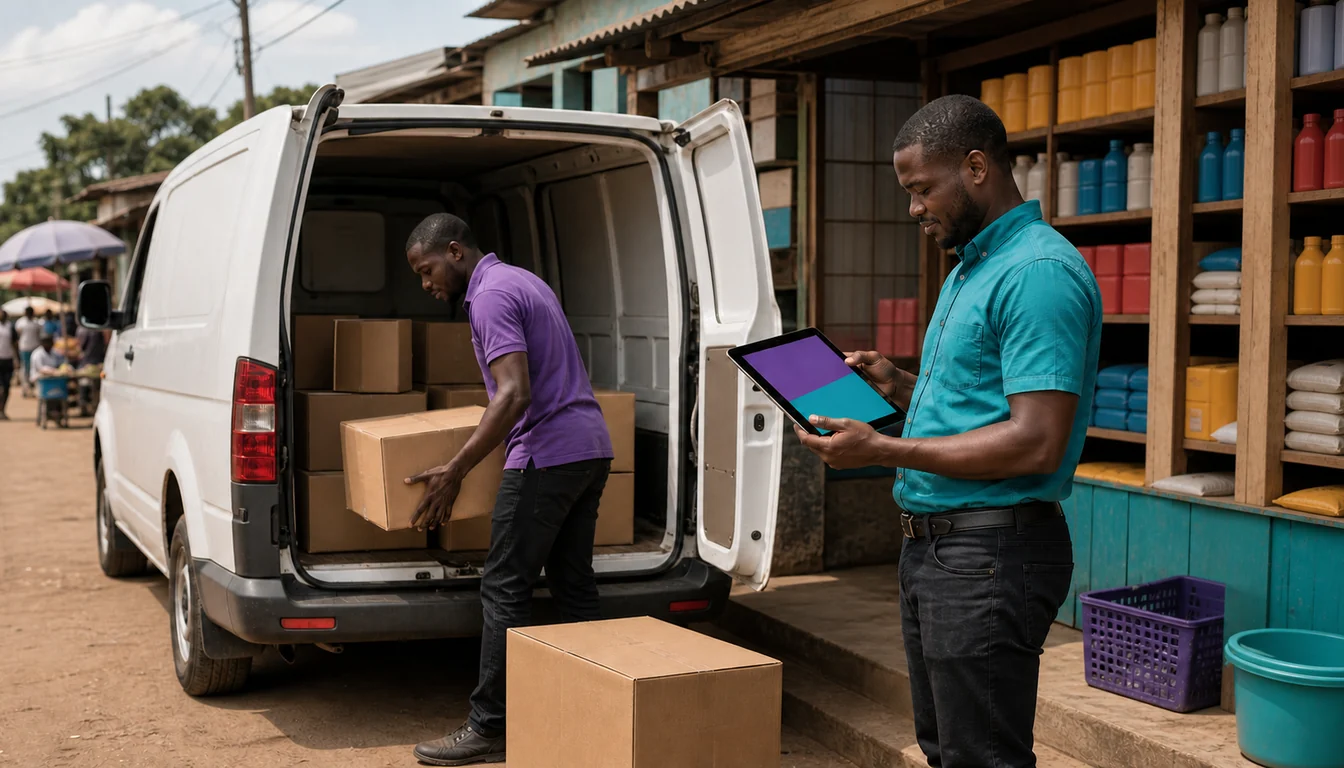
By the third vendor demonstration, most distributor management systems look interchangeable. Every one has orders, stock, invoices, a mobile app and a dashboard. What decides whether a system works for a Ghanaian distribution business rarely appears on a feature grid, because it sits in the parts of the operation a generic demonstration never touches: the wholesaler two tiers down, a part-payment split between a wallet and cash, an invoice that has to reach the Ghana Revenue Authority, and a beat in the Upper West where the signal drops out before mid-morning.

Buy for the Channel You Actually Sell Through
Most FMCG volume in Ghana still moves through traditional trade: provision shops, kiosks, container shops, table-top sellers and market stalls, supplied by wholesalers and sub-distributors sitting under an appointed key distributor. Modern trade is real and growing, with chains such as Melcom and Carrefour reshaping the top of the market, but it remains the second channel rather than the main one. A platform designed around chain retail will look elegant in a boardroom and thin on a Kaneshie route.
So do not start from the vendor's feature list. Write your own list of five or six situations your business actually runs, and make every shortlisted vendor walk through them live: a dense Accra beat with dozens of small outlets, a long run into a sparse northern territory, a wholesaler ordering in bulk on credit, a modern-trade account with its own planogram, and a month-end reconciliation across three payment methods. The shortlist usually separates itself within two sessions.
Does It Reach Past the First Hop?
Almost every system handles the first hop competently, because sell-in from the brand to the key distributor is a straightforward transaction between two organised parties. What matters is what the system knows after that handover, when stock moves from the KD to wholesalers, sub-distributors and van routes, and on to the small outlets that generate the demand.
This is harder in Ghana than the software makes it look, because the KD employs the selling team while the brand employs the supervisory layer. Ask each vendor to show the data model rather than the dashboard. Can the platform hold a genuine third tier, or is "sub-distributor" simply a customer record on the KD's ledger? Can a wholesaler place and track its own orders through a distributor portal rather than by phoning a sales office? A system that answers only the first hop leaves you where you are now, which is blind below the key distributor.
Can It Close the Cash Cycle in Cedis?
Collections in Ghana are unusual by regional standards, and a system built elsewhere often gets them wrong in a way that stays invisible until month end.
Reconciling mobile money, bank transfer and cash
Mobile money is the dominant rail, and Ghana's schemes are fully interoperable through GhIPSS, so a payment from MTN MoMo, Telecel Cash or AT Money settles across networks in seconds, alongside GhQR, GhanaPay and ordinary bank transfers. Cash remains real at the table-top and market-stall tier. Since the transfer levy on digital payments was repealed in April 2025, the old cost argument for preferring cash has gone, and most distributors now collect across all three methods at once.
The evaluation question is therefore reconciliation, not acceptance. Ask how an invoice part-settled by a wallet transfer and part-settled in cash is recorded, where the wallet confirmation reference is stored, and who is allowed to mark a payment as received. Every figure should land in one GHS ledger, not in three parallel records that a clerk merges by hand.
Credit limits and receivables
Then look at the credit side. The system should hold a limit and terms per customer, age receivables in cedis, and decide at the point of order whether stock is released or held. Ask whether a supervisor can override a block, and whether that override is logged. Good payment and collections management is mostly about making the awkward decision visible on the day it is taken.
Will Every Invoice Stand Up to the GRA?
This is where a lot of shortlists fall apart. Ghana's E-VAT regime is already in force: every VAT-registered business must issue invoices through a Certified Invoicing System connected to the Ghana Revenue Authority, and under the current law that applies with no revenue threshold. Any vendor describing electronic invoicing as an upcoming mandate, or offering it as a roadmap item for next year, is telling you they have not sold into this market.
Ask three practical questions. How do invoices produced by the system reach a Certified Invoicing System, and what must finance do manually in that flow? What happens to a van-sales invoice raised at a shop front while the device had no signal? And how are credit notes and returns handled, since a return that never reaches the tax record is a reconciliation problem that grows quietly.
Ask too how tax configuration is maintained. The 2026 VAT reform recoupled the NHIL and GETFund levies into VAT so they can be claimed as input tax, scrapped the flat rate scheme in favour of a unified system and lifted the registration threshold. Rules of that kind change by amendment, so configuration should be a setting your finance team can update, not a code release you wait for. Treat any claim of GRA certification as a warning sign: a platform supports the regime, it is not approved by it. Our note on what E-VAT means for distributor systems covers this further.
How Does It Behave After Six Hours Without Signal?
Connectivity across the southern urban belt is good enough that a demonstration in Accra proves nothing. Coverage thins for real across the Savannah, North East, Upper East, Upper West, Oti and Bono East regions and on rural cocoa and agro routes, and 5G remains nascent, with the shared commercial backbone switched on only in parts of Accra, Kumasi and Tamale during 2026. A representative on a northern beat genuinely loses signal for hours at a time.
Offline capture is now claimed by nearly everyone, so the differentiator is reconnection behaviour rather than the claim. Put a device into flight mode during the demonstration, ask the vendor to complete a full day of work on it, then reconnect and watch. Does the queue upload in order? What happens if a price or a scheme changed centrally while the device was dark? Can the same stock be committed twice by two representatives who were both offline? Those answers tell you whether the offline story is engineered or asserted.
Can It Plan Coverage Across 16 Regions?
Ghana has 16 regions and a live district tier of Metropolitan, Municipal and District Assemblies, and coverage economics change completely from one end of the country to the other. A visit frequency that pays in Greater Accra is uneconomic in Upper West. Any system you buy should let you model that difference rather than force one national beat template.
Addressing is the other half of the problem. GhanaPostGPS is the official digital addressing standard, but day-to-day navigation is still landmark-led, so a beat built from written addresses will not survive a change of representative. Ask whether the outlet master is geo-tagged at the first visit, how duplicates are detected and merged, and whether beats can be drawn on a map, rolled up to district and regional views, and compared as planned against actual coverage. Strong route and beat planning here is built on coordinates and outlet history, not street names.
Does It Control Batch and Expiry?
If you distribute food, beverages, medicines, cosmetics or household chemicals, you sit under the Food and Drugs Authority, whose mandate comes from the Public Health Act, 2012 (Act 851). Batch discipline is then an operational requirement, and it is the area where paper-based distributors are most exposed.
Ask whether batch and expiry are captured at goods receipt rather than typed in later, whether picking follows first-expired-first-out by default, and whether the ordering screen warns a representative before short-dated stock is pushed to a slow-turning outlet. Ask how a recall would work: from a batch number, can you list every wholesaler, sub-distributor and outlet that received it? For pharmaceutical distribution, where retail splits between pharmacies and chemical shops, that trace is the whole control. A capable batch management module should also treat near-expiry returns as a normal transaction, since informal returns handling is where stock value and audit trails disappear together.
How Does It Handle Personal Data in the Field?
A field force collects a surprising amount of personal information: shop owners' names and phone numbers, photographs that include people, identity details captured during outlet onboarding, and continuous location data about your own staff. In Ghana that is governed by the Data Protection Act, 2012 (Act 843), administered by the Data Protection Commission.
Buyers rarely raise this in a first meeting, and they should. Ask how consent is captured when an outlet is registered, what role-based controls stop a representative exporting a full customer list, what the retention policy is, and whether records can be corrected or deleted on request. Ask where data is hosted and what the contract says about transfers outside Ghana. On staff location, ask whether tracking can be limited to working hours, and whether that limit is a configurable setting rather than a promise. As with tax, a vendor should say the platform supports compliance with Act 843; one claiming certification under it is describing something that does not exist.
Is the AI Doing Real Work?
Nearly every distributor management system now carries an AI label, and the label covers everything from a genuine forecasting model to a set of threshold alerts renamed for the brochure. Both can be useful, but you should know which one you are buying.
Forecasting that respects a Ghanaian season
Demand here is shaped by patterns no generic model knows: Christmas and Easter as the FMCG peaks, Homowo, Odwira and Akwasidae in the south, Damba and Eid in the north, the cocoa main and light crops moving rural liquidity, and harmattan changing northern route conditions from December. Ask whether the forecast is trained on your own secondary sales history at outlet and SKU level or on a generic seasonal curve, how many months of clean data it needs before its output is worth acting on, and whether a planner can see why a number was produced, override it, and have the override treated as a signal rather than discarded.
Anomaly detection that earns attention
The more immediately valuable capability is usually anomaly detection, because it turns a large stream of field activity into a short list a supervisor can work through: collections marked received with no matching wallet reference, discounting outside scheme rules, orders booked against outlets that were not visited, duplicate outlet records created to claim coverage, a sudden spike in returns at one wholesaler. Ask what happens when something is flagged, who receives it and how quickly, and how false positives are tuned, because an alert stream nobody trusts is worse than no alerts. Ask what the system does in the first ninety days, before it has your history. An honest vendor will say rules carry the load early and the models improve later.
What Will Implementation Demand From Your Back Office?
The last question decides whether any of the previous answers matter. If your distributor's back office runs on paper, exercise books and a spreadsheet, implementation is mostly a data exercise, and the vendor cannot do it for you.
Ask for a written checklist of what you must supply before configuration starts: a cleaned outlet master, an SKU and price master, opening stock counts by batch where relevant, credit terms per customer, and the scheme rules that currently live in one manager's head. Agree who cleans that data and by when. Insist on a pilot in one territory, ideally a dense southern beat and a long northern route, before a national rollout. Ask how training reaches a field force that reads English but works in Twi, Ga, Ewe, Dagbani and Hausa, and whether refresher material stays on the device. Confirm device standards, support hours in GMT, and what happens during an unplanned power outage at the depot. Then agree how adoption will be measured. Sign-off is not adoption; daily usage by the people on the beat is.
How 1Channel Helps Ghanaian Distribution Buyers
1Channel is built for the structure described above: a key distributor tier feeding wholesalers, sub-distributors and van routes, with traditional trade and modern trade running on one platform rather than two. The questions in this guide are the ones we expect buyers to put to us, and to every other vendor on the shortlist.
- Multi-tier distribution management that records movement from the key distributor down through wholesalers and sub-distributors to individual provision shops, kiosks and market stalls.
- Collections captured across mobile money, bank transfer and cash, reconciled into a single GHS ledger with credit limits enforced at the point of order.
- Invoicing and tax records structured to support Ghana's E-VAT regime, with configuration your finance team can maintain as rules are amended.
- Offline-capable mobile working for northern and rural beats, with ordered synchronisation and conflict handling when a device reconnects.
- Geo-tagged outlet masters and beat planning that roll up to MMDA and regional views across all 16 regions.
- AI-assisted forecasting and anomaly detection trained on your own secondary sales history, surfacing exceptions a supervisor can act on the same day.
See how the questions are answered in practice
Walk through multi-tier distribution, cedi collections, E-VAT-ready invoicing and AI-assisted planning on one platform built for Ghanaian distribution.
Explore AI-Powered DMS →Key Takeaways
A distributor management system is chosen well when the evaluation is built around your own operation rather than the vendor's demonstration script.
- Test the second and third tiers. Sell-in to the key distributor is easy for any system; visibility across wholesalers, sub-distributors and small outlets is what separates them.
- Judge collections on reconciliation. Accepting mobile money, bank transfer and cash is common; landing all three against one invoice in a single GHS ledger is not.
- Treat E-VAT as present tense. Certified Invoicing System filing is already required of VAT-registered businesses with no threshold, so roadmap framing is a disqualifier.
- Break the network during the demonstration. Offline capture is claimed universally; ordered synchronisation and sane conflict handling on reconnect are not.
- Insist on geo-tagged coverage planning. With landmark navigation still the norm, beats built on coordinates survive a change of representative and beats built on addresses do not.
- Ask what implementation costs you, not the vendor. Master data cleaning, a single-territory pilot and field training in the languages your team uses decide whether the platform is adopted.
Run the same questions past every shortlisted vendor, in the same order, and keep the answers written down. The system that handles your hardest beat, your messiest reconciliation and your tightest compliance deadline is almost never the one with the longest feature list.