Ghana's rains arrive on two calendars. The south has a major rainy season, roughly April to June, and a minor one, roughly September to November.
The north has a single, longer season, roughly May to October. A beat built for dry roads rarely survives either calendar unchanged.
That matters most for teams selling into farming areas: agriculture and agro-chemicals, FMCG, building materials, and logistics and field services.
This post compares a dry-season beat with a rainy-season one, shows where one year-round plan breaks, and follows two regions that switch on different dates.

Where One Year-Round Beat Plan Breaks
Most beats are built once, on a weekday pattern: the same shops on the same day every week. That pattern quietly assumes travel time never changes.
In the rains it does. Feeder roads to farming towns slow down, and a day planned for twelve outlets may only reach eight or nine.
The timing is awkward for agro-input sellers. The rains are also planting time, so farm-input shops want more of the rep just as each visit takes longer.
The damage shows up quietly. Reps skip the farthest shops, the plan still looks complete on paper, and nobody sees the gap until sales for that area fall.
Dry-Season and Rainy-Season Beats Compared
The two beats differ in more than the number of visits. Here is how an agro-input beat typically changes between the seasons.
| Element | Dry-Season Beat | Rainy-Season Beat |
|---|---|---|
| Outlets per day | The full planned count | Fewer, set against slower travel |
| Farm-input shops | Standard visit frequency | More frequent around planting |
| Route order | Shortest loop for the day | Main-road outlets first, feeder-road towns grouped together |
| Plan type in 1Channel | Weekday Market Visit Plan that repeats each week | Dated Market Visit Plan uploaded for the season |
| What to check | Beat Compliance Report, weekly | Beat Compliance Report in the first two weeks, then weekly |
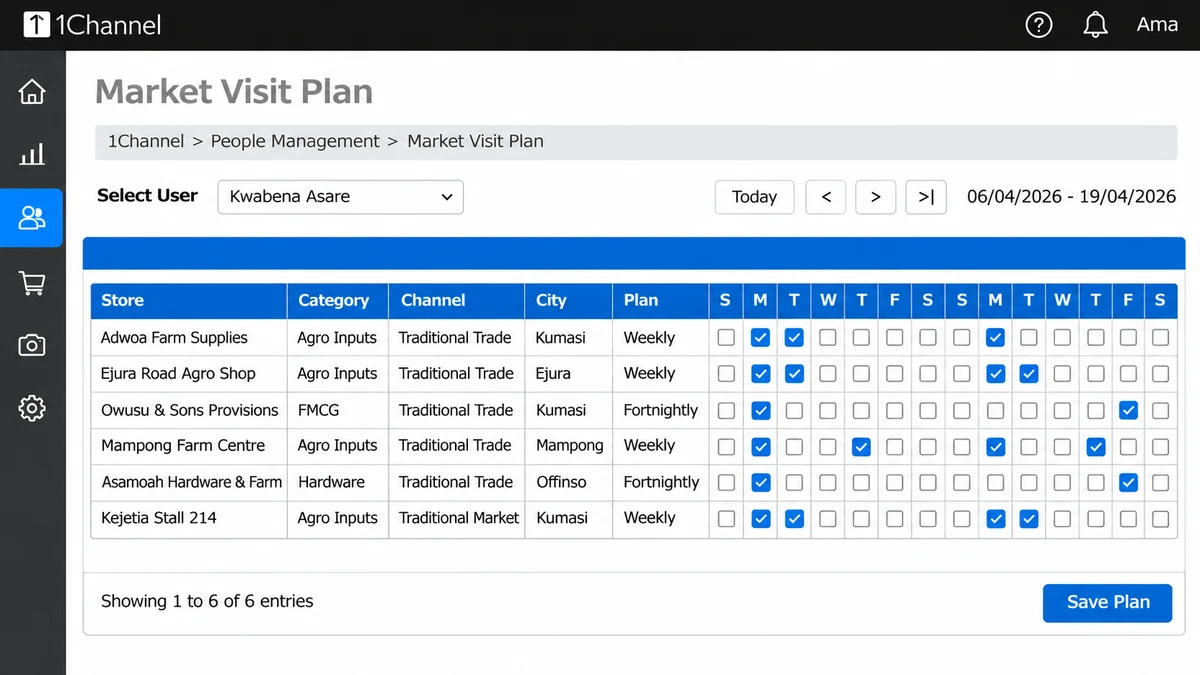
In 1Channel, both are the same Market Visit Plan. The weekday version repeats a pattern, while the dated version ticks each store against specific days.
Either can be bulk uploaded from a downloaded format file, keyed by store and user, store and distributor, or a recurring weekday pattern.
Two Regions, Two Switch Dates
Because the north and south run on different rains, one company-wide switch date is wrong for at least one of them. Plan by region instead.
Worked Example: Kumasi, Ashanti Region
An Area Sales Manager for an agro-chemicals distributor runs six Field Sales Representatives out of Kumasi, on a weekday plan of twelve outlets a day.
Before the major rains, she uploads a dated April-to-June plan by store and user, with nine outlets a day and input shops earlier in the week.
She reviews it a month at a time in the Market Visit Plan Report, which takes a date range of up to 31 days and filters by city.
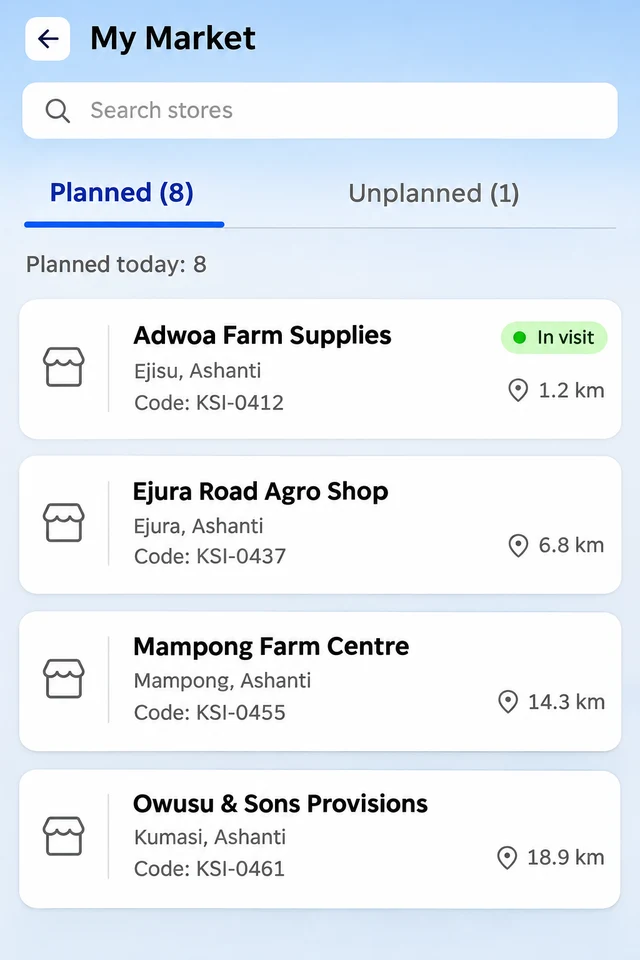
On the phone, each rep's My Market screen splits the day into Planned and Unplanned tabs, with the distance to every outlet shown on its card.
Worked Example: Tamale, Northern Region
The same distributor's Tamale team keeps its dry-season weekday plan through April, when the south has already switched.
Its rainy-season plan runs from May to October. For the first two weeks, the manager checks the Beat Compliance Report, which divides stores covered by stores planned.
One rep sits at 70% while the rest pass 90%. His beat puts two feeder-road towns on the same day, so the manager splits them across two days.
Testing a Wet-Month Plan Before It Goes Out
A rainy-season plan only helps if it fits the working day. 1Channel's AI journey planner turns outlet locations into realistic road travel time using an average speed.
An admin can lower that speed and adjust time per outlet for the wet months. Visits that no longer fit working hours appear in a shortfall report.
How 1Channel Lets Beats Change With the Season
1Channel's field sales app keeps the plan, the day's progress and compliance reporting in one place, so a seasonal change is an upload, not a rebuild.
Plans are set by rep and by store, so Kumasi and Tamale can each switch on their own calendar.
Switch Beats When the Rains Do
See how visit plans, compliance reports and route planning work for field teams that cover farming areas.
Explore Sales Force Automation →Common Mistakes to Avoid
- One switch date for the whole country — the southern and northern rains start weeks apart.
- Cutting every visit evenly — protect farm-input shops around planting and trim lower-priority outlets first.
- Waiting for month-end to review — check beat compliance in the first two weeks of a new plan.
- Forgetting to switch back — re-upload the dry-season weekday plan once the roads recover.
Note: Software screens may vary based on your business structure and configured workflows.