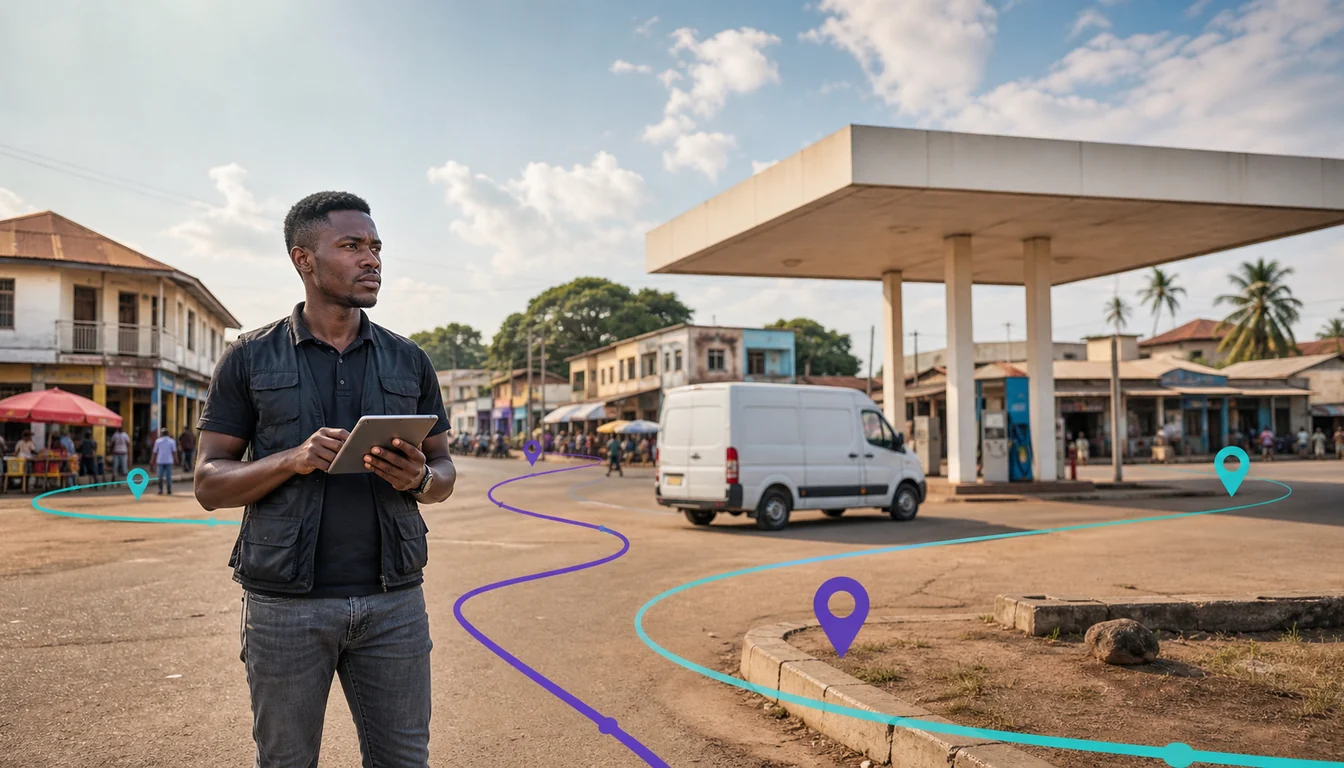
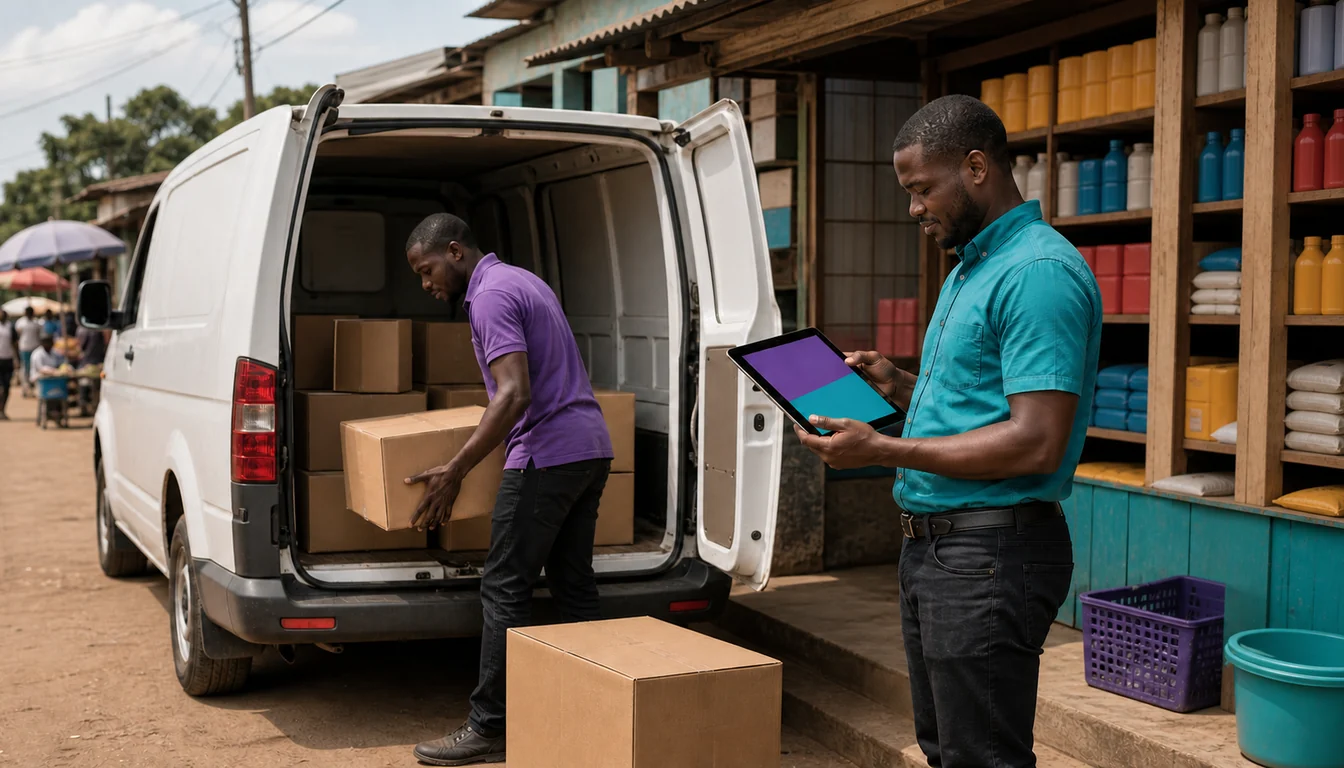
Ghana's FMCG volume does not sit in supermarket aisles. It sits in a provision shop on a residential lane, in a metal kiosk beside a junction, in a converted container at the edge of a lorry park, on a table outside a compound wall, and in stalls inside a traditional market. Modern trade is growing and worth planning for, but a brand that treats traditional trade as an afterthought is ignoring where its cases go.
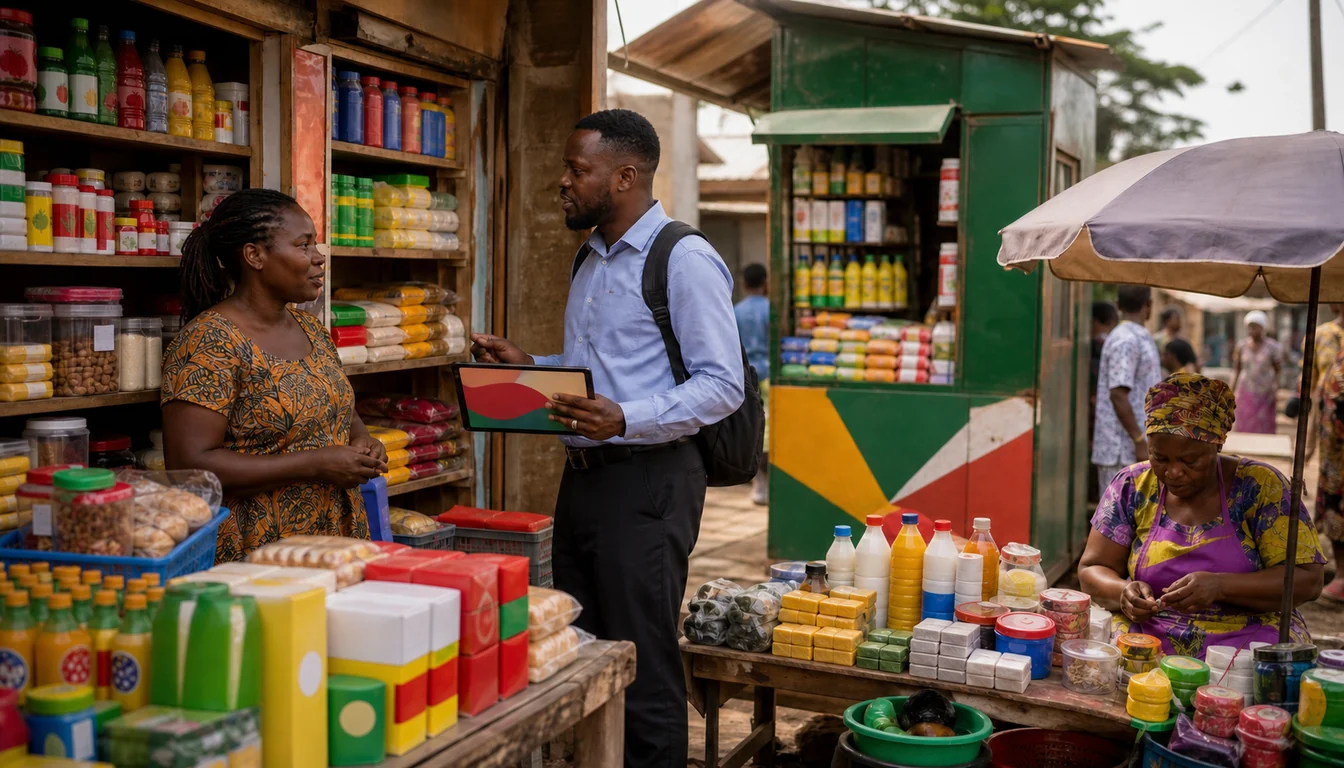
Winning there is not about pushing more stock into the trade. It means understanding a route to market with three layers, several outlet formats that behave nothing like one another, and a structural break in visibility most brands never close.
The route from brand to shelf in Ghana
The dominant model in Ghanaian FMCG distribution is the key distributor. A KD holds a defined territory, takes ownership of stock at sell-in, and finances the working capital that carries it. A brand may appoint several KDs across dense commercial regions, while in thinner territory one covers ground that would support three in Greater Accra.
Below the KD sit wholesalers and sub-distributors. This tier moves a great deal of volume and is the least documented part of the channel. A wholesaler in a market district buys in bulk, breaks it down, and serves retailers arriving on foot or by cart. Sub-distributors take a smaller slice of territory and run their own vans. Neither reports to the brand by default, which is why digitising the wholesaler and sub-distributor layer is usually a brand's second project after the KDs.
Five outlet formats, five different jobs
Brands often build one national coverage plan, one pack list and one promotion mechanic, then wonder why execution varies. The variance is rarely regional. It is format variance, predictable once the formats are named.
The provision shop
The provision shop is the small independent neighbourhood grocery and the backbone of the channel. It carries a real assortment, has enclosed storage, and its owner knows the households who return weekly. It holds stock depth, takes a mixed case, and is where secondary display and shelf discipline repay investment. It also absorbs a short credit cycle best, because turnover is steady and the owner is known.
Kiosks and container shops
A kiosk is a standalone roadside structure in wood or metal. A container shop is a converted shipping container, now a standard retail unit in Ghanaian towns. Both trade on footfall and impulse rather than a household shopping mission, and both have limited secure storage, which caps how much a representative can sell in at one visit however good the scheme. Smaller packs, faster visit cycles and single-serve lines beat depth here.
Table-top sellers
The table-top seller works from a table at a junction or outside a compound. Working capital is thin, the assortment is narrow, and buying is decided against today's cash. Sachets and single-serve packs move; a full case does not. Many brands find this tier uneconomic to serve directly, and often that is correct. The realistic answer is to serve it through the wholesaler tier while still capturing it in the outlet master, so the brand can tell whether its packs reach it.
Market stalls in traditional markets
A market stall is a volume tier in its own right, especially for dry goods and foodstuffs. Stalls buy in larger quantities than their size suggests and often supply other retailers as well as consumers. Visit planning must respect the market-day cycle rather than a fixed weekly beat, because a stall called on a non-market day is a wasted visit.
How traditional markets are actually organised
Traditional markets in Ghana are governed structures, not open ground. Within a commodity's section of a market, a market queen (ohemmaa) holds a recognised leadership role covering pricing conventions, allocation and entry for traders in that commodity. This is real market structure with real authority, and it long predates any brand's route plan.
The implication for a brand is narrow. A trade scheme is agreed with the brand's own trade partners through the KD and executed at the individual stall; the market's leadership structure is not a counterparty to a promotion and should never be approached as one. It does mean access, timing and conduct inside a market section follow local convention, and a field team that ignores that will find its calls unproductive for reasons no report explains.
Where visibility ends: the key-distributor handover
Here is the structural problem that defines Ghanaian FMCG distribution. The brand employs the Sales Supervisor and the Area Sales Manager. The key distributor employs the distributor sales representatives who call on the outlets. Stock ownership, payroll and record keeping all change hands at the same point.
So a brand sees its sell-in to the KD precisely and almost nothing after it. Which provision shops were called on, which kiosks were skipped, whether a promotion reached the stall or stopped at the depot: it lives in the KD's own books, in the KD's format, on the KD's clock. Brands then plan the next quarter from primary sales, which measures how much stock a distributor was persuaded to take, not consumer offtake.
Closing that gap does not mean taking the selling team onto the brand's payroll. It means the DSRs working in a shared system, so every call, order, payment and stock position is captured once, where it happens, and is visible to both parties. That is the argument for sales force automation here, explored further in our post on closing the secondary sales gap.
Pack sizes, credit and promotion mechanics by format
Once formats are captured in the outlet master, four decisions can be made per format rather than per country.
- Pack architecture. Sachets and single-serve for table-top sellers and kiosks, mixed and smaller cases for provision shops and container shops, bulk and multipacks for market stalls and wholesalers. A structured SKU catalogue mapped to outlet type stops representatives offering a pack the outlet cannot store or fund.
- Visit frequency. High-frequency, low-value calls for impulse formats, a steadier cycle for provision shops, market-day alignment for stalls. Frequency follows throughput and storage, not a uniform weekly rule across 16 regions.
- Credit treatment. Provision shops with a trading history can carry a short credit cycle against a defined limit in GHS. Kiosks and table-top sellers are cash or mobile money on delivery. What matters is releasing stock against that limit at the point of order, not discovering the exposure at month end.
- Promotion mechanics. Consumer-facing offers work where a shopper browses; trade offers, multipacks and display incentives work where the retailer decides. One national mechanic across both wastes budget in one direction and under-invests in the other. Trade promotion management keeps the mechanic, the eligible outlet list and the proof of execution together.
Seasonality overlays all four. Christmas and Easter are the national FMCG peaks, with Homowo, Odwira and Akwasidae in the south and Damba and Eid in the north shaping regional demand, while harmattan from December changes what a northern route can achieve. Pack mix and scheme calendars should move with those peaks.
Collections across mobile money and cash
Ghana has an unusually clean collections story. Mobile money is the dominant rail, MTN MoMo, Telecel Cash and AT Money are fully interoperable through GhIPSS, and GhQR and GhanaPay give merchants a unified way to accept payment. A transfer between two wallets settles in seconds, with no transfer levy.
Cash has not disappeared. At the table-top and market-stall tier it is still very real, so a KD's day ends with money arriving through several rails at once. The problem is not the cost of collecting; it is reconciling wallet, bank and cash receipts against the right invoice and outlet before the numbers are a week old. Capturing the payment reference at collection, alongside the order, is what makes payment reconciliation tractable.
Coverage economics from the south to the north
Ghana is long and thin, and outlet density is uneven across its 16 regions. Greater Accra and Ashanti carry dense clusters where a representative completes a full day of calls in a small radius. Move into the Savannah, North East, Upper East, Upper West, Oti and Bono East territory and the same beat design collapses, because distance between outlets rises while drop size does not.
Two Ghanaian realities shape the response. First, outlets are found by landmark, not street address: GhanaPostGPS is the official national digital addressing system, but navigation is still landmark-led, so a geo-tagged outlet master is what makes a beat repeatable when a new representative inherits the route, as covered in our post on beat planning when the address is a landmark. Second, mobile coverage thins on northern and rural agricultural beats, so the field app must keep working with no signal and sync when it returns. Distributors also plan around occasional unplanned local outages at depots. Territory design is a planning exercise before it is a software one, and route planning is where the two meet.
How 1Channel Helps FMCG Brands in Ghana's Traditional Trade
1Channel is built for this shape of channel: a brand selling through appointed key distributors into a long tail of small independent outlets, with wholesalers and sub-distributors in between. It gives the brand and the KD one shared record of the market, without either side changing who employs whom.
It is a cloud platform, so a KD in Tamale and a brand's head office work from the same live data, while the field app keeps capturing calls offline where northern coverage thins. Automation and AI-assisted analysis turn that activity into coverage and assortment decisions rather than a reporting chore.
- Outlet master by format. Every format classified and geo-tagged, from provision shops and kiosks to market stalls and modern-trade stores, so pack lists, visit frequency and credit rules differ by format, not by guesswork.
- Secondary sales visibility below the KD. DSR calls, orders, returns and stock positions captured in the distributor mobile app and visible to the brand's supervisory layer the same day.
- Coverage planning across 16 regions and MMDA-level territory. Beat plans built from geo-tagged outlets and landmark references, with market-day cycles respected for stalls.
- Collections and credit in GHS. Payment capture at the point of collection, with references recorded for reconciliation across mobile money, bank and cash, and credit limits applied at order entry.
- Schemes with proof of execution. Format-specific mechanics with eligible outlet lists, photographic proof from the field, and settlement tracked against claims.
- Compliance-aligned records. Order, invoice and payment records structured to line up with Ghana's E-VAT regime, in force for VAT-registered businesses through a Certified Invoicing System connected to the GRA.
See every call your distributors' teams make
1Channel's Sales Force Automation gives Ghanaian FMCG brands a shared, offline-capable record of every outlet visit, order and collection below the key distributor.
Explore Sales Force Automation →Key Takeaways
Traditional trade is not one channel with one plan. It is a layered route to market with formats that behave differently, and the brands that win model it as it is.
- The channel has three layers, not one. Key distributors hold territory, wholesalers and sub-distributors break bulk, and provision shops, kiosks, container shops, table-top sellers and market stalls sell to consumers.
- Format determines everything downstream. Pack size, visit frequency, credit treatment and promotion mechanics should vary by outlet format, so the outlet master must classify format first.
- Traditional markets are governed structures. The market queen role is real leadership within a commodity section, to be understood and respected, never a counterparty to a trade scheme.
- Visibility breaks at the KD handover. The distributor employs the selling team while the brand employs the supervisory layer, so secondary sales go dark unless both work in one shared system.
- Collections run on two rails. Mobile money is dominant and fully interoperable through GhIPSS, cash remains real at the smallest tier, and reconciling both is the actual work.
- Coverage economics change as you move north. Dense southern beats and sparse northern routes need different frequency and route models, planned from geo-tagged outlets and supported by an app that works without a signal.
Start by classifying every outlet by format and geo-tagging it. Almost every other decision, from pack list to beat plan to credit rule, becomes answerable once that record is right. The next question is usually how to serve a growing modern trade without losing the traditional base.