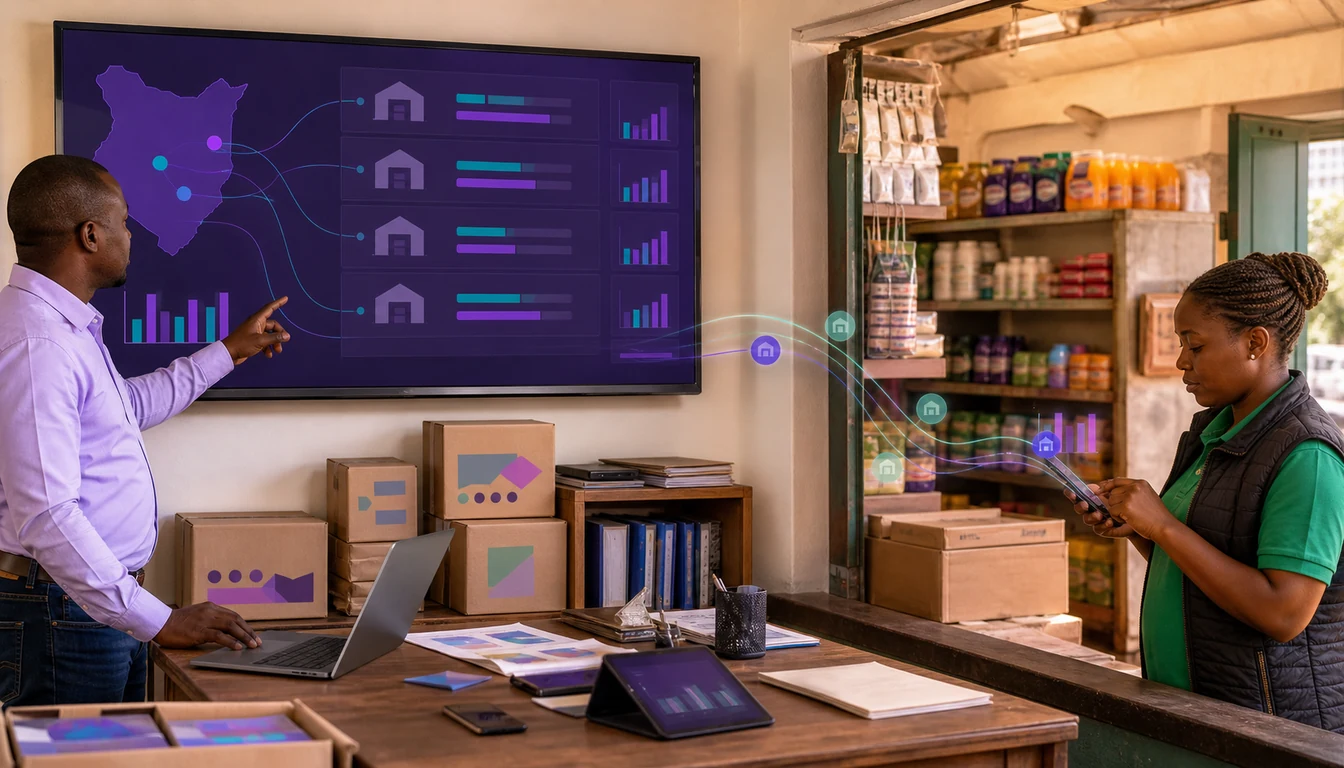
A rep stands in the doorway of an agrovet an hour out of Nakuru, phone in one hand, a torn carton in the other. The owner wants her usual order plus two lines she has never bought, and she wants to know now what she will pay. The signal indicator has been empty since the last turning.
Nothing about that moment is unusual, and nothing about it should be dramatic. What decides the outcome is a decision made months earlier: whether the application treats a missing network as a fault, or as a normal state it was built to work inside.
Treated as a fault, the visit ends with a promise to call back and a number in a notebook. Built for absence, the rep finishes the visit and the order reaches the depot the moment the phone finds a network. Same road, same shop, same rep — different software.

Design From Absence, Not Degradation
Most field applications are written for a connection that is merely slow. They retry, they show a spinner, they eventually ask the user to try again. That is offline-tolerant: the software fails politely. Offline-first never asks the network for permission to do its job, and treats every connected moment as an opportunity rather than a requirement.
The test is blunt. Put the handset into flight mode before the rep leaves the vehicle and see whether a full visit completes: arrive, identify the outlet, count the shelf, take the order at a price the rep can defend, note a payment, close out. Any step that reaches for a server is a stop sign wearing the costume of a field.
This matters most where volume sits outside the cities — past Nakuru towards Eldoret, around the lake beyond Kisumu, off the Northern Corridor into towns where one wholesaler serves a ring of dukas, kiosks and roadside stalls. Coverage there varies from one stretch to the next, and varies inside buildings in ways no map predicts.
What Must Complete On The Handset
The rule is simple to state and unpopular to implement: anything a rep is measured on must be completable with no network at all. Otherwise the metric measures geography rather than effort. That puts the following entirely on the device:
- Outlet identification and check-in — a new kiosk near the open-air market cannot wait for a server to agree it exists.
- The visit: shelf and stock counts, merchandising audit, competitor presence, expiry and damage notes, photographs.
- Order capture at a price the rep can state out loud, with discount and scheme logic evaluated on the handset rather than fetched.
- Returns, damages and credit notes — the transactions a rep skips when software makes them hard.
- An acknowledgement the shopkeeper can keep, even if it is only an order number read aloud.
- Attendance and route close-out, so nobody is marked absent for working somewhere quiet.
What genuinely cannot happen offline — a credit release, a validated tax invoice number, a stock allocation — should be a named second step, not a hidden dependency that surfaces in front of a customer.
The Queue Is The Product
Once work happens without a network, the queue stops being plumbing and becomes the most important object in the system. Every offline action is an entry in an ordered local store, each with its own identity, timestamp and state.
Make it visible. The rep should see how many items are waiting and when the device last synchronised. A rep who can see three orders pending will find a signal before lunch; one who sees nothing finds out at month end.
Prioritise deliberately, because a connection may last a minute. Send orders and collections ahead of merchandising photographs. Retries should back off rather than hammer, and a failure must surface as something the rep can act on. Record both the device time and the received time in EAT and reconcile them centrally — device clocks drift and can be changed.
When A Queued Order Finally Lands
An order written at ten and received at four is not the same object as one written and received at four. The world moved in between, and what the system does about that gap must be decided in advance.
Duplicate prevention comes first, because it is the failure the trade notices. The handset generates the order's identifier before any network exists, and the server treats a second arrival of that identifier as the same order. Never build duplicate detection on whether a button press appeared to succeed — a request that times out may well have been processed, and a duka that receives two deliveries remembers it.
Then conflict: the price may have moved, the line may have been withdrawn, a promotional quantity may be exhausted, or credit headroom may have been consumed by a delivery from the wholesaler. Each case needs a stated policy.
- Accept and flag — the order stands and someone reviews the exception before dispatch.
- Accept and re-price — the current price applies, and the rep is told, so the shopkeeper hears it from a person rather than from an invoice.
- Hold for release — usually credit, where a human decision belongs anyway.
- Reject with a reason — rare, and only where fulfilment is impossible.
Whichever applies, the rep must reach the customer before the truck does. Most reputational damage from deferred sync comes not from the delay but from the customer learning about the change from a delivery note.
What A Rep Can And Cannot Be Told Offline
Offline data is borrowed data. The question is not whether to show it, but how honestly to label it.
Price can be told with confidence. A versioned KES price list on the device, with effective dates and scheme logic evaluated locally, lets a rep quote and commit. The exception is a promotion capped by quantity, which is really a stock question.
Stock cannot be told truthfully. The handset holds last-known availability, which is not availability. Separate "in the catalogue" from "expected available", show the as-at time beside it, and let the rep say the accurate sentence: this was at the depot this morning and I will confirm today. A rep given one number that proves wrong stops trusting all of them.
Credit sits in between. The device can carry the limit and the balance as at the last synchronisation, which is enough to know whether a conversation is likely. Suppose a duka carries a KSh 30,000 limit and most of it was used as at last night — the rep can take the order and be clear that release depends on the position at the depot. What no rep should do offline is tell a shopkeeper she is cleared.
Power, Battery And The Cost Of Data
Connectivity is not the only reason to run without a live link. Kenya experienced a nationwide power outage in 2026, and electricity costs sit high enough that businesses watch them closely; a proposed tariff increase was withdrawn by government before July 2026. Neither fact means the grid is unreliable day to day, and neither makes Kenya a hard place to trade. They are simply two more reasons a route should not depend on everything upstream being awake at once. Where reps work from device-held masters, an interruption at the back end delays processing rather than selling.
Battery is the constraint the rep feels. Charging cannot be assumed at an outlet, and a phone that dies at two ends the day whatever the network is doing. That argues for location polling at a sensible interval rather than continuously, photographs at a resolution that is useful rather than maximal, and background sync that wakes on a schedule rather than constantly.
Data is a personal cost as much as a company one. Synchronise deltas rather than whole master files, compress payloads, hold large media until a stronger connection appears, and never trigger a full catalogue refresh mid-route. An application that is expensive to run gets switched off — or kept installed with mobile data disabled, which is worse.
A Morning On The Eldoret Run
Picture a rep leaving Eldoret before seven with fourteen calls planned: dukas in town, then two agrovets and a wholesaler further out, then kiosks near an open-air market on the way back. Before starting the vehicle he taps one prepare-for-the-day action, and the device pulls the route, refreshed price lists, the outlet master and last-known credit positions.
Town calls clear as he works. Past the last roundabout the signal thins. At the first agrovet he counts stock, photographs a shelf, records an expiry issue and takes an order including a line the owner has not bought before, priced from the list rather than guessed. At the second, the owner pays part of a balance from her own phone; he captures the payment reference and says nothing about clearance, because the application does not let him.
The wholesaler wants a large order against credit. The device shows the limit and the balance as at the morning's sync, with the stamp visible to both of them, so the rep takes the order and says release will be confirmed from the depot. Neither man is surprised, because it is what the screen says.
Around midday, back near the A104, the phone finds a network while he eats. Orders go first, then collections, then photographs. One order returns flagged: a promotional line has run out, and the office has already telephoned the wholesaler to offer the standard pack. The morning contained several dead zones and no lost orders.
Designing The Day So A Dead Zone Costs Nothing
Offline-first is also a way of organising the day, so that the moments needing a network are moments where a network is likely. Three habits do most of the work.
Give the day explicit synchronisation anchors — a prepare step before departure, an opportunistic clearing at midday, a close-out in the evening — and synchronise silently in between whenever possible. Sequence routes so connection-dependent work sits where coverage is dependable, usually the town end rather than the far end. And warn the rep when device masters are ageing, rather than letting stale prices quietly become quotes.
Design the escalation ladder too. A credit release above a threshold, an outlet dispute or a delivery promise the rep cannot make alone all need a person, and a telephone call is a legitimate part of an offline design. Most often missed: teach the back office to read silence correctly. Dashboards should show "last synchronised at" plainly and never convert an absent record into an accusation.
Documents, Receipts And What Must Wait
Some artefacts cannot be manufactured on a handset, and pretending otherwise creates a problem that surfaces later in a tax return. KRA has required electronic tax invoices through eTIMS since January 2024, covering all businesses — including non-VAT-registered traders and distributors — regardless of turnover. From 1 January 2026, KRA validates income and expenses declared in income-tax returns against eTIMS data, and an expense without a valid eTIMS invoice is not deductible. The penalties are material, and a tax adviser or KRA itself is the right source of guidance.
The design consequence is straightforward. Where a document's validity depends on a step outside the handset, the offline artefact should be honest about what it is: an order acknowledgement, a delivery note, a proforma. The tax invoice follows once the record has landed.
Payments follow the same logic. M-Pesa is the default way money moves on Kenyan routes, and a till or paybill payment happens on its own rail. The rep records that a payment was made and captures the reference; matching it against invoices is a back-office reconciliation. Offline, a rep asserts a fact, never a conclusion.
Where These Programmes Go Wrong
The failure modes are consistent enough to list, and most are decisions rather than accidents.
- Offline is added late. Scoped as a phase-two feature and bolted onto an architecture that assumed a server, it never fully works, because the assumption is everywhere in the code.
- The pilot runs on easy ground. A programme validated on Nairobi routes proves the application works where the network works. Pilot the hardest route, with the people who work it.
- The queue is invisible. Reps believe orders were sent, the office never received them, and the discovery happens at month end.
- Retries create duplicates. Without a device-generated identifier and server-side idempotency, a flaky connection turns one order into two, and the credibility cost lands on the rep in the shop.
- Stale masters are treated as truth. A rep quotes a withdrawn price, and the company either honours a price it did not intend or embarrasses its own representative.
- Every launch pulls everything. Full master downloads burn data and battery, and train reps to keep mobile data switched off — defeating the whole design.
- Compliance metrics punish geography. Real-time targets applied to thin-coverage routes generate gaming, not performance.
Each of these is visible in a design review, if somebody asks the flight-mode question early enough.
How 1Channel Supports Offline-First Field Work
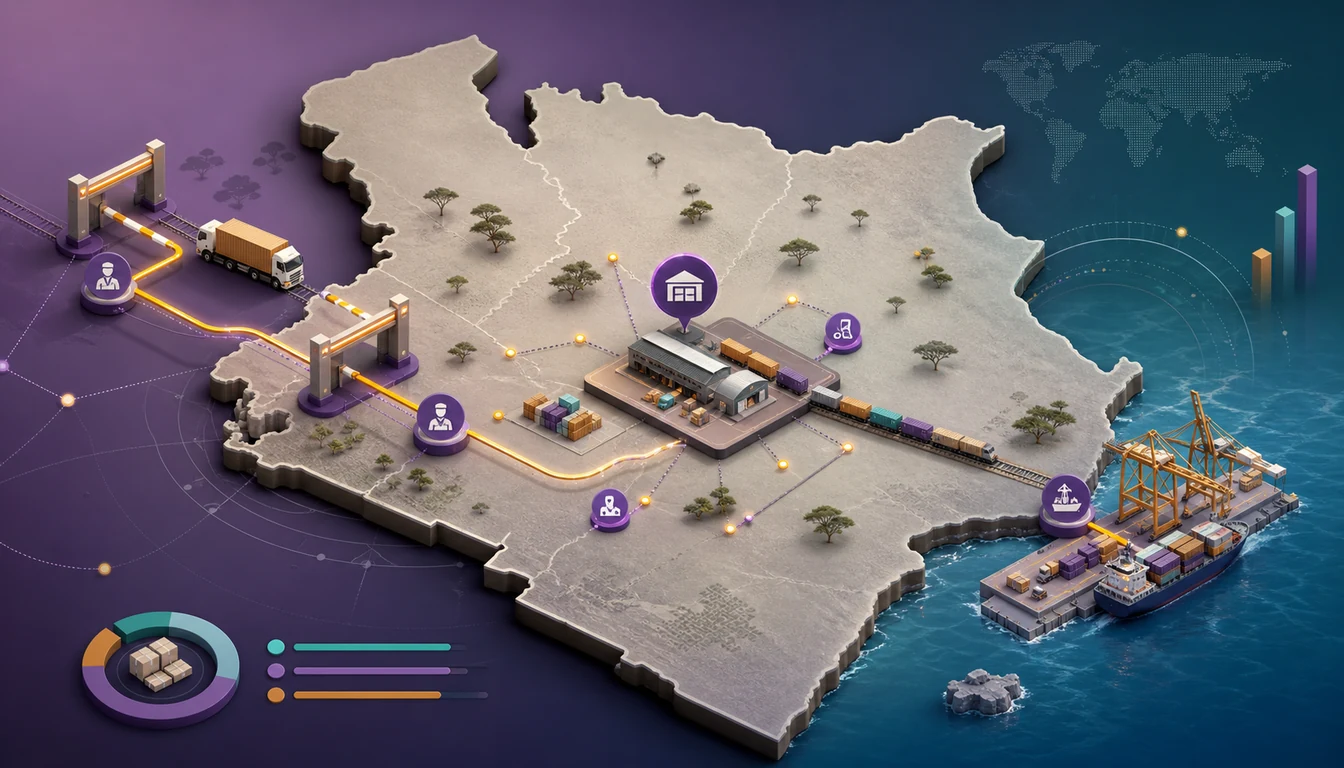
1Channel's field applications are built to operate without a live connection and to synchronise when one becomes available. The handset holds what a rep needs to finish a visit alone: outlet master and route plan, product catalogue, versioned price lists with discount and scheme logic, and last-known credit position with the time it was captured.
Work captured offline — orders, visits, merchandising audits, stock checks, returns, collections, attendance and photographs — is queued on the device and transmitted when connectivity returns, with the back office able to see what has landed and what is outstanding per rep and per route. Order identity is established on the device, so a retried transmission is recognised as the same order rather than a new one.
Configuration is where the Kenya-specific work sits: KES price lists and outlet-level pricing, credit limits and release rules, mandatory fields tuned so none require a server, beat plans matched to real geography, and workflows that distinguish an offline acknowledgement from a tax invoice. 1Channel can support eTIMS-aligned invoicing and record-keeping workflows — a capability, not a certification, and no substitute for advice from a tax adviser or KRA.
Key Takeaways
Offline-first is less a technical feature than a set of promises about what a rep can finish, what a rep can say, and what happens to work that has not yet been transmitted.
- Treat absence as the base case. If a full visit cannot be completed in flight mode from first tap to last, the application is offline-tolerant rather than offline-first, and it will fail on the routes that matter most.
- Give every queued action its own identity on the device. Device-generated identifiers and server-side idempotency are what stand between a flaky connection and a duka receiving the same delivery twice.
- Say when, not only what. Price can be committed from the handset; stock and credit are borrowed facts and need an as-at stamp, so a rep never turns a memory into a promise.
- Budget battery and data as carefully as time. Deltas rather than full masters, deferred photographs and restrained polling keep the application alive to the end of the day — and a queued day keeps a route working when the depot itself is interrupted.
- Design the day, not only the app. Synchronisation anchors, connection-dependent steps sequenced where coverage is dependable, a named escalation path, and managers who read silence as a road rather than as idleness.
Get these right and a dead zone becomes what it should be: a few hours between an order being written and an order being received, invisible to the shopkeeper and irrelevant to the month's numbers.