Payment providers in Oman are folding online gateways, point-of-sale terminals and remote payment links into single platforms with one reconciliation view.
This post covers what was announced, why unified reconciliation changes the collections job, and what a distributor should capture at the point of payment.
It matters most where money is collected across many small outlets: FMCG, pharma and healthcare, consumer durables, and building materials distribution.
What Changed in the Payment Stack
AmwalPay, a payment service provider licensed by the Central Bank of Oman, now runs a payment gateway, POS solutions and payment links on one platform.
Its Pay by Link feature lets a business request payment over WhatsApp, email or SMS, with no card terminal at the outlet.
The platform connects to Shopify, WooCommerce and custom APIs, and reports across branches through a single merchant portal and mobile app.
Two capabilities matter more than the channel list itself: reconciliation unified across channels, and real-time visibility branch by branch.
Why It Lands on the Collections Desk
Consolidation on the acceptance side does not consolidate anything on the distribution side. A settlement still arrives as a net batch.
One payout can cover dozens of outlet payments from a single route, and the bank line never says which invoice each one clears.
Unified reconciliation inside a payment platform answers which transactions happened. It does not answer which invoice each transaction settles.
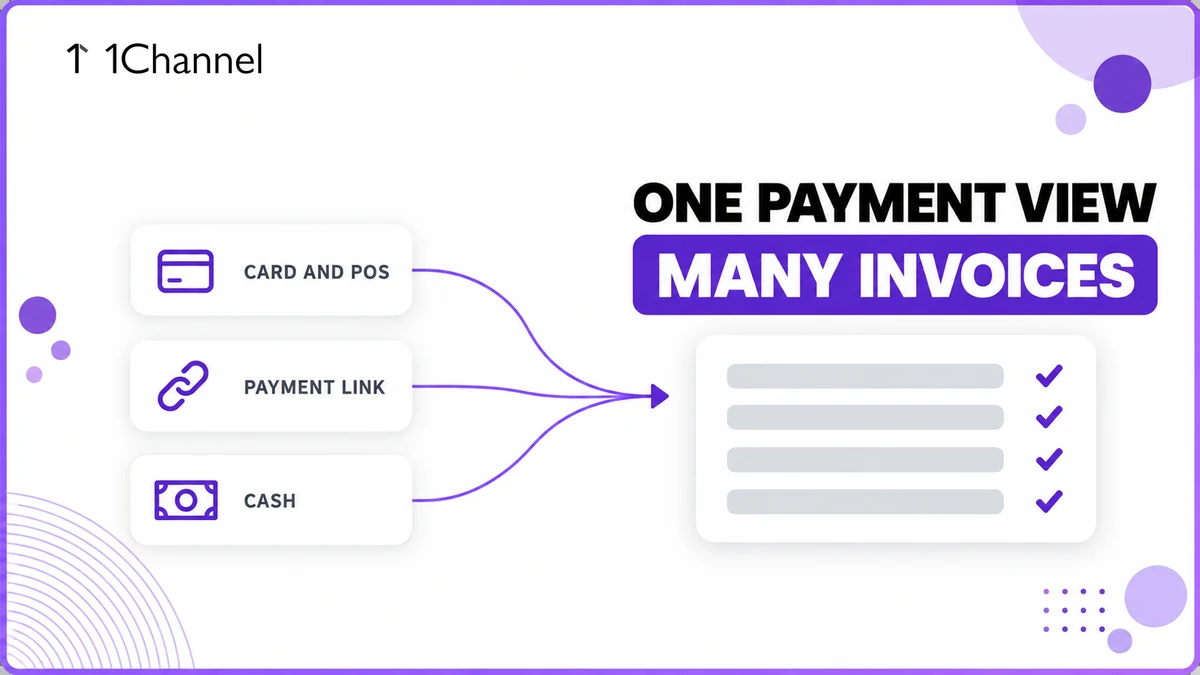
| Collection channel | What the payment platform reports | What the distributor must still capture |
|---|---|---|
| Card or wallet at the outlet | The transaction inside the daily batch | Invoice reference and outlet |
| Pay by Link | Payment confirmed against a link | Which invoice the link was raised for |
| Transfer from a head office | A credit in the bank account | The run of invoices the credit clears |
| Cash at a baqala counter | Nothing at all | Amount, invoice and outlet, at the counter |
That last column is the distribution system's job, and it has to be filled in at the point of collection rather than at month end.
How 1Channel Keeps Collections Tied to Invoices
1Channel records the collection channel and the invoice reference together, in the field, at the moment a payment is taken.
Its AI-driven workflow automation then routes anything that fails to match, so an unreconciled batch surfaces as an exception instead of a month-end surprise.
Match Every Collection to an Invoice, Whatever the Channel
See how the platform's payment and credit management tools tie card, link, transfer and cash collections back to structured invoices.
Explore Payment & Credit Management →Key Takeaways
Payment acceptance is consolidating quickly. The reconciliation work it leaves behind has not moved anywhere.
- One platform still means one net batch. A consolidated payout covers many outlets, and none of the bank lines name an invoice.
- Capture the channel and the invoice together. Record both at the outlet, at the moment of collection, whatever form the payment takes.
- Pay by Link needs its own reference discipline. A link raised without an invoice reference is a payment nobody can match later.
- Cash has not gone anywhere. The baqala tier still settles in cash and needs the same discipline as any digital channel.
- Treat unmatched items as exceptions, not backlog. Automated routing surfaces a broken match in days rather than at month end.
Get that right and a consolidating payment market becomes an advantage rather than one more reconciliation queue.
Source: Oman Observer