Every carton moving through a Vietnamese distributor warehouse carries a batch code and an expiry date printed somewhere on it. Whether that information survives the journey from the receiving bay to the shelf of a tạp hóa outlet decides three separate things: how much stock is written off, how fast a recall can be closed, and whether a brand can tell its own goods apart from someone else's when a complaint lands.
Why Batch and Expiry Discipline Is Harder in Vietnam
Vietnam stretches roughly 1,650 km from the Red River Delta to the Mekong Delta, and a great deal of consumer stock travels a long way along that spine before it reaches a shelf. A case picked in the North may be transferred to a sub-distributor in the Centre and finally sold through a traditional market stall in the South. Each handover is a chance for the batch identity to be lost, and the goods spend that whole time in a hot, humid climate that erodes the practical shelf life of food, beverage, personal care and pharmaceutical lines well before the printed date arrives.
The second complication is structural. Vietnamese route to market is genuinely multi-tier: brand, then distributor (nhà phân phối), then sub-distributor and wholesaler, then the outlet. The distributor typically employs the salesman team while the brand employs the Sales Supervisor and Area Sales Manager layer above it. That means the people who physically hold the stock and the people accountable for the brand's inventory health are usually in different organisations, working from different records.
Layer Tết on top. Ahead of Lunar New Year, forward buying runs deep across the channel, and the North and the South build that stock on visibly different clocks, with northern trade committing earlier and southern trade compressing its buying into a shorter window. Whatever does not sell through in the festive weeks stays in the network afterwards, ageing quietly at the tier with the least visibility.
Where the Batch Record Usually Breaks
- Goods are received against a purchase order quantity only, with the batch code never keyed in at all.
- Batches are captured in a spreadsheet that lives on one machine at one warehouse and is never reconciled against the stock ledger.
- Pickers take whatever pallet is nearest the door, so the oldest stock migrates to the back and stays there.
- Transfers to a sub-distributor or wholesaler are recorded as a quantity move, dropping the batch identity at exactly the tier that is hardest to see into.
- Returns come back with no batch reference, so damaged and expired units cannot be tied to the consignment they came from.
Capturing the Batch at Goods-In
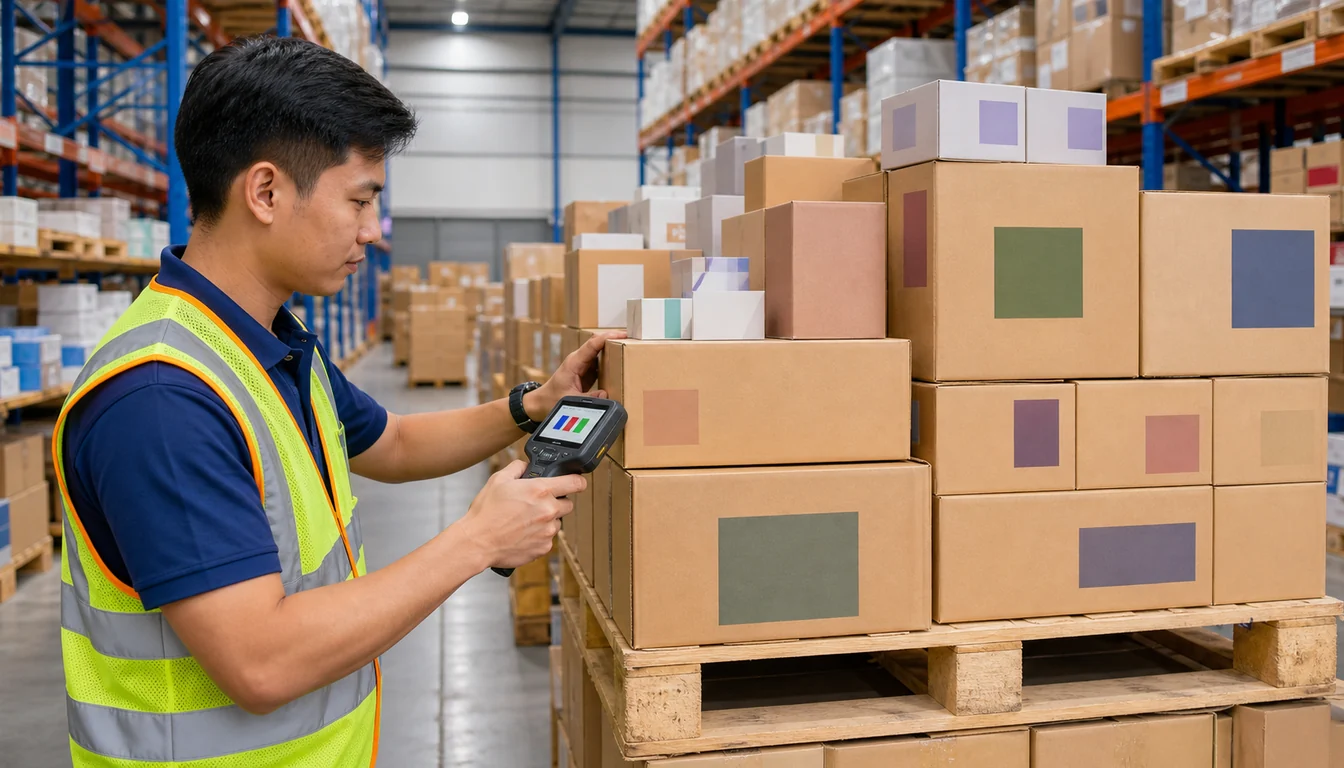
Batch tracking is decided at the receiving bay. If the code is not captured when the consignment is booked in, no downstream system can invent it, and every later question about that stock becomes a manual hunt through paper. Scanning at goods receipt, with the batch and expiry recorded against the received quantity as part of the goods receipt note rather than as an afterthought, is the cheapest control available anywhere in the chain.
It is also the point where discrepancies are still worth arguing about. Short-dated stock arriving from a manufacturer, a mixed pallet holding two batches under one item code, or a quantity that does not match the inbound document are all things a receiving clerk can query on the spot and nobody can resolve three weeks later.
What a Usable Batch Record Holds
- The batch or lot code exactly as printed, with manufacturing and expiry dates.
- The quantity received against that specific batch, not merely against the SKU.
- The supplier and the inbound document the consignment arrived under.
- The storage location it was put away to, so a physical count can be reconciled without opening every pallet.
- Any storage condition the line requires, for chilled and temperature-sensitive stock.
FEFO Picking Across a Multi-Tier Network
First expired, first out is the only picking rule that protects a dated catalogue. First in, first out is a reasonable approximation only when every receipt arrives with the same remaining shelf life, which is almost never true once a distributor buys from several plants or takes a promotional lot with a shorter date. FEFO sorts by the date that actually matters.
Making it stick means the pick list has to arrive already sequenced by expiry, with the location and batch named, so the picker is not making a judgement call at the rack face. Where an override is genuinely needed, it should require a reason that is recorded rather than a silent substitution. A warehouse system that enforces FEFO at the point of picking converts a policy that everybody agrees with into behaviour that actually happens on a Monday morning.
The harder half is the tier below. Once a case is transferred to a sub-distributor or a wholesaler, most brands lose sight of it, which is the same blind spot that makes secondary sales visibility such a persistent problem in Vietnamese distribution. Carrying the batch identity through the transfer document, and asking the second tier to dispatch against batch rather than quantity alone, is what keeps ageing stock from disappearing into the channel and reappearing as a complaint.
Seeing Near-Expiry Stock Early Enough to Act
Expiry is not a binary event. Stock passes through a window where it is still perfectly saleable but needs to move faster than the normal rate of sale, and the whole value of batch data is that it makes that window visible while there is still time to do something commercially sensible.
Practically, that means ageing buckets by days remaining rather than a single expired or not-expired flag, and alerts that reach the Sales Supervisor and the distributor together rather than surfacing in a month-end report. With enough notice, the options are ordinary trade actions: redeploy stock to a region turning faster, prioritise those batches in the beat plan so reps push them at high-throughput minimart and tạp hóa outlets, or attach a short, targeted scheme rather than a blanket discount that costs margin across the whole line. Without notice, the only option left is a write-off, valued in VND and absorbed by whichever tier is holding it. This is the same discipline that sits behind reducing stock-outs and leakage in distributor warehouses, viewed from the other end of the shelf-life curve.
Recalls and Returns Need the Trace to Run Both Ways
Traceability is only useful if it works in both directions. Forward, from a batch to every distributor, sub-distributor and outlet that received a unit of it. Backward, from a single returned or complained-about unit to the batch, the consignment and the receiving date behind it. Most distributor records handle neither, because the batch was never carried on the outbound document in the first place.
The stakes rise sharply in regulated categories. Medicines are overseen by the Drug Administration of Vietnam, and health supplements, medical nutrition and special-diet foods fall under the Vietnam Food Administration, both under the Ministry of Health. For businesses distributing those lines, being able to say precisely which outlets hold a given batch is not a reporting nicety, it is the difference between a contained withdrawal and a national one. Distributors serving pharma and healthcare networks tend to feel this first, but food and beverage brands face the same question whenever a quality issue surfaces.
Returns are the everyday version of the same capability. Expired, damaged and near-date units come back from outlets continuously, and a structured returns process that records the batch on the return, not just the SKU and quantity, tells you which consignments are generating the problem, which territories are over-ordering relative to their rate of sale, and which credit notes are legitimate. Since e-invoicing has been mandatory for all businesses in Vietnam since 2022, the credit side of a return has to be documented properly anyway, so tying it to a batch costs almost nothing extra.
Batch Records as a Channel-Integrity Control
Counterfeit and grey-market goods are a named challenge in the Vietnamese market, alongside fragmented distribution and sharp price sensitivity. That reframes batch discipline as something more than a compliance chore. A brand that knows which batches were shipped to which distributor can answer a question that is otherwise unanswerable: was this product, found in this territory at this price, ever actually sold into this territory by us?
That single check does a lot of work. It separates genuine stock from imitation, exposes diversion between regions where pricing or scheme value differs, and gives the Area Sales Manager something concrete to raise with a distributor instead of a suspicion. It also protects the honest partners in the network, who are usually the ones losing volume to whatever undercuts them. It asks nothing more of you than that the batch identity survives each handover in your own records.
How 1Channel Helps with Batch and Expiry Tracking in Vietnam
1Channel carries batch and expiry as first-class attributes through the whole distribution flow, from goods receipt at the distributor warehouse to the outbound invoice and the return, rather than treating them as free-text notes that stop at the door. Because the same platform runs the field application the Sales Representative uses on the route, ageing stock is visible to the person who can actually sell it, not only to the person who counts it.
The design assumes a Vietnamese network: a deep tạp hóa and traditional-market base served alongside minimart and modern-trade accounts, a distributor tier that employs its own salesman team, and territory that runs north, centre and south on a Monday to Friday working week with Saturday mornings common in trade.
- Batch and expiry captured at goods-in against the receipt, with put-away location, so physical counts reconcile without opening pallets.
- FEFO-sequenced pick lists and outbound documents that carry the batch through to the distributor, sub-distributor and wholesaler tiers.
- Near-expiry ageing buckets with alerts to both the distributor and the brand's Sales Supervisor and Area Sales Manager layer, valued in VND.
- Batch visibility inside route execution, so short-dated lines can be prioritised at high-throughput outlets during and after the Tết peak.
- Returns and credit capture against the originating batch, aligned with the e-invoicing obligations already in force for all Vietnamese businesses.
- Forward and reverse batch trace for withdrawal scenarios, including regulated lines distributed under Ministry of Health oversight.
Track Every Batch From Goods-In to Outlet
See how 1Channel's batch management module keeps batch and expiry data intact across every tier of a Vietnamese distribution network.
Explore Batch Management Software →Key Takeaways
Batch and expiry control in Vietnam is won at the edges of the process, at receiving and at the handover to the next tier, not in the reporting layer.
- Capture at goods-in or lose it forever. A batch code not recorded when the consignment is booked in cannot be reconstructed later, and every downstream trace depends on it.
- FEFO beats FIFO on a dated catalogue. Sequencing pick lists by expiry date, with recorded reasons for any override, is what turns a stated policy into daily warehouse behaviour.
- The sub-distributor tier is where visibility dies. Carrying the batch identity onto transfer and dispatch documents keeps ageing stock from vanishing into the wholesale layer.
- Near-expiry alerts buy commercial options. Ageing buckets by days remaining let teams redeploy, prioritise in the beat plan or run a targeted scheme instead of writing stock off.
- Traceability must run both ways. Forward from batch to outlet and backward from a returned unit to its consignment, which matters most for lines overseen by the Drug Administration of Vietnam and the Vietnam Food Administration.
- Batch data protects channel integrity. With counterfeit and grey-market goods a named market challenge, knowing where a batch was legitimately shipped is a practical defence for the whole distributor network.
For distributors handling food, beverage, personal care or pharmaceutical lines across a country this long and this warm, batch discipline is not overhead. It is the mechanism that keeps write-offs contained, recalls small and the channel honest.