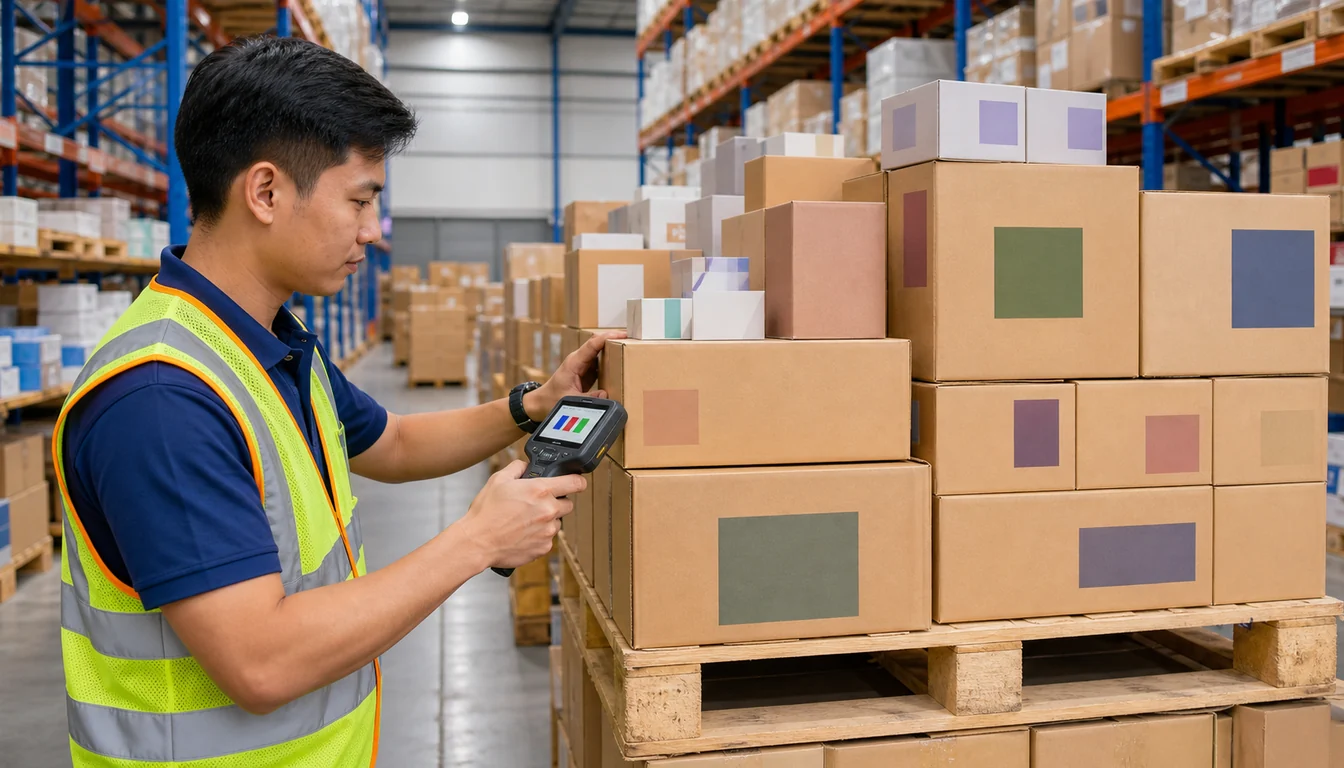
Fragmented distribution is one of the most frequently named challenges in the Vietnamese consumer goods market, and it has a specific address. Not the brand's own depot, and rarely the appointed distributor. It is the tier below: the sub-distributors and wholesalers who take stock from the distributor and push it out to the last stretch of retail nobody else can reach economically. That tier is where most brands lose sight of their own goods, and it is the hardest part of the channel to digitise because none of it is owned.

Why Vietnam Has a Second Tier at All
A distributor (nhà phân phối) in Vietnam typically employs its own field team and services a defined area on a fixed call cycle. That works well across a dense urban beat, where a representative covers dozens of outlets in a morning without leaving a few square kilometres. It stops working the moment the same distributor is asked to service scattered tạp hóa stores strung along a provincial road, the stall clusters inside a traditional market (chợ), or the small trade around a commune centre hours from the depot.
The economics are simple. Putting a representative and a vehicle in front of a low-volume outlet a few hundred kilometres away costs more than that outlet will ever order. So a second tier absorbs the cost: a wholesaler in a market town who buys in bulk, breaks it down and sells to whoever walks in, or a sub-distributor who takes a defined sub-area and runs a smaller version of the distributor's operation.
This tier is not a defect in the route to market. It is what makes coverage possible across a country roughly 1,650 kilometres long, reorganised since 1 July 2025 into 34 provincial units with only communes and wards beneath them, from the Mekong Delta to the northern mountain provinces. The problem is not that the tier exists. The problem is that it is usually invisible.
Where a Brand Loses Sight of Its Own Goods
Most brands have solid numbers up to the first sale, and workable secondary numbers too, because the distributor's field team books orders on an app that the brand's Sales Supervisor and Area Sales Manager layer reviews. The break happens at the third movement: stock leaving the distributor into a wholesaler or sub-distributor, and then leaving that business into outlets the brand has never listed.
Once goods cross that line, several things stop being knowable. Nobody can say which outlets actually bought, so coverage counts become estimates. Nobody can separate genuine consumption from stock parked in a depot, so a strong month may just be a loading month. Nobody can see how long a batch sat before it moved, which matters most where expiry discipline is non-negotiable. And nobody can confirm that the scheme discount reached the outlet it was funded for.
That last one is the expensive gap, because trade spend routed through an unmeasured tier is spend the brand cannot evaluate. It is the same visibility break examined from the other direction in our post on primary versus secondary sales visibility in Vietnam's distributor network.
What Digitising the Second Tier Actually Means
Digitising a wholesaler does not mean running their business for them. They are an independent company with their own credit relationships, their own product mix and often several competing brands on the same racking. It means four specific transactions move out of notebooks, phone calls and messaging apps into a shared record both sides can see.
Ordering Through One Shared Record
The first step is almost always ordering, because it is the transaction the second tier already wants to be easier. A sub-distributor ordering on a portal gets live stock availability, the correct price for their tier, schemes applied automatically and a confirmed despatch date, instead of a phone call to a sales desk that may not have the answer. A well-built distributor order management system makes this the path of least resistance rather than an extra task, which is the only way adoption survives the pilot.
Stock Declaration as Routine, Not Favour
Closing stock at the second tier is the number that converts loading into real consumption. Asking for it as a monthly favour produces a figure someone estimated at the end of the month. Building it into the ordering flow produces something usable: the wholesaler declares what is on hand when they raise the next order, because the system uses that declaration to calculate a suggested quantity. The declaration stops being reporting and becomes part of getting stock.
Claim Settlement That Closes in a Cycle
Damage claims, expiry claims and scheme reimbursements are the sharpest friction point at this tier, because the money is real and the process is usually manual. A wholesaler kept waiting on a claim prices that delay into future orders, or quietly favours the brand that settles faster. Structured claims with photographic evidence, batch references and a visible approval status turn a recurring argument into a queue with a clock on it.
Price and Scheme Compliance to the Outlet
Where the same stock can be sold at several tiers of price, leakage follows. A wholesaler buying at a scheme price for one channel and selling into another distorts every reading the brand takes. Tier-specific price lists, scheme eligibility enforced at order entry and settlement tied to declared onward sales close most of that gap. Scheme management is worth more here than anywhere else, because this is where the money is hardest to trace.
Why an Independent Business Would Share Its Data
Here is the honest obstacle. A sub-distributor's onward sales data is commercially valuable to them and slightly dangerous in the brand's hands, because it reveals their customer list, their margin behaviour and their real dependence on any one supplier. If the only pitch is transparency, the answer will be polite agreement followed by nothing. Programmes that stall almost always stalled here.
The tier adopts when the system gives back more than it takes:
- Faster settlement. Claims and scheme payouts that close in a defined cycle rather than an open-ended one.
- Better fill rates. Visibility of live stock at the distributor before committing to an order, so fewer trips are wasted on unavailable lines.
- Credit that reflects behaviour. A documented payment history that supports a better limit, instead of a limit set by memory and relationship.
- Seasonal certainty. Allocation visibility in the weeks before Tết, when demand is at its peak and the north and south build stock on genuinely different clocks.
- Less rework. One order record instead of a message thread, a phone call and a handwritten note that disagree with each other.
Sequencing matters as much as the offer. Start with the second-tier partners who already carry volume and are already reasonably organised, prove that claims settle faster, then expand outward. Align the effort with how the first tier is already managed, so the same distributor portal serves both layers rather than creating a parallel process nobody maintains.
E-Invoicing Already Changed the Paper Trail
A common objection to second-tier digitisation is that these businesses do not keep records. In Vietnam, that objection is out of date. Electronic invoicing has been compulsory for all businesses, organisations and traders since 1 July 2022 under Decree 123/2020/ND-CP and Circular 78/2021/TT-BTC, amended by Decree 70/2025/ND-CP from 1 June 2025 with guidance in Circular 32/2025/TT-BTC, and with invoice-violation penalties restructured by Decree 310/2025/ND-CP from 16 January 2026. It is a settled obligation administered by the Tax Department under the Ministry of Finance, not a coming deadline.
The consequence is significant. A wholesaler is already issuing structured electronic invoices for onward sales, so a structured transaction record already exists at the tier the brand cannot see. The task is not to create documentation from nothing. It is to line the brand's order, despatch and claim records up with documentation the partner is already obliged to produce, so reconciliation becomes a matching exercise rather than an investigation. With penalties tightening, second-tier partners want clean records for their own reasons, and that shared interest is the most useful opening a programme has.
Two cautions. Payment and invoice are not the same event here: settlement still arrives as cash, cash on delivery, VietQR transfers and e-wallet payments in whatever mix the partner prefers. And field applications at this tier capture outlet contacts, photographs and location, which brings them within the Law on Personal Data Protection (Law No. 91/2025/QH15), in force since 1 January 2026 and implemented by Decree No. 356/2025/ND-CP. Consent, retention and access controls belong in the design from day one.
Reading the Tier Once It Is Visible
Visibility is only useful if somebody acts on it, and four readings do most of the work. Stock cover by partner separates who is loaded from who is genuinely selling. Outlet coverage through the second tier shows whether a wholesaler is extending the brand's footprint or reselling to outlets the distributor already serves. Batch age warns of expiry exposure before returns arrive. Scheme cost per incremental outlet shows whether spend here is buying reach or subsidising business that would have happened anyway.
Read alongside first-tier numbers in one distributor analytics view, those readings also reshape territory design: a province served well by two wholesalers may need no direct route at all, while a cluster where second-tier sales are climbing may justify a distributor of its own. That is the planning question taken up in our post on territory and coverage planning after the move to 34 provinces.
How 1Channel Helps Digitise Sub-Distributors and Wholesalers
1Channel is built for multi-tier channels rather than a single distributor layer, so second-tier partners work inside the same platform the brand and its distributors already use, with their own logins, price lists and view of what they are owed. The design principle is reciprocity: every screen a wholesaler fills in gives them something back in the same session, which is what keeps a second-tier programme alive after the launch enthusiasm fades.
- Tiered ordering with live availability. Partners order against real distributor stock at their own price tier, with schemes applied at entry and a confirmed despatch commitment.
- Closing stock captured in the order flow. Declarations drive suggested order quantities, so stock visibility is a by-product of ordering rather than a reporting chore.
- Structured claims with evidence and status. Damage, expiry and scheme claims carry photographs and batch references, then run through approval to settlement on a visible clock.
- Onward sales to outlets, including unlisted ones. Second-tier sales are captured against tạp hóa stores, traditional-market stalls, minimarts and convenience outlets, extending the master outlet list rather than guessing at it.
- Mixed collections reconciled properly. Cash, cash on delivery, VietQR transfers and e-wallet settlements are matched to invoices and ageing in VND, without forcing partners onto one payment method.
- Seasonal allocation by region. Tết and Mid-Autumn build-ups are planned against the different stocking clocks in the north and the south, on a Monday-based working week with Saturday-morning trading.
Bring Your Second Tier Onto One Portal
Give sub-distributors and wholesalers ordering, stock declaration and claim settlement in one place with 1Channel's distributor portal, and see the goods you can currently only estimate.
Explore Distributor Portal Software →Key Takeaways
Vietnam's second distribution tier is the difference between national ambition and national coverage. Here is what matters when you set out to make it visible.
- The tier exists for a reason. Sub-distributors and wholesalers service provincial routes and traditional-market clusters no single distributor can cover economically.
- Visibility stops where ownership stops. Once stock crosses into the second tier, coverage, consumption, batch age and scheme delivery become estimates rather than facts.
- Four transactions carry the programme. Ordering, stock declaration, claim settlement and scheme compliance are what actually need to move into a shared record.
- Reciprocity beats mandate. An independent business shares data when it gets faster settlement, better fill rates, fairer credit and seasonal certainty in return.
- The documentation already exists. Electronic invoicing has been compulsory for every business since 1 July 2022, so reconciliation is a matching exercise, not a records-creation exercise.
- Design for the payment mix and the data law. Cash, cash on delivery, VietQR and e-wallet settlements all need reconciling, and outlet data captured here falls under the Law on Personal Data Protection.
Start with the partners who already carry volume, settle their claims faster than anyone else does, and let the coverage picture build outward from there. A tier that keeps declaring is a tier you can finally plan around.