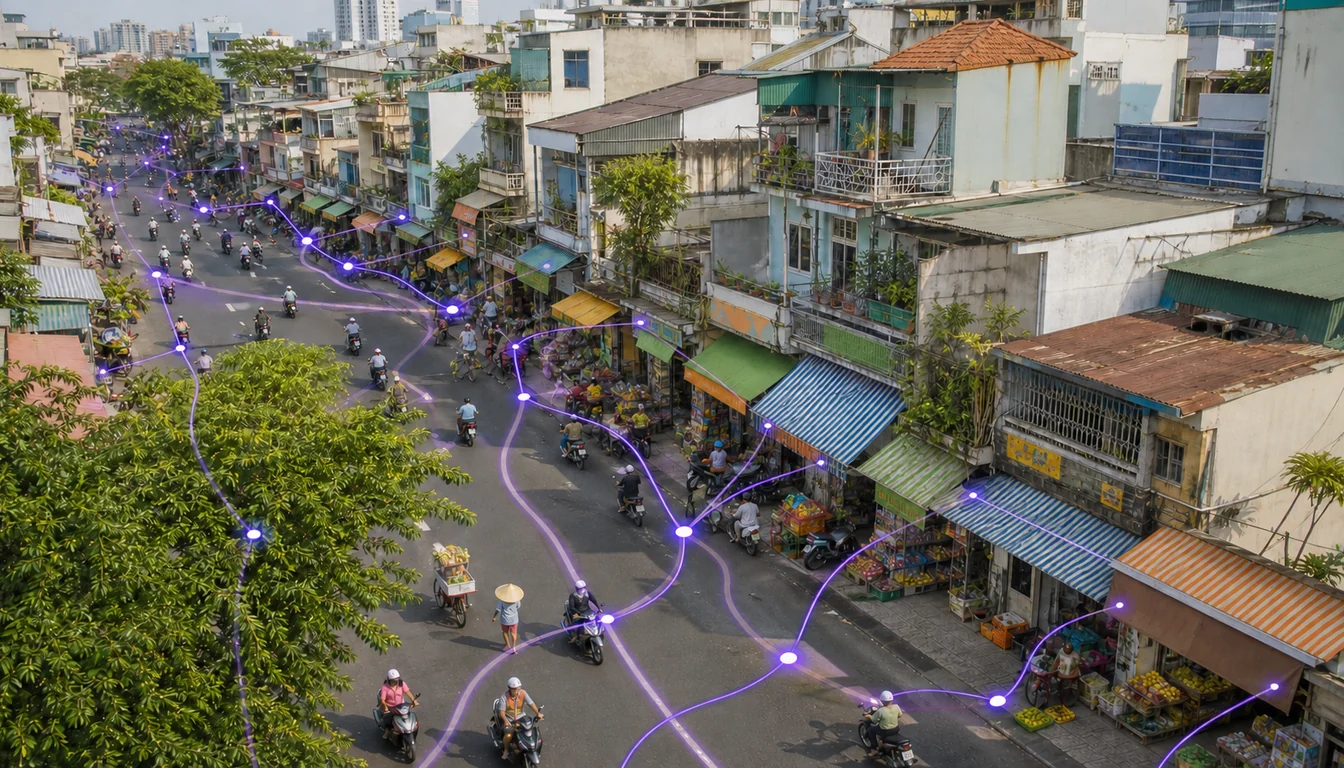
Field sales in Vietnam is rarely difficult for the reason people expect. Mobile networks are strong, 4G reaches effectively the whole territory and 5G now covers the great majority of the population, so a representative standing outside an outlet in Hanoi, Da Nang or Can Tho can almost always transmit an order the moment it is taken. The hard part is everything around that moment: how many outlets there are, how differently they buy, who the representative actually reports to, and how far apart the ends of the country are.
What Actually Makes Vietnam Field Sales Hard
Three structural facts shape almost every field sales decision a brand or distributor makes in Vietnam, and none of them is about connectivity.
The first is channel depth. Independent tạp hóa stores and traditional markets (chợ) still carry the majority of everyday FMCG volume, and there are a great many of them, clustered tightly in urban wards and thinly spread across commune territory. At the same time the minimart format is expanding faster in Vietnam than almost anywhere in the region, with WinMart+, Bach Hoa Xanh and Co.op Food pushing well beyond the two big cities, and convenience chains such as Circle K, GS25 and FamilyMart consolidating in the metros. A single territory now contains both channels, side by side, on the same street.
The second is the employment structure. In most Vietnamese FMCG operations the distributor (nhà phân phối) employs the sales team that physically calls on outlets, while the brand employs the Sales Supervisor and Area Sales Manager layer that manages the distributor network. The person accountable for coverage does not sign the payslips of the people delivering it. That single fact changes what a field sales system has to be good at.
The third is distance. Vietnam runs roughly 1,650 km from north to south, and the North, the Centre and the South behave like three related but distinct markets in taste, channel mix, stocking rhythm and distributor structure. Since 1 July 2025 the country has also been organised into 34 provincial units under a two-tier structure of province and commune or ward, which means a lot of legacy territory definitions no longer map cleanly onto how the country is administered.
One Route, Two Very Different Buyers
A representative working a mixed urban beat may call on forty or more outlets in a day and switch between two entirely different selling conversations while doing it.
The tạp hóa and traditional market call
These calls are short, frequent and relationship-led. The owner buys in small quantities, watches shelf space closely, is highly price sensitive and often settles in cash or by QR transfer on the spot. Order lines are few but visit frequency is high, so the value of the system is in speed: a catalogue that opens instantly, last-order recall, scheme eligibility calculated before the order is confirmed, and payment capture that takes seconds. Get call time wrong here and coverage collapses, because the route simply cannot be finished.
The minimart and modern trade call
Modern trade calls are longer and more evidence-driven. Planogram compliance, share of shelf, promotion execution, secondary display presence and stock cover all have to be captured and photographed, and the outcome is often a report to a chain buyer rather than an order at the door. A platform that handles only one of these two calls forces the field team into paperwork for the other, and the paperwork is where accuracy dies. This is where structured retail execution software earns its place alongside plain order taking.
What a Sales Supervisor Needs Every Day
The Vietnamese Sales Supervisor is the role a field sales platform really has to serve. They typically own a geographic area, sit on the brand payroll, and manage one, two or several distributors whose teams they do not employ. Their working week is Monday to Friday with a Saturday morning common in trade and distribution, and in that time they are expected to answer questions that no single distributor's own records can answer.
- Did the planned coverage actually happen? Not orders booked, but outlets visited, in sequence, with a reason recorded for every productive and non-productive call.
- Is the outlet universe real? Newly opened minimarts, closed tạp hóa outlets, duplicate records created by two representatives working overlapping ground, and outlets sitting in the wrong commune after the 2025 reorganisation.
- Are all my distributors comparable? Same product master, same scheme definitions, same visit classifications, so that two distributors in the same area can be measured on the same basis.
- Where is secondary sales going? Primary despatch to the distributor tells the brand almost nothing about which outlets are actually buying, which is exactly the visibility gap a fragmented multi-tier structure creates.
- What needs coaching, and who needs it? Strike rate, lines per call, average call duration and range selling, at representative level, not just at distributor level.
None of this works if each distributor runs its own spreadsheet. The Supervisor needs one consolidated view across distributors they do not employ, which is why a distributor portal and a shared field application matter more in Vietnam than in markets where the brand employs the whole field force directly. The mechanics of separating despatch from real off-take are covered in more depth in our post on primary versus secondary sales visibility in Vietnam.
Designing Territory Across a Long Country
Territory design in Vietnam is not a single national exercise repeated three times. The North, centred on Hanoi, the Red River Delta and the Hai Phong gateway, has its own distributor structure and stocking behaviour. The Centre, running down the coastal corridor through Hue and Da Nang, is long, thin and served by fewer, larger distributors covering more ground per representative. The South, anchored on Ho Chi Minh City and the Mekong Delta around Can Tho, is the deepest and most competitive of the three. The Central Highlands and the Northern Mountains add dispersed, low-density retail where drive time dominates the working day.
Practically, that means beat frequency, calls per day, journey plan shape and even the definition of a viable route have to differ by region rather than being set nationally. Urban wards support tight, high-frequency walking beats through dense clusters of tạp hóa outlets; delta and highland territory needs longer, lower-frequency loops built around travel time. Good route planning software lets each region carry its own rules while still rolling up into one national coverage picture, and the beat mechanics for dense urban clusters are worked through in our guide to beat planning for dense tạp hóa routes.
Tết makes the regional split unmistakable. Lunar New Year is Vietnam's commercial peak by a wide margin, but the North and the South prepare for it on different clocks: northern retailers tend to build stock well ahead, while many southern retailers compress buying into a much shorter window before the holiday. A single national forecast is therefore wrong in both directions at once. Mid-Autumn Festival adds a second, narrower peak for confectionery and gifting. Targets and beats have to run on regional calendars.
What the Field App Must Capture at the Outlet
Because connectivity is not the constraint, the design question becomes what to capture rather than whether it can be sent. Four things matter most in the Vietnamese context.
- Order and invoice data that fits an existing obligation. E-invoicing has been mandatory for all businesses since 1 July 2022, with the regime amended in 2025 and invoice-violation penalties restructured from January 2026. Field-captured orders have to flow into distributor billing cleanly, with correct outlet and tax identifiers, because the compliance requirement is already live rather than approaching.
- Mixed payment capture. Cash, cash on delivery, VietQR transfers over NAPAS 247 and e-wallet settlements all coexist in the same route, often in the same day. Collections recorded at the outlet must reconcile against the invoice and the correct outlet reference, not simply against a daily cash total.
- Photographic and location evidence, handled lawfully. Shelf photographs, display proof and geotagged visit records are ordinary field practice, and they are also personal and commercial data. The Law on Personal Data Protection (Law No. 91/2025/QH15) has been in force since 1 January 2026, so retention rules, consent handling and access control belong in the system design rather than in a later clean-up.
- Attendance and working time. The Labour Code 2019 governs working hours and overtime, administered since March 2025 by the Ministry of Home Affairs. Accurate field attendance and working-time records support that obligation; the field application should keep clean records without anyone claiming a legal mandate for a particular tracking method.
Offline resilience still has a place, but a narrow one. A representative working remote mountain communes or parts of the delta may lose signal for stretches of a route, so the application should queue and sync rather than fail. That is a route-specific safeguard, not a value proposition.
How 1Channel Helps Vietnam Field Sales Teams
1Channel gives brands and their distributors one field sales platform that works for both halves of the Vietnamese trade: the dense, high-frequency tạp hóa and traditional market base, and the structured, evidence-heavy minimart and modern trade calls sitting in the same territory. Because the platform is shared, a Sales Supervisor can measure distributors they do not employ on a single consistent basis.
For teams running mixed territory across a long country, the practical capabilities matter more than the feature list.
- Channel-aware call flows so a short tạp hóa order call and a full modern trade audit run from the same application without forcing one to borrow the other's steps.
- Region-specific beat and journey plans for the North, the Centre and the South, built on the current 34 provincial units and commune or ward structure rather than on abandoned territory tiers.
- Multi-distributor consolidation that gives the Supervisor and Area Sales Manager layer one coverage, productivity and secondary sales view across every distributor in their area.
- Mixed collections handling for cash, COD, VietQR transfers and e-wallet settlements, reconciled in VND against the right invoice and the right outlet.
- Order flows aligned to e-invoicing obligations already in force, so field-captured orders reach distributor billing with the identifiers the invoice needs.
- Regional target and promotion calendars that let Tết and Mid-Autumn planning follow northern and southern stocking rhythms instead of one national date.
Build Field Coverage That Works From Hanoi to the Mekong Delta
See how 1Channel's sales force automation platform gives Vietnamese Sales Supervisors one consistent view across every distributor and every channel in their area.
Explore Sales Force Automation →Key Takeaways
Vietnam rewards field sales systems that are honest about what the real constraints are.
- Coverage, not connectivity, is the constraint. Mobile networks reach almost everywhere, so the difficulty lies in outlet density, channel mix and distance rather than in getting data off a device.
- Two channels share one territory. A very deep tạp hóa and traditional market base sits alongside the region's fastest minimart expansion, and each needs its own call flow, pricing and proof requirements.
- The distributor employs the field team. Because the brand employs only the Sales Supervisor and Area Sales Manager layer, a shared platform is the only realistic way to measure coverage consistently across distributors.
- Three regions, three rhythms. Across roughly 1,650 km, the North, Centre and South differ in channel mix, distributor structure and Tết stocking behaviour, so beats, targets and promotion calendars should be set regionally.
- Territory should follow the current map. Vietnam has had 34 provincial units and a two-tier province and commune or ward structure since 1 July 2025, and coverage definitions built on older tiers will misreport.
- Compliance is already live. E-invoicing has been mandatory since 1 July 2022 and personal data protection has been statutory since 1 January 2026, so order, payment and evidence capture must fit obligations that exist today.
The brands gaining ground in Vietnamese trade are not the ones with the most features in the field application. They are the ones whose Sales Supervisors can see, on any Monday morning, which outlets were covered, what sold through, and which distributor needs attention this week. Pairing field execution with territory management is usually where that discipline starts.