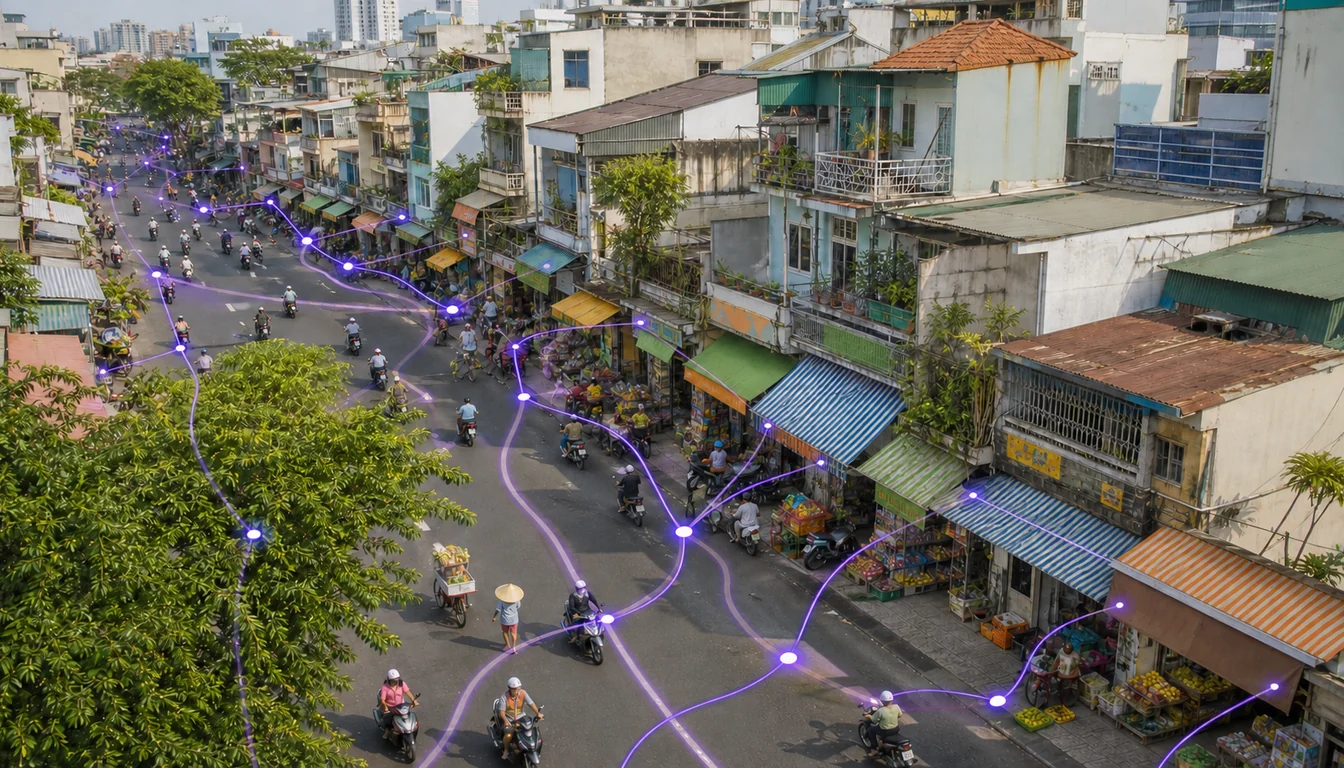
Density, Not Addressing, Is the Real Constraint
Beat planning advice written for other emerging markets usually starts from a problem Vietnam does not have. Streets are named and numbered, ward addresses resolve, mapping is accurate and mobile data is strong across the country, so a new Field Sales Representative can find an outlet on the first attempt. That part of the job works.
What makes a Vietnamese beat hard is the opposite of scarcity. In a typical urban ward, sellable outlets sit shoulder to shoulder: a tạp hóa, another four doors along, a minimart on the corner, then a traditional market (chợ) whose stalls hold many more buying points in one footprint. Travel time between calls is almost nothing while the number of decisions a rep makes in a morning is enormous. Add narrow alleys no car can enter, motorbike-based teams, one-way traffic and a day that pauses for a long midday break, and the problem becomes sequencing and capacity, not navigation.
This fails quietly. Coverage looks fine on paper, every outlet appears in the master list, and reps still skip the awkward third of the beat each cycle. A well-built plan inside a route planning system accepts that density instead of averaging it away.
Cluster Before You Sequence
The most common planning mistake in Vietnamese cities is to hand outlet coordinates to an optimiser and ask for the shortest route. When outlets are metres apart, minimising travel distance saves almost nothing, and the sequence often zig-zags across a road that is genuinely hard to cross on a loaded motorbike at peak hour. Build the beat in two stages instead: define clusters first, then sequence the clusters.
What Makes a Workable Cluster
A cluster is a group of outlets a rep can work on foot with the bike parked once: one street segment on one side of the road, one alley branch, one apartment block frontage, or one traditional market. Its natural size is set by how long a bike can reasonably be left parked and how much stock or sample material must be carried between calls. Recording clusters in the outlet master, rather than leaving them implicit in a rep's head, is what keeps a beat workable when that rep is on leave or moves area.
Alleys, Parking and One-Way Flows
Vietnamese alleys, the hẻm, hold a large share of neighbourhood retail and they change the arithmetic. An alley is quick to enter on a motorbike and effectively closed to a delivery car or truck, so the beat plan and the delivery plan may not share the same shape. Under pre-selling, the rep works the alley freely while delivery is scheduled to a drop point at its mouth. Under van sales, alley outlets need a different handling rule, which is why the choice between van sales and pre-selling should be settled before the beat is drawn.
Traffic direction deserves the same treatment. A sequence that ignores one-way flow and peak-hour congestion gets quietly re-ordered by the rep every day, and once reps are improvising, the planned sequence records nothing useful.
Setting Call Targets Reps Can Actually Hit
Calls per day should be derived, not inherited. Start from the productive selling window, which in most Vietnamese territories splits into a strong morning block, a long midday pause when small outlets are at their quietest, and an afternoon block running to early evening. Traditional market stalls sit heavily in the morning half. That shape, not an eight-hour block, is what the beat must fit inside.
Three measured quantities then set the target: in-store time by outlet type, movement inside a cluster, and movement between clusters. In-store time is the one most often guessed. An order-taking call at a small tạp hóa is short, a merchandising and shelf-check call at a minimart is considerably longer, and a first call at a newly recruited outlet longer again, so a single blended target produces a plan that overruns every afternoon.
Drop size needs the same discipline. Every route has a drop value in VND below which the call, the delivery and the paperwork cost more than the order earns. When an outlet consistently orders below that line, change its frequency or fold it into a wholesaler's coverage. Tracking order value and call outcome together in a sales force automation platform turns that into a decision the Sales Supervisor can defend. Raising a calls-per-day target without redrawing the clusters, by contrast, only produces shorter calls, thinner merchandising and eventually visits that are logged rather than made.
Visit Frequency by Outlet Behaviour
Frequency should follow how an outlet actually behaves, not how large its shopfront looks. Vietnam's dual-channel structure puts several genuinely different buying rhythms on the same street.
- High-throughput tạp hóa. A store beside a market, a school or a factory gate turns stock quickly with very little back-room storage. It buys small quantities often and substitutes a competitor's product the moment a fast line runs out, so it justifies the highest frequency on the beat.
- Residential tạp hóa. A quieter store deeper inside a ward turns stock more slowly and can hold a larger order, so lower frequency with a bigger drop is usually the better trade.
- Traditional market stalls. Stallholders buy in small lots and buy early. They belong to a morning cluster with their own frequency rule, and treating a whole market as one call badly understates the work.
- Minimarts and convenience stores. Chains such as WinMart+, Bach Hoa Xanh, Co.op Food, Circle K and GS25 order through their own systems, so the call covers availability, planogram compliance and promotion setup. It is longer, less order-driven, and measured by retail execution quality.
Holding that segmentation in outlet and store management records rather than a spreadsheet is what allows frequency to be changed for a whole class of outlets at once.
GPS-Verified Visits and Ghost Visit Prevention
Every distributor asks for GPS check-in, and most get less assurance from it than they expect, because density defeats a loose geofence. Where outlets sit a few metres apart and the accepted radius is generous, a rep standing in one place satisfies the geofence for several neighbouring outlets at once. The location stamp is real and the visit is still fictional. Preventing that takes four controls working together:
- Geocoding captured at the shopfront, once. Coordinates recorded during outlet survey, not derived from a street-level address.
- A geofence tuned to urban density. Tight enough that adjacent outlets stay distinguishable, with a documented exception path for alley outlets where the signal fix is weaker.
- Duration and sequence, not just a dot. A visit with a plausible in-store duration, in a plausible cluster order, is far harder to fabricate than a single tap.
- Work evidence attached to the visit. An order, a stock check, a shelf photograph or a recorded reason for no order. A visit with no output is not a visit.
Two points of care. Vietnamese law does not require GPS or biometric tracking of field staff, so this is an operational control the business chooses rather than an obligation to invoke. And because these records hold location traces, outlet contacts and photographs, they fall under the Law on Personal Data Protection (Law No. 91/2025/QH15), in force since 1 January 2026, so define the purpose, keep retention explicit and handle field activity records the same way in every territory.
Ho Chi Minh City Versus a Mekong Delta Province
The same national beat template will not survive both ends of the country.
In Ho Chi Minh City the constraint is congestion and cluster density. Outlets per kilometre are high, travel between adjacent calls is trivial, and the day is shaped hard by traffic peaks and the midday pause. Modern trade sits on the same streets as general trade, so one ward may need two call types at two frequencies running through it. Beat quality here is decided almost entirely by in-store time discipline and by how sensibly the clusters were drawn.
In a Mekong Delta province the constraint inverts. Outlets string out along roads, canals and market towns, so travel between clusters becomes the dominant cost and the market town anchors the day. Frequency is lower, drop sizes larger, and sub-distributors and wholesalers carry more of the last stretch of coverage. On the most remote stretches a brief loss of signal is possible, so visit capture should tolerate it, though that is a route-level detail rather than a national design principle.
Both patterns sit inside Vietnam's two-tier administrative structure of province and commune or ward, in place since 1 July 2025 across 34 provincial units. Aligning beats to that structure keeps reporting comparable when territories are re-cut, a topic covered in more depth in our post on territory and coverage planning across Vietnam's provinces.
Building the Weekly Cycle
Vietnam's business week runs Monday to Friday, with Saturday-morning working common in trade and distribution, so every beat calendar, roster and coverage report should be laid out Monday first. That sounds trivial until a supervisor is reading one calendar and a rep another.
A practical cycle assigns a fixed cluster set to each weekday so outlets learn when their rep arrives, which improves order readiness in small stores. Saturday mornings suit high-throughput outlets and market clusters rather than administrative catch-up, and fortnightly or four-weekly cycles work for lower-frequency segments provided they sit in the same plan.
Leave deliberate headroom for Tết. Lunar New Year is Vietnam's commercial peak, frequency has to rise across the whole beat, and the north and south build stock on different clocks, with northern retailers loading earlier and southern retailers compressing the build into a shorter window. A beat running at full capacity all year cannot absorb that, and Mid-Autumn creates a smaller version of the same pressure for confectionery and gifting lines.
How 1Channel Helps Beat Planning for Dense Tạp Hóa Routes
1Channel gives Vietnamese distributors and brand teams one place to design beats, run them and check they were actually worked. Clusters, frequencies and call types sit against the outlet master, so a change to a segment applies across the territory instead of outlet by outlet. Because the plan and the field app share the same records, the Sales Supervisor sees the gap between the beat as designed and the beat as worked on the day it happens, not at month end.
- Cluster-aware beat design for dense tạp hóa streets, alley outlets and traditional-market stalls, with modern-trade calls planned alongside general trade.
- Frequency and call-type rules by outlet segment, so a high-throughput tạp hóa, a residential store and a minimart each get the visit pattern they need.
- GPS-verified visits with tuned geofences, in-store duration and mandatory call outcomes, with data handling aligned to Vietnam's personal data protection law.
- Coverage and productivity analysis across north, centre and south territories, with drop value in VND, strike rate and lines per call visible by cluster and by rep.
- Order capture feeding distributor fulfilment and e-invoicing, mandatory for all Vietnamese businesses since 1 July 2022.
- Seasonal beat adjustment for Tết and Mid-Autumn build-up, with different phasing for northern and southern territories.
Design Beats That Survive Vietnam's Densest Streets
See how 1Channel's route planning software builds cluster-aware beats, sets frequency by outlet segment and verifies every visit across Vietnamese territories.
Explore Route Planning Software →Key Takeaways
Vietnamese beat planning rewards teams that design for density and access instead of borrowing a template built for a different market.
- Addressing is not the problem. Vietnamese streets and mapping work well, so beat quality is decided by outlet density, alley access and time discipline, not by navigation.
- Cluster first, sequence second. Group outlets into units a rep can work with the bike parked once, then order the clusters around traffic flow and the midday pause.
- Derive call targets from measured time. In-store time by call type plus movement inside and between clusters sets the realistic number, and a minimum drop value decides which outlets keep their frequency.
- Frequency follows throughput and storage. A fast-moving tạp hóa needs short, frequent calls; a minimart call is longer, less order-driven and judged on execution quality.
- Ghost visit prevention needs more than a check-in. Shopfront-level geocoding, a tight geofence, in-store duration and mandatory call evidence together make a fabricated visit impractical.
- City and delta beats differ by design. Ho Chi Minh City routes are constrained by congestion and density, Mekong Delta routes by distance between market-town anchors.
Start by fixing the outlet master and the cluster definitions, because every other decision on the beat, from frequency to verification to seasonal Tết loading, is downstream of those two records being right.