For manufacturers operating through distributors, wholesalers, and retail outlets, managing channel sales can quickly become complex. From stock visibility and secondary sales tracking to payment collections and beat-level execution, every stage requires real-time control.
This is where Sales Force Automation (SFA) software becomes highly valuable.
SFA helps manufacturers streamline channel sales by giving complete visibility into distributor stock, secondary sales movement, receivables, collections, and field team performance across territories.
Whether a company sells FMCG products, cleaning solutions, personal care products, or household goods, SFA helps ensure that products move efficiently from distributors to retailers while enabling field teams to take faster decisions.
What Does Channel Sales Management Mean for Manufacturers?
Channel sales management refers to the process of selling products through third-party partners such as:
- distributors
- wholesalers
- stockists
- dealers
- retailers
Instead of selling directly to every retail outlet, manufacturers rely on channel partners to distribute products in different markets and territories.
For example, a company like Hindustan Unilever or ITC Limited may work with multiple distributors across regions to ensure products reach thousands of retail stores.
Without a structured system, manufacturers may struggle with:
- stock visibility
- outstanding payments
- sales tracking
- beat coverage
- outlet performance
- collection follow-ups
This is where SFA solves the operational gap.
Streamline Distributor Management with SFA
1Channel's Distributor Management Software provides complete visibility into distributor stock, secondary sales, ledger balances, and payment collections to help manufacturers manage channel sales efficiently across territories.
Explore Distributor Management Software →1. Real-Time Distributor Stock Visibility
One of the biggest challenges in channel sales is knowing what stock is available at the distributor level.
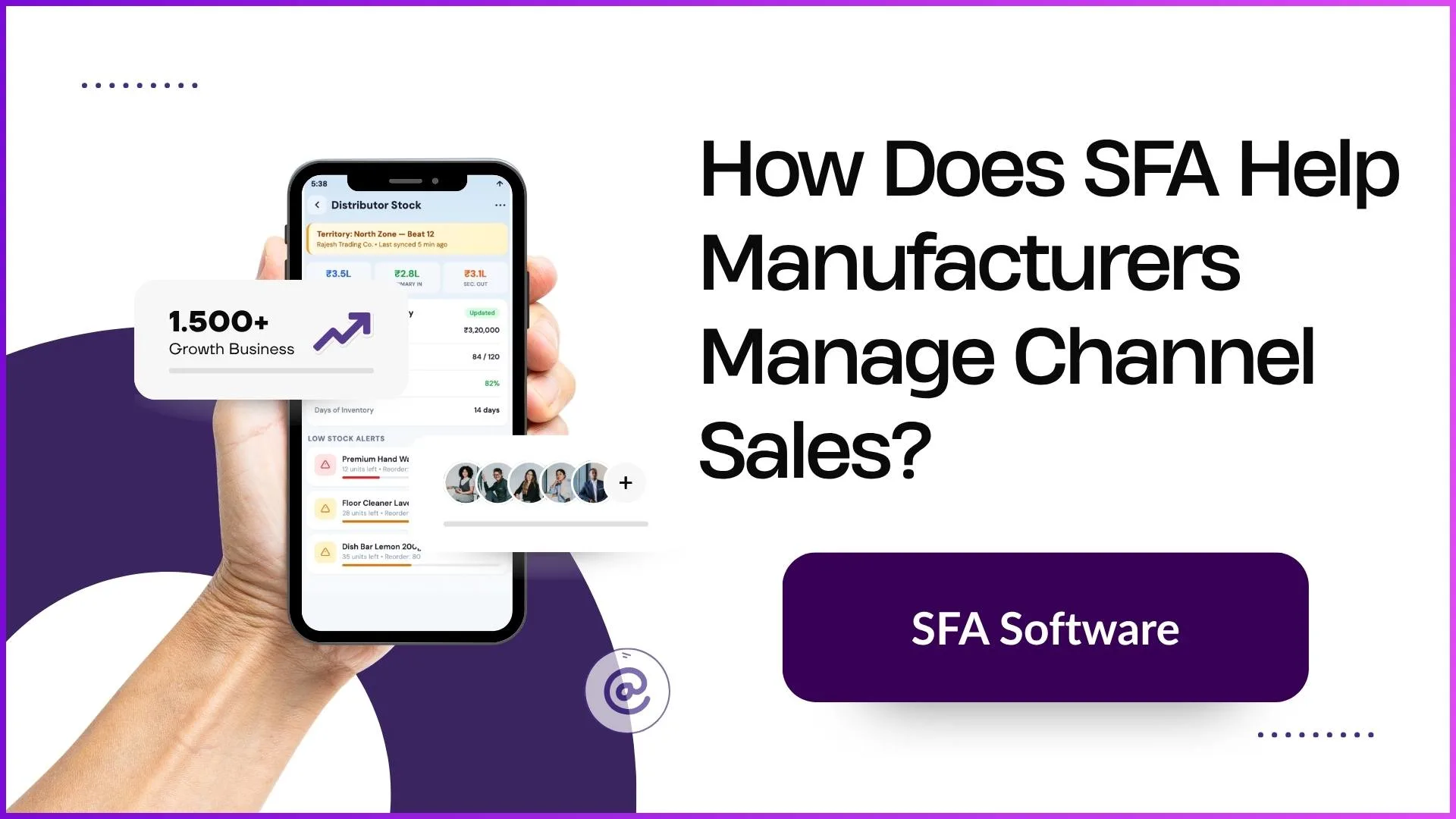
SFA provides a centralized view of:
- opening stock
- inward stock
- secondary sales outflow
- closing stock
- SKUs in stock
- days of inventory
- low-stock alerts
For example, from the provided workflow:
- Closing stock: ₹23,20,000
- SKUs in stock: 84/120
- Sell-through rate: 82%
- Inventory days: 14 days
This helps manufacturers quickly identify stock health.
Example
Suppose Dabur India is selling personal care products through distributors.
If Premium Hand Wash 250ml is showing low stock at Rajesh Trading Co., the area sales manager can immediately plan replenishment before stock-outs happen at retail outlets.
This improves product availability and reduces lost sales opportunities.
2. Secondary Sales Tracking Across Distributors
Primary sales only show stock pushed to distributors.
But manufacturers need visibility into secondary sales, meaning sales from distributor to retailer.
SFA helps track:
- today's sales
- week-to-date sales
- month-to-date sales
- delivered orders
- in-transit orders
- recent outlet-level sales
For example:
- Sunrise Mart
- Green Valley Store
- Patel General Store
- Verma Grocery Mart
all show product-level movement.
Example
If Godrej Consumer Products wants to know whether Floor Cleaner Lavender 1L is moving well in North Zone, SFA provides retailer-level visibility.
This helps identify:
- fast-moving SKUs
- slow-moving products
- beat-wise demand trends
Manufacturers can then adjust schemes, promotions, or stock planning.
3. Complete Distributor Ledger Management
Financial control is a major part of channel sales.
SFA helps manufacturers manage complete distributor ledger visibility, including:
- outstanding balances
- invoices
- payments received
- credit notes
- overdue amounts
- running balances
For example:
- Outstanding balance: ₹3,42,000
- Credit limit utilization: 42.8%
- recent invoice and payment entries visible
This reduces dependency on manual ledger reconciliation.
Example
A company like Marico can quickly check whether a distributor is approaching their credit limit before approving new dispatches.
This prevents credit risk and improves financial discipline.
4. Collection Tracking and Payment Recovery
Delayed payments can directly affect working capital.
SFA helps manufacturers track receivables through:
- ageing buckets
- pending collections
- recently collected amounts
- payment modes
- overdue invoices
For example:
- 0–15 days
- 15–30 days
- 30–60 days
- 60+ days
This ageing-based visibility helps teams prioritize recovery.
Example
If Mehta Distribution has pending invoices in the 30+ day bucket, the finance or field team can immediately follow up.
This ensures faster collections and better cash flow management for manufacturers like Nestlé India.
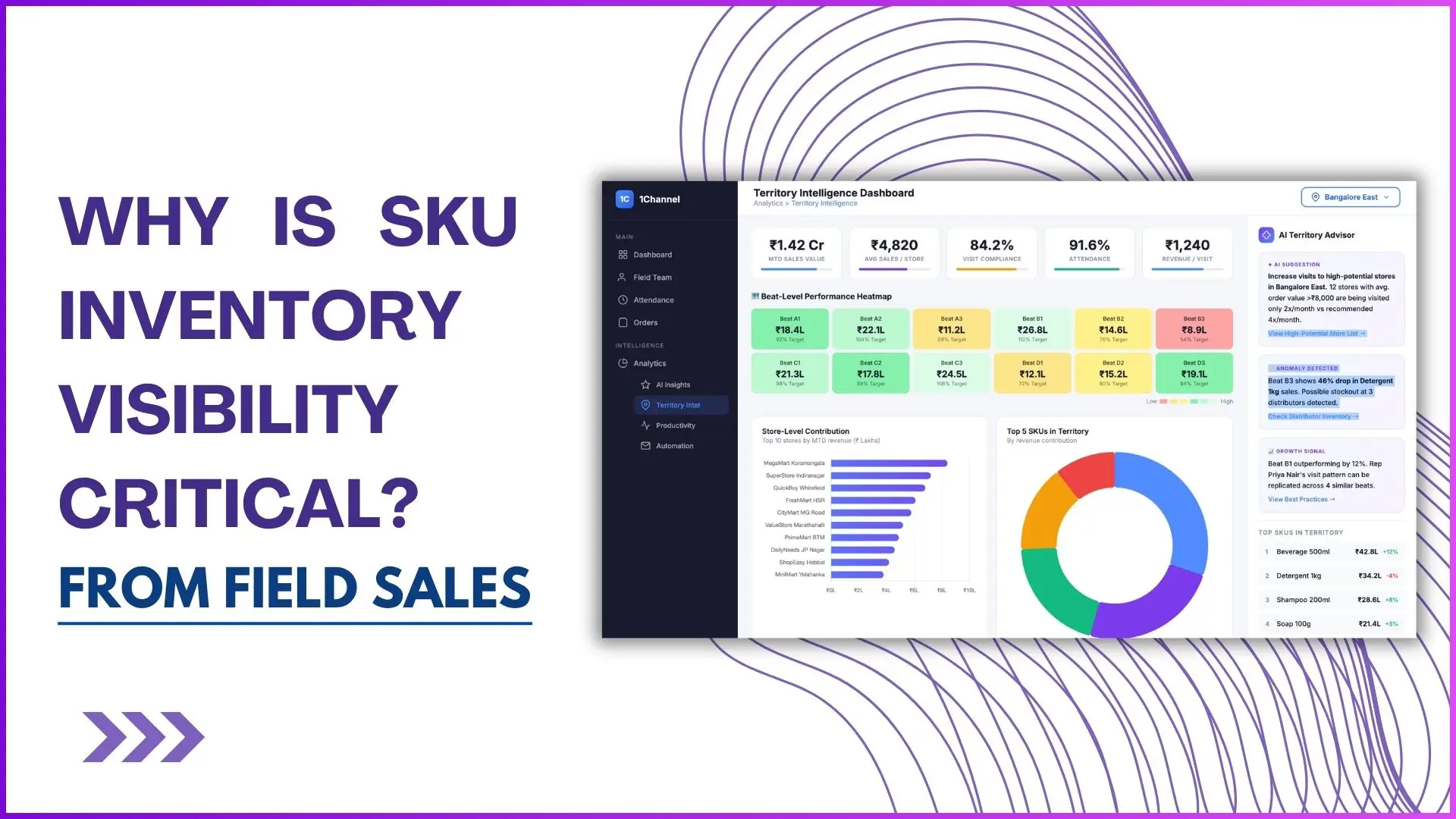
5. Beat-Wise Channel Performance Monitoring
Manufacturers need to track performance by:
- beat
- territory
- distributor
- sales representative
- outlet coverage
SFA enables beat performance visibility like:
- Beat 12 – Lajpat
- Beat 14 – Karol Bagh
- Beat 18 – Pitampura
- Beat 9 – Rohini
Each beat can be monitored for:
- target achievement
- outlet visits
- productive calls
- strike rate
- sales gap
Example
If Beat 14 shows only 76% achievement, the sales manager can identify the issue early and push the team with schemes or visit planning.
This helps manufacturers improve territory performance.
6. Outlet Coverage and Visit Productivity
Field execution is critical in channel sales.
SFA helps monitor:
- total outlets
- visited outlets
- productive calls
- strike rate
- coverage %
For example:
- 38 visited outlets
- 95% achievement
- 89% strike rate
Example
If Britannia Industries wants to improve retail penetration in a specific market, outlet-level visit visibility helps ensure the field team is visiting the right stores consistently.
This improves market coverage and retail execution.
7. Faster Decision-Making for Sales Managers
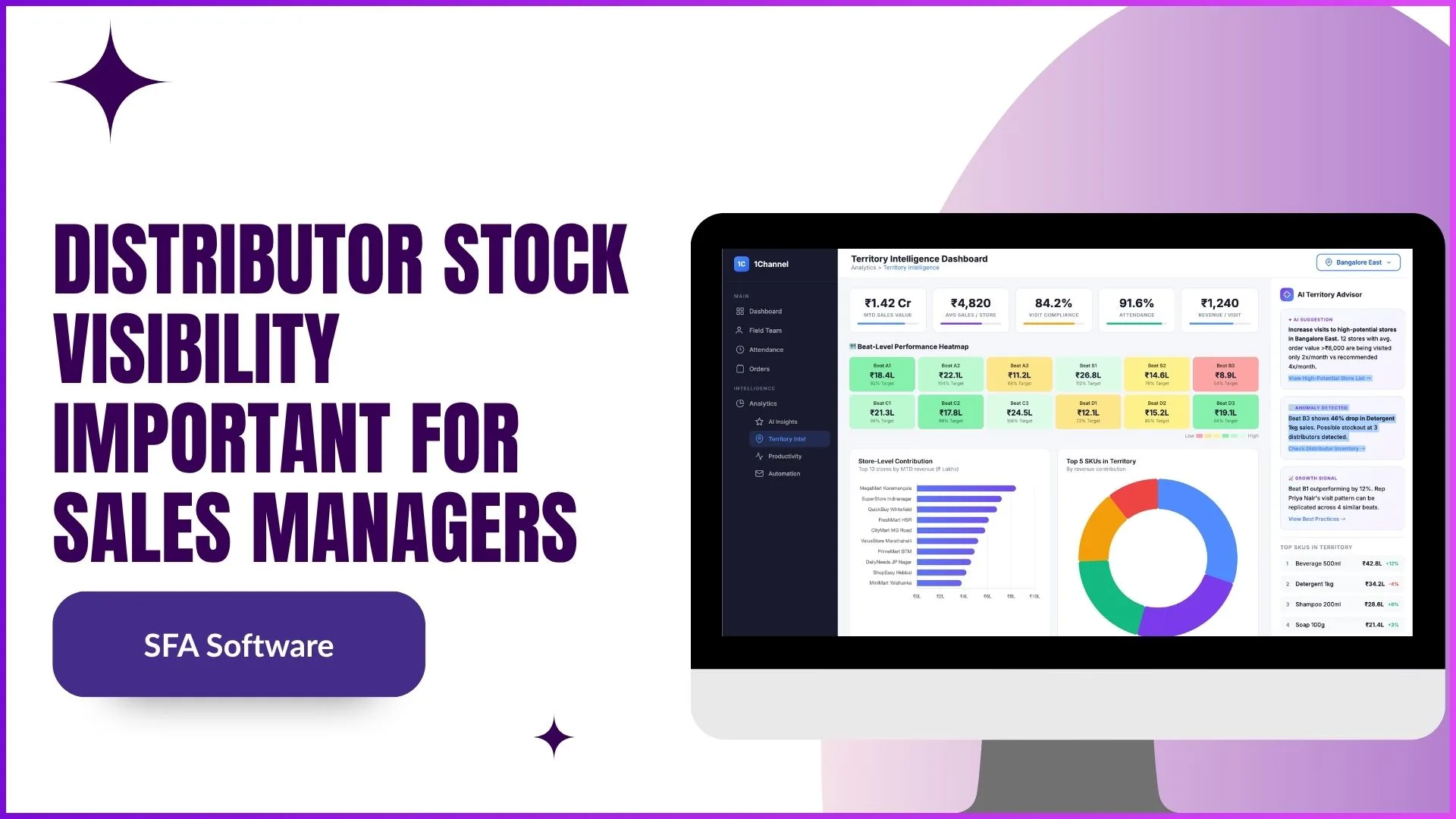
With admin dashboard visibility, managers can track everything from one place:
- distributor stock
- ledger status
- collections
- beat performance
- regional comparisons
This makes decision-making faster.
For example, if the North Zone is on track but West Zone shows low stock and poor collections, the sales head can immediately take corrective action.
Why This Matters for Large Manufacturing Brands
For companies like:
- Hindustan Unilever
- Dabur India
- ITC Limited
- Marico
- Godrej Consumer Products
channel sales operations often involve hundreds of distributors and thousands of retail outlets.
Without SFA, manual reporting delays visibility.
With SFA, manufacturers gain:
- operational control
- financial visibility
- faster collections
- better stock planning
- stronger field productivity
How 1Channel SFA Helps Manufacturers Manage Channel Sales
1Channel SFA helps manufacturers manage their complete channel sales lifecycle through a structured SFA workflow.
It enables teams to track:
- distributor stock and secondary sales
- ledger balances and invoice history
- collection ageing and recovery
- beat-wise sales performance
- outlet coverage and productivity
This helps sales managers, ASM teams, and channel heads make faster and data-backed decisions across territories.
For manufacturers scaling distributor-led sales operations, this improves visibility, control, and execution efficiency.
Manage Channel Sales Efficiently with SFA
1Channel Sales Force Automation provides end-to-end channel sales management with distributor stock tracking, secondary sales visibility, ledger management, and beat-wise performance monitoring to help manufacturers drive growth across territories.
Explore Sales Force Automation →FAQs
How does SFA improve channel sales visibility?
SFA provides real-time visibility into distributor stock, secondary sales, collections, and beat performance, helping manufacturers monitor the complete sales channel.
Can SFA help track distributor payments?
Yes, it helps track outstanding balances, invoices, overdue payments, and collection status through ledger and collection tracking modules.
Why is secondary sales tracking important?
Secondary sales tracking helps manufacturers understand actual market movement from distributor to retailer, which is more useful than only primary sales data.
Can manufacturers monitor beat performance in SFA?
Yes, beat-wise performance, outlet visits, sales targets, and coverage percentage can all be monitored.