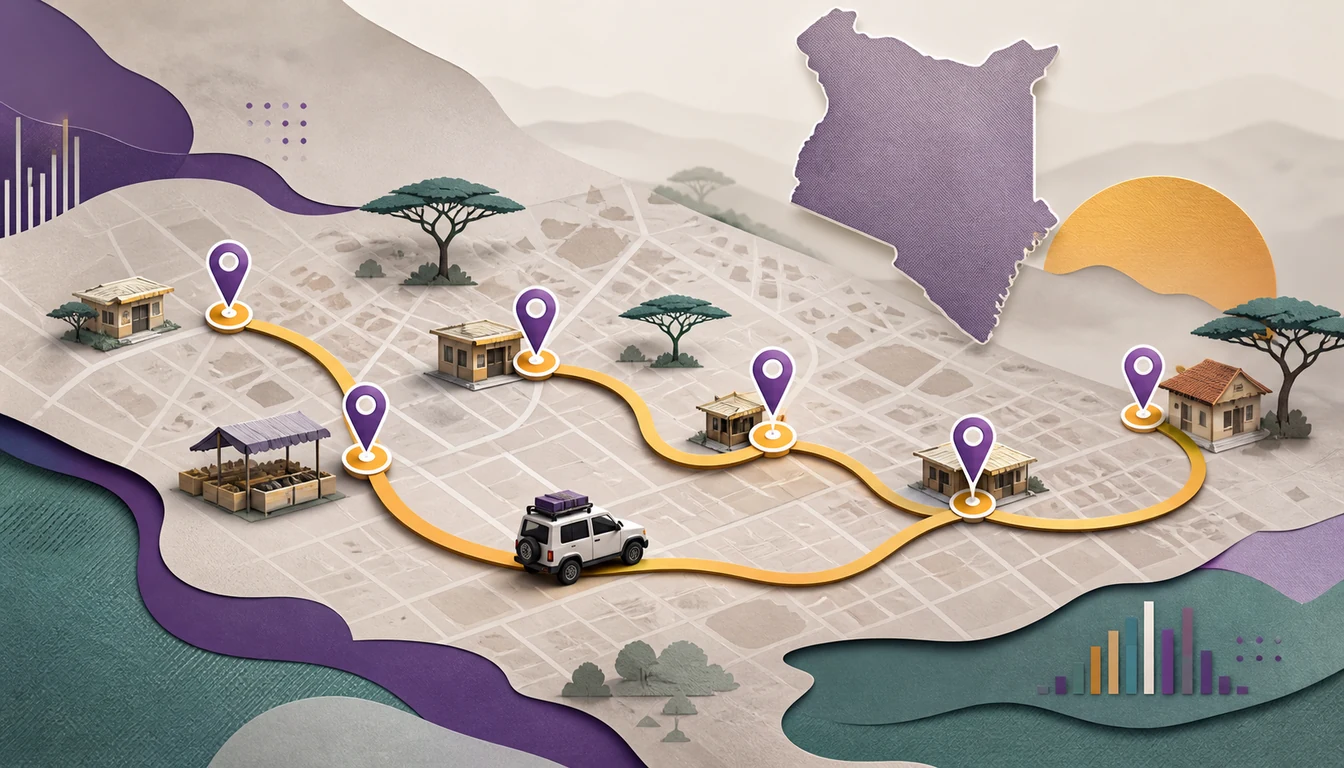
A rep pulls out of a distributor yard in Nakuru a little after seven, with twenty-odd calls before the yard closes again. Around the fourth stop, a duka owner asks something new: the reformulated pack has landed, the shelf price has moved, and he wants to know why he should carry both variants when the old one still sells.
She has the answer somewhere. It was covered at head office five weeks ago, in a deck she saw once, in English. The conversation in front of her is in Kiswahili, with the numbers in English, the two switching mid-sentence the way they do in almost every trade conversation in the country.
She is fluent in both, so that is not the problem. The problem is that the only version of the answer she was ever given exists in one language, and it is not the one she is standing in.

What A Bilingual Field Force Actually Means
English and Kiswahili are both official languages in Kenya, and that constitutional fact has an ordinary commercial consequence: your field team is genuinely bilingual, and it does not use the two languages for the same jobs. Reporting, pricing and anything touching the distributor's books tend to sit in English. Persuasion, negotiation and most of what happens across a duka counter tend to sit in Kiswahili, or in a mix of both.
Content that ignores this split ends up half-useful. A module written entirely in English teaches the specification and leaves the rep to improvise the pitch. A module written entirely in Kiswahili feels natural but drifts away from the terms printed on the invoice and the order screen.
That is a design failure, not a translation failure. The starting point is a language map: for each module, which language the content is authored in, which language the assessment is taken in, and which terms stay in English on purpose.
Short Modules On The Rep's Own Phone
The traditional answer is a training day: pull the region's reps into Nairobi or a depot town, run a full day, send everyone back. It works once. It cannot keep pace with a market where packs change, prices move, and a rule like eTIMS invoicing changes what a distributor will accept at the counter — and for a team spread from Mombasa up the Northern Corridor to Eldoret, every session costs travel and selling days per head.
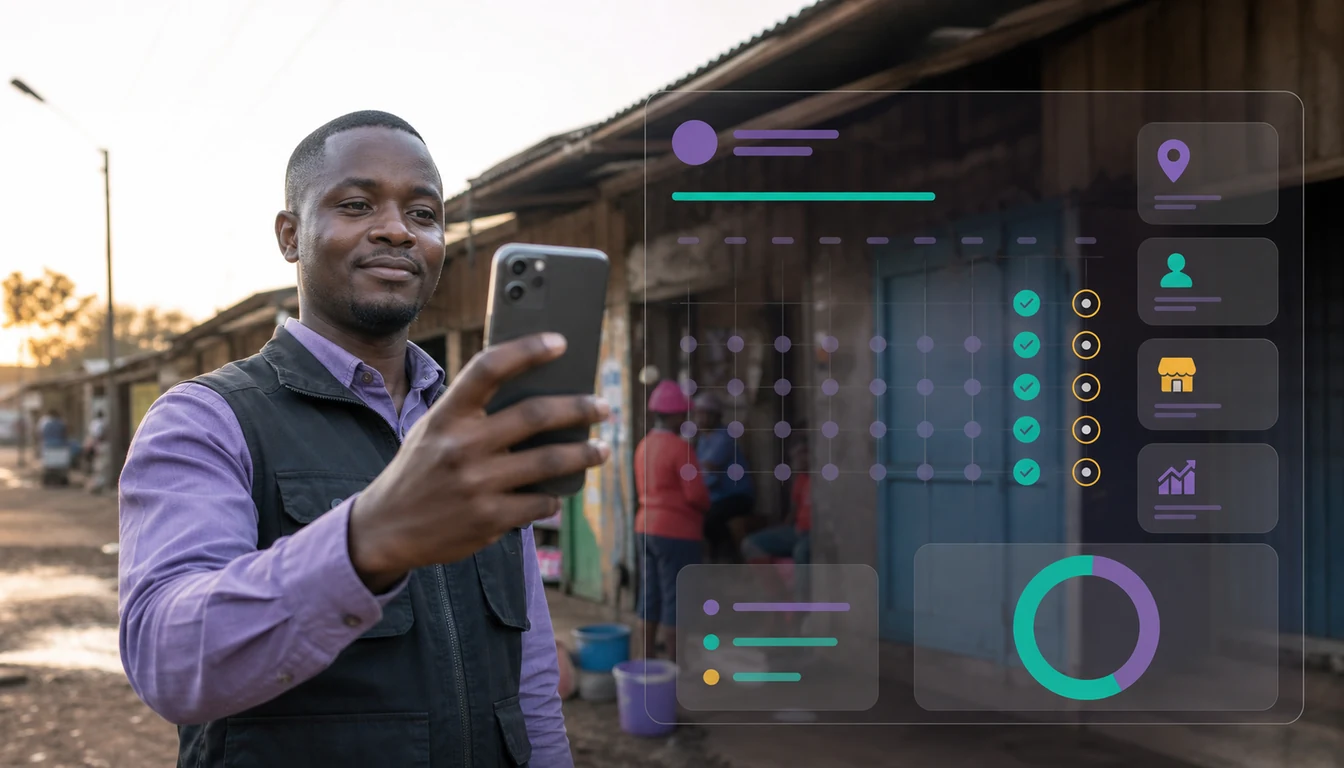
The device that can keep pace is already in the rep's pocket: almost certainly an Android phone she bought herself, with limited storage, a battery that has to last until evening, and a data bundle she pays for. Modules should be short enough to finish standing outside a shop — three to seven minutes, one idea each. A rep does not have a study hour. She has the gap between parking and walking in, the wait while a kiosk owner serves a customer, and the ride between calls.
- One module, one job. A single objection, a single SKU change, a single step of the order flow — not a chapter.
- Light payloads. Compressed images and short clips, so a module downloads on a weak connection without eating a day's bundle.
- Readable on a small screen. Slides built for a projector are unreadable on a phone held in one hand at a counter.
- Resumable. A call interrupts everything, so the module must remember where she stopped.
- Voice where text is slow. Short audio in Kiswahili often lands better than a paragraph.
Building In Two Languages From The Start
The common approach is to build the English module, ship it, and translate later if budget allows. That gives you the worst of both: English on time, and Kiswahili after the promotion has ended.
The alternative is to treat the two versions as one deliverable with two outputs — a shared script, a locked glossary, and an explicit decision about which terms are not translated. Some should stay in English because they are printed in English on everything the rep touches: SKU codes, batch numbers, the invoice line, the eTIMS reference, KEBS marks, the trade price in KSh as it appears on the price list.
Everything else belongs in the language the conversation happens in — why a duka owner should take the second variant, how to respond when a wholesaler undercuts your trade price, how to ask for payment on an overdue account without losing the relationship. Objection handling in stiff textbook Kiswahili is as useless as objection handling in English. It has to sound like the counter, which means people who sell must write or review it.
The Third Language Question
Most Kenyan field teams are not bilingual so much as trilingual. A rep working around Kisumu may sell in Dholuo for part of the day; in the central highlands the community language may be Kikuyu; in the north-east, Somali. Reps use these languages because they build trust faster than either official language can.
The instinct is to build a third content set. Resist it: building three full versions of every module triples the authoring and creates three things to update every time a price changes.
What works is a two-language content core plus deliberate local coaching. Ship English and Kiswahili modules, then let the area supervisor run the practice in whatever language the team sells in, using a short discussion guide attached to the module. The knowledge is standardised; the delivery is local. That is the only split that stays maintainable past the first quarter.
Offline Download For Long Routes
Connectivity in Kenya is good in the towns and thin between them. A route working outward from Nakuru, or a van sales run down a rural stretch off the A104, will pass through long sections with a single bar or none. Add power interruption — Kenya has had grid failures and carries high electricity costs, so a charging routine is not guaranteed — and any programme assuming a live connection will not run.
Offline-first is therefore the operating assumption, not a feature. Assigned modules download in the morning while the rep is still on depot Wi-Fi. She can open, complete and be assessed on them with the connection off entirely, and her attempts and scores queue on the device and sync when signal returns.
Design against two failure modes. The first is silent failure: the module reports as downloaded but only cached the first screen, and she discovers this fifty kilometres out — so show her, before she leaves, exactly what is on the device. The second is battery cost: short audio, images and text survive a full day where autoplaying video will not.
Quizzes That Test The Job, Not The Slide
Most field quizzes test whether the rep watched the module. That is a completion check wearing a quiz costume. The useful version tests whether she can do the thing.
Scenario questions do this well. Instead of "which of the following is a feature of the new pack?", ask: a duka owner says the pack is too expensive and points at the competitor's shelf — what do you say first? Instead of "what is the returns policy?", show a photograph of a damaged case and ask what she must capture on the app before leaving. Photo questions suit shelf and planogram standards, because the field version of that skill is visual.
Language matters here as much as in the content. If she will handle that objection in Kiswahili, the objection in the quiz should be in Kiswahili. If she will read an invoice in English, the invoice question should be in English. A quiz that switches language relative to the real task measures translation ability, not readiness. Beyond that, keep the mechanics humane: short quizzes, a few retries with a cooling-off gap, and feedback that explains the wrong answer rather than only marking it.
Levels, Badges And Internal Certification
Structure helps, because "here is a library of modules" is not a programme. Levels give a new joiner a visible path: an induction level cleared before the first solo route, a product level per category, a compliance level covering invoicing, and an advanced level for reps moving towards supervision. Gating is where they earn their keep — requiring a pass before a rep is assigned a new category converts training from an aspiration into a prerequisite. Used everywhere, though, it becomes an obstacle course and people find ways around it.
Be precise about what a certificate is. What an internal programme issues is a company certification: proof that this rep, on this date, met your standard on your content. It is not an external accreditation and should never be presented as one. Reps value the recognition more when it is honest about what it covers.
Gamification works here when it rewards effort rather than territory. Streaks for weekly completion, badges for clearing a level and team standings tend to motivate. Individual national leaderboards tend to demotivate, because a rep on a dense Nairobi route has more idle minutes between calls than a rep covering distance around Machakos.
A Morning On The Kisumu Route
Consider a Tuesday in Kisumu. A rep loads her day before leaving the depot: the route plan syncs, and with it two modules — a four-minute refresher on the reformulated pack and a two-minute clip on the changed order flow. Both download while she is still on depot signal.
By mid-morning she has worked a cluster of dukas near the market and is waiting at a matatu stage for a colleague. Four minutes is exactly what she has, so she takes the pack refresher: audio in Kiswahili, the specification panel in English, the trade price shown in KSh as it appears on her order screen. The quiz is one scenario: the shopkeeper says his customers will not pay more. She picks the answer leading with the smaller unit cost per use, the argument she has heard work.
Two calls later, an agrovet on the edge of town asks about supply on a seasonal input, and the answer is in neither module. She flags it in the app as a question the content does not cover. That flag is worth more than her quiz score: it tells the training team there is a live field question with no answer in the library, from a channel that behaves differently from general trade.
Her records sync that evening when she is back in signal. Nobody chased her, nobody travelled, and the training took under seven minutes across a full day.
Where These Programmes Go Wrong
These programmes fail in predictable ways, and almost none of them are about the technology.
- Translation as an afterthought. English ships on launch day, Kiswahili six weeks later, and the team learns to ignore the second version because it is always stale.
- Desktop content on a phone. Twenty-slide decks and half-hour recordings uploaded unchanged — available in theory, unopenable at a counter.
- A live connection assumed. The pilot works perfectly in a Nairobi office, then meets a route where signal drops for an hour.
- Completion mistaken for readiness. Green ticks tell you people pressed play, not that anyone can handle the objection.
- The supervisor left out. If the area manager has no view of who is behind, the programme is a corporate broadcast and gets treated like one.
- Content that is never retired. A library that only grows fills with prices and packs that no longer exist, and reps stop trusting it.
The common thread is treating the programme as a content-delivery project rather than a field-performance one. Success is not what was published; it is what changed at the counter.
Measuring Readiness, Not Completion
Completion rate is the easiest number to produce and the least informative. Readiness is harder and worth the effort: for a given rep, on a given category, at a given moment — can she do the job?
That view combines three things the platform already sees. Assessment performance tells you what she knows, and is more useful sliced by topic than as one score. Field behaviour tells you whether it transferred — whether reps who cleared the new-pack module are placing the new pack. Supervisor observation tells you what neither can: a short structured check during a joint route visit, scored the same way every time.
Slice all of it by language version and by region. If the Kiswahili cohort scores consistently lower on a module, that is almost never a knowledge gap — it is a content-quality gap in that version, and it is fixable. If a region lags, ask about connectivity and supervisor load first.
Then use readiness for something: gate a launch beat on it, or decide where the field trainer spends next week. A score that only appears in a monthly deck will be gamed within two cycles; one that determines who gets the new category will be taken seriously.
How 1Channel Supports Bilingual Field Training
1Channel's sales team LMS is part of the same mobile platform field teams use for route plans, outlet visits, orders and attendance. That matters because it removes a second app and a second login from the rep's day — the module sits alongside the route rather than in a system she has to remember to open.
The relevant capabilities are straightforward. Content is organised into short modules grouped into levels, with quizzes and pass marks that can gate progression. Modules and quiz attempts work offline: assigned content downloads to the device, attempts queue while the rep is out of signal, and records sync when the connection returns. Badges and completion tracking give the programme visible structure, dashboards roll results up by team and region, and separate trainer and learner views let field trainers run sessions while reps see only what is assigned to them.
Because the content library is yours, both language versions of a module live in the same programme and are assigned the same way — which is what makes it practical to keep English and Kiswahili in step rather than treating one as the afterthought.
One point of honesty, since it is where training vendors overreach: a certificate issued through the platform is an internal, company-issued record of what a rep completed and passed against your own standard. It is not an external accreditation, and 1Channel does not represent it as one.
Key Takeaways
Training a Kenyan field force is not a translation exercise bolted onto an English programme. It is a design problem, and most of the work is decided before a single module is authored.
- Map the languages before you build. Decide per module which language carries the content, which carries the assessment, and which terms stay in English because the invoice and the order screen use English.
- Author both versions together. Kiswahili shipped six weeks after English is Kiswahili nobody opens; a shared script and a locked glossary make parallel delivery affordable.
- Design for the gap between calls. Three to seven minutes, one idea, light enough to download on a weak connection, and resumable after an interruption.
- Assume no signal and no charger. Modules and quiz attempts must work fully offline and sync later, because long routes and power interruption are ordinary conditions here.
- Measure readiness, and be honest about certificates. Combine assessment, field behaviour and supervisor observation, and describe internal certification as exactly that, never as external accreditation.
Handle the third community language through local coaching rather than a third content set, keep the library pruned, and give supervisors a real role in the practice. A bilingual field force is not a complication to work around. It is already a team that can have the conversation, once somebody gives them the answer in the language they will need it in.