Retail execution is where a brand plan meets the counter of a provision store in Aba or a table-top seller in Onitsha Main Market. In Nigeria, more than nine in every ten units of fast-moving consumer goods still move through general trade.
That means open-air markets, kiosks, neighbourhood shops and roadside table-tops. Modern trade like Spar, Justrite and the Ebeano chain is a smaller, faster-growing slice, concentrated in Lagos, Abuja and a handful of state capitals.
The gap between what a brand team designs in head office and what a shopper actually sees on the shelf is the execution gap. Closing it is the entire job of a merchandising audit.
Most Nigerian FMCG operators inherited tools built for tidy, addressed, always-connected retail. Kano's Kantin Kwari and Lagos's Balogun and Mile 12 markets do not work that way. This article sets out how to run audits that hold up across both Nigerian modern trade and general trade.
Two Channels, Two Audit Realities
Modern trade and general trade look like the same task on a planning slide. On the ground they demand very different audit designs.
Treating them identically is the most common reason execution scores look healthy while sales stay flat. The table below shows where the two channels part ways.
| Audit factor | Modern trade (Spar, Ebeano) | General trade (kiosk, provision store) |
|---|---|---|
| Main question | Compliance to an agreed layout | Presence, visibility and trust |
| What reps check | Planogram, facings, share of shelf, promo accuracy | Brand present, POSM installed, cooler stocked, price |
| Connectivity | Power and Wi-Fi usually available | Signal drops inside covered markets |
| Biggest risk | Inconsistent scoring between reps | Phantom execution and false self-reporting |
Modern trade: structured shelves, planogram discipline
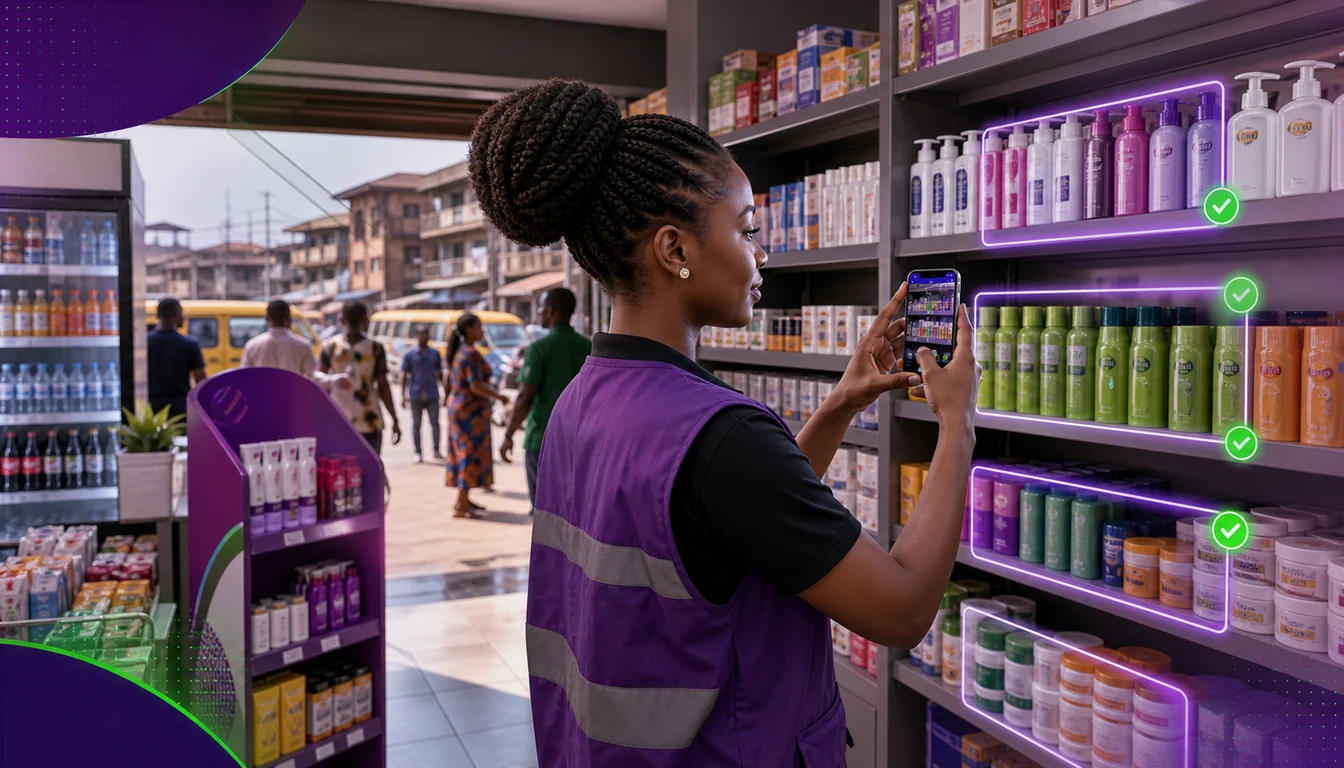
In a Spar or Ebeano outlet, the audit is about compliance to an agreed layout. Reps check planogram adherence, facings and share of shelf, on-shelf availability, pricing and promotion accuracy, and the state of secondary displays.
Because these outlets are addressed, well-lit and usually have power and Wi-Fi, the constraint is not connectivity but consistency. The same store audited by two different people should return the same score.
General trade: presence, visibility and trust
In a kiosk or provision store, there is rarely a planogram to comply with. The questions become simpler and harder at once: is the brand present, is the point-of-sale material (POSM) actually installed, is the branded cooler stocked with your product or a competitor's, and is the retailer selling at the recommended price.
Here the real risk is trust. In a cash-heavy, low-documentation channel, a rep can claim a poster was hung or an umbrella deployed when it was not. Your audit design has to assume that and build in proof.
What a Merchandising Audit Should Measure
A useful audit captures a small number of things well, rather than a long checklist filled in carelessly. For most Nigerian FMCG programmes, the core metrics are five.
- Availability — is the SKU physically in the outlet, and are the priority packs (often the lowest-price sachet or single-serve format that drives Nigerian volume) in stock.
- Visibility — POSM deployed and intact: branded umbrellas, posters, shelf strips, standees and coolers, verified with a geotagged photo rather than a tick.
- Price compliance — the retailer's actual selling price against the recommended price, captured in naira, so you can see margin abuse or under-cutting across a market cluster.
- Share of shelf and cooler — how much visible space your brand holds versus competitors, which matters as much in a kiosk fridge as on a supermarket gondola.
- Freshness and condition — expiry, damage and dusty stock, which protects both the shopper and your standing with NAFDAC-conscious buyers.
Whatever you measure, define it once and centrally. A supervisor in Port Harcourt and one in Ibadan should be scoring the same behaviour the same way. Ambiguous questions are the fastest route to unusable data.
Designing for Power Cuts and Dead Signal
No audit programme survives Nigerian field conditions unless it is offline-first. Reps will lose signal inside covered markets and will face grid blackouts during a working day.
The workflow has to let a rep open the outlet, capture the audit and shoot geotagged photo proof entirely offline. It then syncs automatically the moment connectivity returns, without losing a single visit.
Two practical design choices follow from this.
- Landmark-based outlet mapping. Because streets are frequently unnamed, outlets should be pinned by GPS coordinate and described by landmark ("second stall after the mosque gate, blue kiosk") rather than a street address that does not exist. This is how a new rep finds the same 40 outlets the previous rep covered.
- Low-battery, low-data discipline. Phones may not be charged again until evening, and data is a real cost to field staff. Photo compression, a light interface and background sync keep the app usable through a long, hot market day.
Multi-Level Audits Against Phantom Execution
The single biggest threat to merchandising spend in a cash, low-trust channel is phantom execution. That means POSM reported but never deployed, coolers "branded" only on paper, and visits logged from a rep's own home.
A one-person, self-reported audit cannot catch this. A staged, multi-level review can. Here is how the layers work in practice.
- L1 — field capture. The rep or merchandiser records the audit at the outlet and submits geotagged photos as first-line evidence.
- L2 — supervisor review. A territory supervisor scores the submitted proof, rejecting blurred, reused or clearly staged images before they count.
- L3 — brand or agency sign-off. A final reviewer approves execution quality before any activation is marked complete and any incentive is paid.
Informal outlets open and close constantly, so the audit also needs an honest bypass workflow. A rep should be able to flag an outlet as closed, relocated or under construction with a documented reason, so it drops out of the denominator instead of quietly dragging coverage down.
Handled well, this is what keeps target-versus-achievement numbers believable region by region — North, South-West, South-East and South-South.
Beat Planning, Drives and Clean Retailer Payouts
Audits do not happen on their own. They hang off a route plan and an activation calendar.
In dense clusters like Balogun or Onitsha Main Market, beat plans should reflect how a rep actually walks the market, not a straight-line map. They should also leave room for ad hoc visits so a newly opened kiosk can be onboarded on the spot.
Structuring a merchandising drive — its outlets, POSM list, duration and reference images — before reps go out is what turns scattered visits into a measurable campaign. A clear drive brief keeps every rep working to the same standard.
Closing the loop with the retailer
Execution incentives only work if they reach the retailer cleanly. Nigeria's rapid shift to bank transfer and fintech wallets — Opay, Moniepoint, PalmPay and the rest — changes what is possible here.
A verified audit can trigger a payout the retailer actually trusts, rather than cash that leaks along the distributor-to-sub-distributor chain. Tying the reward to L2/L3-approved proof also removes the incentive to fake execution in the first place.
Common Pitfalls to Avoid
Most failed audit programmes trip over the same handful of mistakes. Watch for these before they quietly rot your data.
- Copying a modern-trade checklist onto general trade. A planogram question is meaningless at a table-top seller. Ask about presence, visibility and price instead.
- Trusting ticks over photos. In a cash channel, unverified self-reporting invites phantom POSM. Make geotagged proof the default, not the exception.
- Assuming connectivity. If the app cannot capture a full audit offline, reps will skip outlets or back-fill from memory in the evening.
- Punishing honesty. If flagging a closed outlet hurts a rep's score, they will stop flagging. Build a clean bypass so accurate coverage is the easy path.
- Over-long checklists. A 40-question audit done badly is worse than a 6-question audit done consistently across every state.
How 1Channel Helps Nigerian Brands Run Audits That Hold Up
Retail execution in Nigeria is not about importing a shelf-compliance model built for supermarkets and hoping it survives the open market. It is about designing audits for the channel you actually sell through.
1Channel's Cloud AI Retail Execution platform is built for exactly those conditions — offline-first, proof-driven, landmark-mapped and reviewed by more than one pair of eyes, from Lagos to Kano.
For a Nigerian FMCG team, the platform brings the whole audit workflow onto one dashboard:
- Offline audit capture with geotagged photo proof that syncs when signal returns
- Landmark-based outlet mapping for markets on unnamed streets
- Multi-level L1/L2/L3 review to catch phantom POSM and staged photos
- Merchandising drives with a fixed outlet list, POSM brief and reference images
- Price, availability and share-of-shelf tracking captured in naira
- Verified-proof payouts that reach the retailer through trusted fintech wallets
Run Retail Execution That Holds Up in Nigeria
See how 1Channel's retail execution software runs merchandising drives, multi-level outlet audits and offline geotagged photo proof across kiosks, provision stores and open markets — from Lagos to Kano — on one dashboard.
Explore Retail Execution Software →Key Takeaways
If you are building or fixing a merchandising audit programme for Nigeria, keep these points close.
- Design per channel. Modern trade needs planogram discipline; general trade needs presence, visibility and price.
- Assume no signal. Offline-first capture with automatic sync is the only workflow that survives covered markets and grid blackouts.
- Map by landmark. GPS pins and landmark descriptions beat street addresses that do not exist.
- Verify with proof. Geotagged photos and L1/L2/L3 review stop phantom execution before it drains merchandising spend.
- Keep it honest and short. A clean closed-outlet bypass and a tight six-question audit beat a long checklist done carelessly.
Get that right and the numbers on your dashboard start to match the shelves in Lagos, Kano, Ibadan and Onitsha — which is the only measure of execution that matters.