Understanding the difference between Primary Sales and Secondary Sales is essential for businesses that manage distributors, retailers, stock movement, and sales reporting through an SFA system. Both sales types serve different purposes and are tracked differently across pricing, stock, and analytics modules.
This blog explains the difference clearly, using only system-based workflows, reports, and configurations described in the provided content.
What Are Primary Sales?
Primary Sales refer to sales from the company to distributors. These transactions focus on stock movement into the distribution network and are generally controlled and managed at the admin or backend level.
Primary Sales are closely linked with:
- Distributor stock intake
- Primary pricing configuration
- Stock uploads and stock-in records
Example of Primary Sales
A distributor receives new stock from the company.
The admin uploads Primary Sales Price using the Price Management module and records distributor stock through Distributor Stock-In or Stock Upload features.
This transaction is considered Primary Sales, as it reflects supply entering the channel.
What Are Secondary Sales?
Secondary Sales refer to sales from distributors to retailers or stores. These sales represent actual market movement and are usually captured at the store or SKU level.
Secondary Sales are tracked using:
- Store-wise sales data
- SKU-level sales reports
- Date-wise and outlet-wise reporting
Example of Secondary Sales
A retailer sells products received from a distributor.
That sale is recorded through the system and becomes visible in the Secondary Sales Report, showing:
- Store name
- SKU
- Sale date
- Quantity and value
This transaction is categorized as Secondary Sales because it reflects sales happening in the market.
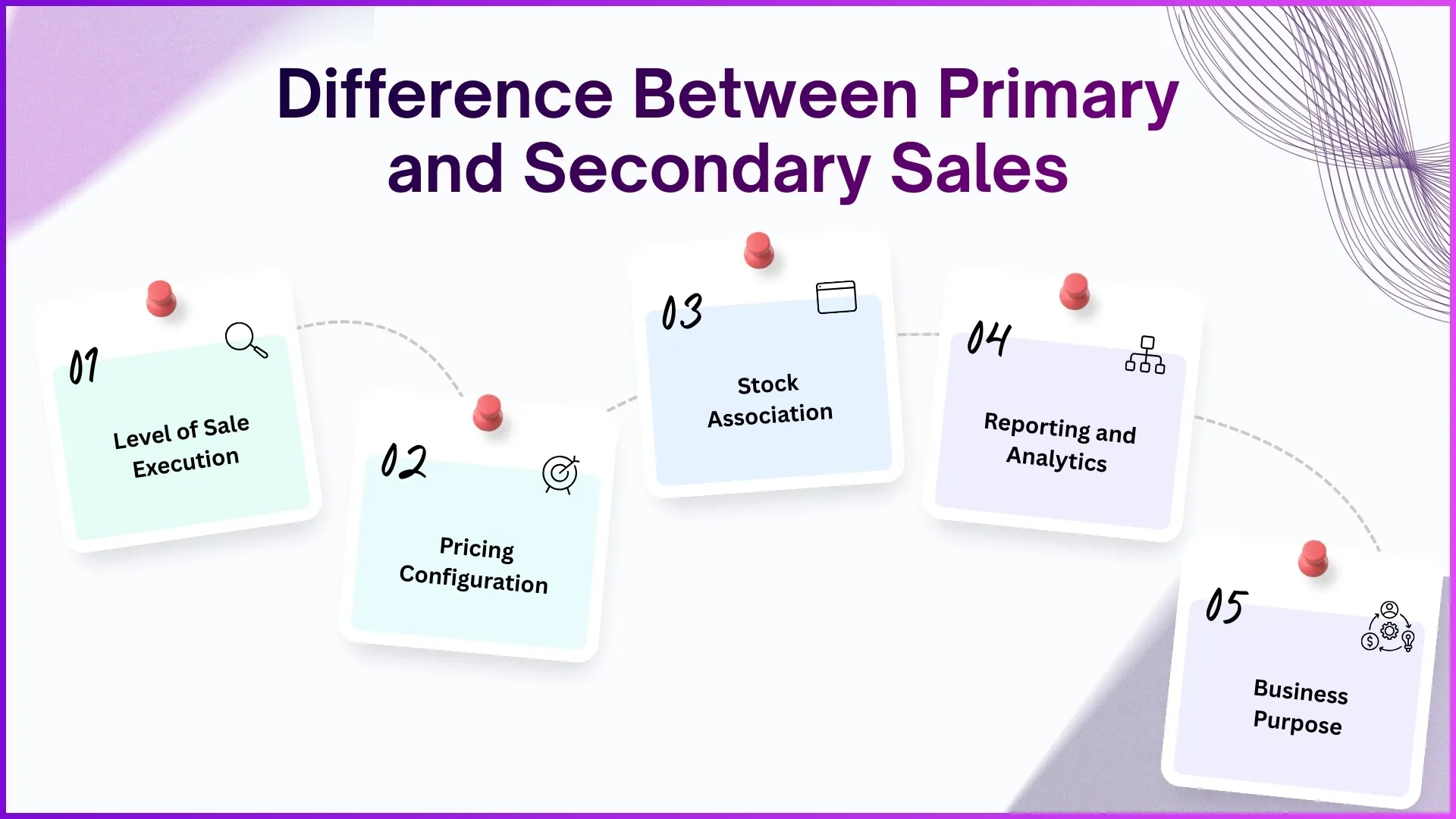
Key Differences Between Primary and Secondary Sales
1. Level of Sale Execution
- Primary Sales happen between the company and distributors.
- Secondary Sales happen between distributors and retail stores.
Example:
Uploading distributor stock reflects Primary Sales.
Generating a store-wise SKU sales report reflects Secondary Sales.
2. Pricing Configuration
- Primary Sales pricing is managed using Primary Sales Price Upload in Price Management.
- Secondary Sales pricing follows store-level and SKU-level sales records.
Example:
Admin uploads primary price for SKUs before stock dispatch.
Retail-level sales automatically reflect secondary values in reports.
3. Stock Association
- Primary Sales increase distributor stock.
- Secondary Sales reduce store or distributor stock based on sales.
Example:
Distributor stock upload increases inventory (Primary).
Sales entry against a store reduces available stock (Secondary).
4. Reporting and Analytics
- Primary Sales are reflected through distributor stock and price records.
- Secondary Sales are tracked using Secondary Sales Reports, MTD Secondary Sales, and SKU-wise sales reports.
Example:
Admin checks distributor stock-in records for Primary Sales tracking.
Sales managers download Secondary Sales reports to analyze store performance.
5. Business Purpose
- Primary Sales ensure product availability in the channel.
- Secondary Sales measure actual market demand and outlet performance.
Example:
Stock dispatch planning is driven by Primary Sales.
Market productivity and sales performance are driven by Secondary Sales.
Why Both Primary and Secondary Sales Matter
Primary and Secondary Sales work together to give a complete sales picture.
- Primary Sales ensure products reach distributors on time.
- Secondary Sales show how products move at the retail level.
- Analytics modules combine both to support better forecasting and planning.
Without Primary Sales, stock flow breaks.
Without Secondary Sales, market performance cannot be measured.
How the System Supports Both Sales Types
The system supports both sales flows using:
- Price Management for Primary Sales pricing
- Distributor and Stock modules for Primary Sales tracking
- Sales, Stock, and Secondary Sales Reports for market-level visibility
This separation ensures accurate reporting, better inventory control, and clear performance tracking.
How 1Channel Helps Manage Primary and Secondary Sales
Unified Control and Visibility
1Channel enables businesses to manage Primary Sales pricing, distributor stock, and Secondary Sales reporting from a single platform.
Accurate Reporting
With dedicated reports for Secondary Sales and structured stock handling for Primary Sales, businesses get clear, reliable data for decision-making.
Flexible Configuration
Price uploads, stock updates, and sales tracking can be customized based on business needs, ensuring smooth coordination across the entire sales chain.
Manage Distribution and Sales with Complete Visibility
1Channel helps you track Primary Sales from company to distributors and Secondary Sales from distributors to retailers—all in one unified platform with powerful reporting and stock management capabilities.
Explore Distributor Management Software →FAQs
What is the main difference between Primary and Secondary Sales?
Primary Sales occur between the company and distributors, while Secondary Sales occur between distributors and retailers.
Are Primary and Secondary Sales tracked differently in reports?
Yes. Primary Sales are reflected through stock and pricing records, while Secondary Sales appear in store-wise and SKU-wise sales reports.
Why is Secondary Sales important for analytics?
Secondary Sales show real market movement and help evaluate store performance, product demand, and sales productivity.
Can pricing differ between Primary and Secondary Sales?
Yes. Primary pricing is uploaded separately, while Secondary Sales values are derived from actual market transactions.