The Buying Chain That Starts at a Village Shed
Almost every distribution story on this site starts with a warehouse and ends at a shop counter. Cocoa runs the other way. The chain begins with a farmer carrying dried beans to a shed in a farming community, and it ends at a port. Nothing about it resembles a route to market for soap or soft drinks, and any operating team that tries to manage it with a standard retail playbook will find the playbook has no word for most of what happens on the ground.
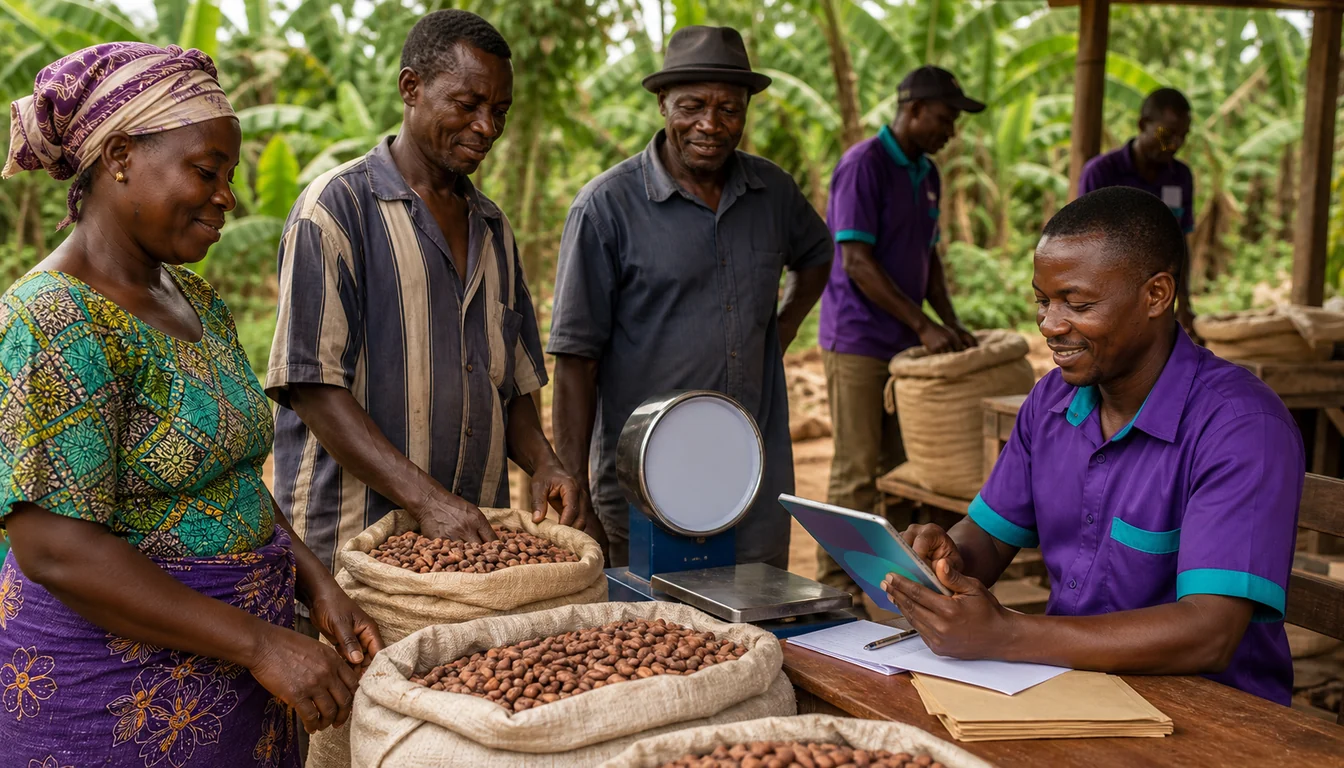
The structure is specific and it is worth stating plainly. COCOBOD regulates the sector. Licensed Buying Companies, universally shortened to LBCs, hold the licences that permit them to buy beans from farmers. Each LBC appoints purchasing clerks, who sit at village societies and buying sheds across the growing districts and do the actual buying: receiving the farmer's beans, weighing them, checking quality, paying, and issuing the record of the transaction. From the society the beans move up to the LBC's district depots, then on to takeover points where quality checks and formal handover happen, and from there to Tema and Takoradi for export.
Read that as an operating model rather than a policy summary and one thing stands out. An LBC is a company whose entire commercial performance is produced by a large, dispersed field force working in places where supervision is expensive, network coverage is uneven, and the person handling the money is also the person keeping the record. That is a field operations problem, and it is the one this article is about.
Why the Purchasing Clerk Is the Hardest Field Role to Support
A sales representative visiting provision shops has a simple loop: arrive, take an order, leave. A purchasing clerk does something considerably heavier at every single transaction, often several times an hour during the peak of the season, standing at a shed with a queue of farmers in front of them.
Weighing and grading happen before the system sees anything
The clerk weighs what the farmer brings, assesses it against the quality standards the sector runs on, and only then agrees what is being bought. Moisture, foreign matter and bean condition all sit in that judgement, and the judgement is made at the shed by one person, usually without a supervisor present. If the weight and the grading assessment are written on a pad and typed into a spreadsheet three days later at a district office, the company has no way of telling a good clerk from a careless one, and no way of investigating a dispute except by asking the two people who were standing there.
Capturing weight, grade assessment and sack count at the moment of purchase, on a device in the clerk's hand, changes the nature of every downstream conversation. It also makes the physical unit traceable: sacks recorded against a society, against a clerk, against a date, can be followed up the chain instead of dissolving into a district total.
Money and records move at the same moment
The clerk is also holding funds. Payment to the farmer happens at the point of purchase, whether that is in cash or through a mobile money transfer, and mobile money in Ghana is genuinely usable for this because the wallets and bank accounts settle across each other through GhIPSS rather than sitting in separate silos. What the clerk cannot do is separate the two acts. The purchase record and the payment record are the same event, and if the system captures one without the other, reconciliation becomes an exercise in reconstructing what somebody remembers.
Clerk-level accountability is therefore not a management nicety. It is the control that tells an LBC whether its funds in the field are matched by beans in its depots, before the discrepancy has had a season to grow.
Two Live Changes That Raise the Bar on Records
Two developments in the sector make this more pressing than it was a few seasons ago, and both push in the same direction: towards a record that is created where the transaction happens rather than assembled afterwards.
The first is COCOBOD's ban on LBCs buying cocoa from farmers on credit, backed by the prospect of licence revocation. Whatever view one takes of the practice, the operational consequence is unambiguous. Buying and paying have to be one event, evidenced as one event. A company that can show, transaction by transaction, that beans were received and the farmer was paid at the same time, has an answer ready. A company whose evidence is a pile of pads and a monthly summary does not.
The second is the Ghana Cocoa Board Bill, 2026, passed by Parliament to reform how the sector is governed and funded, with a new financing model expected to apply from the 2026/27 crop year. It would be unwise to speculate about what that means commercially, and this article will not. The operational point is narrower and safe to make: the way buying is funded and settled is changing, and an LBC whose field records live in a system it controls can adapt its treasury and settlement processes around those records. An LBC whose field records live in paper books has to rebuild the whole practice each time the rules move.
Capture That Survives Thin Network Coverage
Cocoa is bought in farming districts, and farming districts are exactly where mobile coverage stops being dependable. The southern urban belt is well served, but signal thins on rural agricultural routes and across the more sparsely covered regions, and 5G remains nascent outside a few urban pockets. A clerk at a shed down a farm track cannot wait for a connection to complete a purchase while a farmer waits with a load of beans.
This is why offline capture is not a feature footnote for cocoa operations, it is the precondition for using software at all. Every purchase, weight, grade assessment and payment reference has to be recorded on the device, timestamped and geo-tagged where the transaction actually happened, and queued for upload whenever the device next finds signal, whether that is at the district depot in the evening or on the road out. We have written about the wider version of this problem in offline-capable field sales for Ghana's rural routes, and cocoa is its most demanding case, because the data being captured is money and physical stock rather than an order that can be re-taken tomorrow.
The same constraint shapes supervision. District officers covering scattered societies need their visit plans, society lists and checklists resident on the device before they leave the depot, which is a straightforward requirement for field activity management but an impossible one for anything that assumes a live connection.
Society and Depot Records an Auditor Can Follow
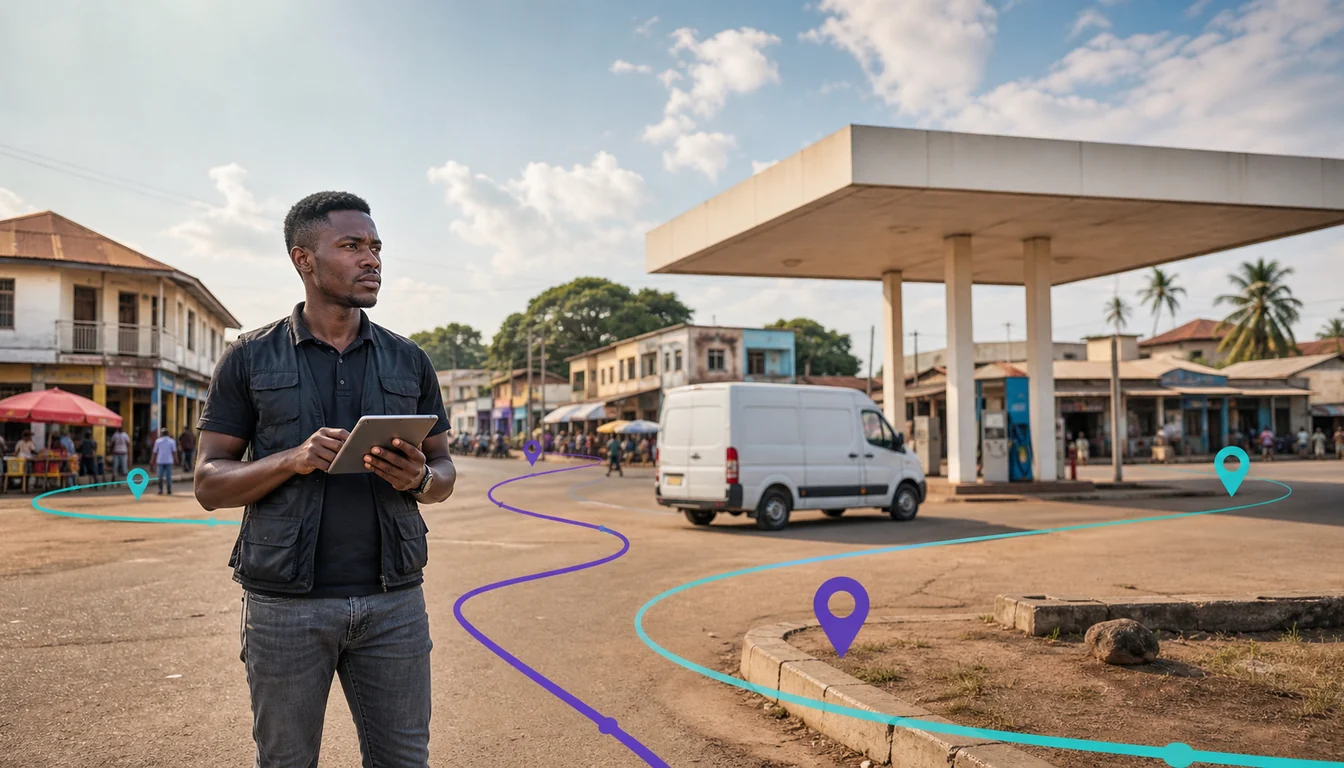
Ask an LBC for a definitive list of its buying points and the answer is often several lists that disagree. Societies open and close, sheds move, clerks are reassigned, and the master list is maintained by whoever last had a reason to update it. GhanaPostGPS gives the country an official digital addressing standard, but in farming districts navigation is still done by landmark and local knowledge, so a written address is rarely enough to find a shed twice.
A geo-tagged master fixes this without arguing with how people actually navigate. Each society and depot is captured once at its real coordinates, with the clerk assigned to it, and every subsequent purchase, visit and evacuation attaches to that record. Supervisors can then plan district rounds that reflect the real map rather than an idealised one, which is the same discipline that makes route planning work for any dispersed field operation and the same coverage economics we set out in territory and coverage planning across Ghana's 16 regions.
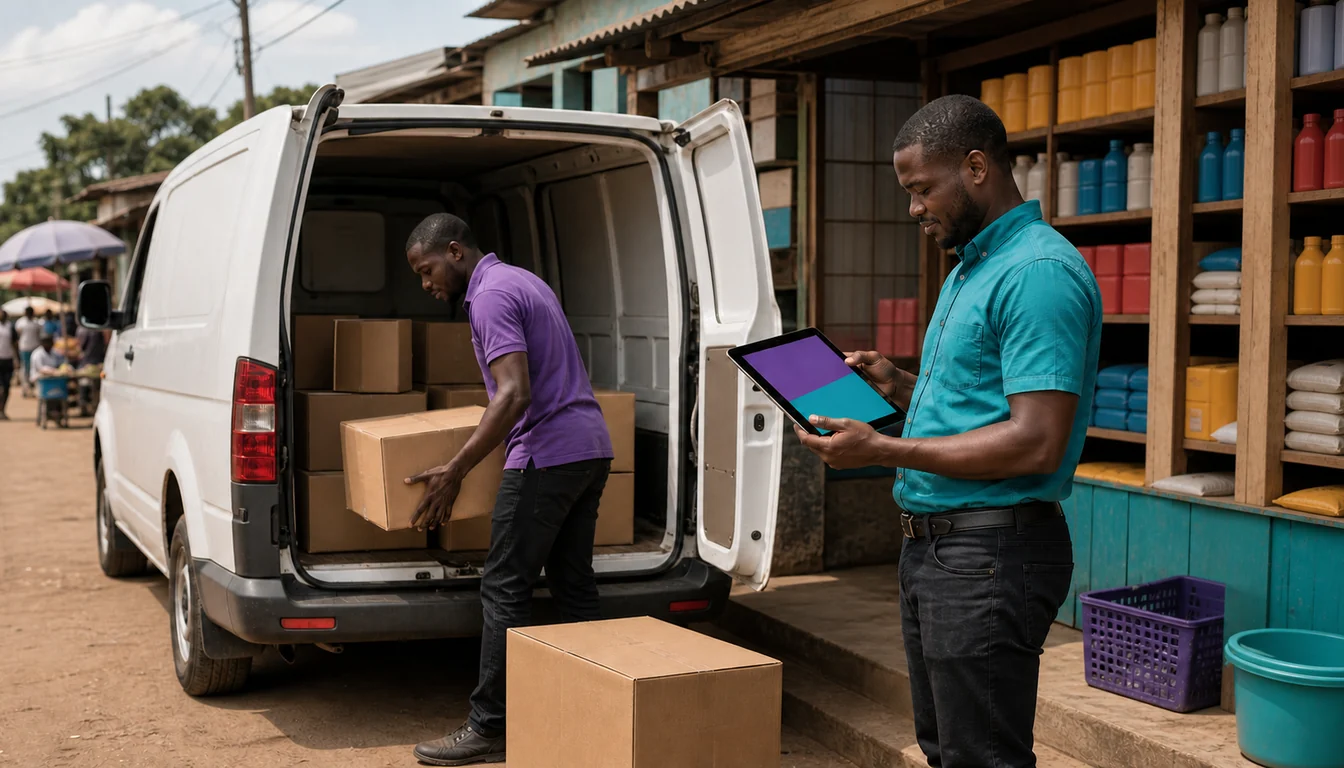
Upstream of the shed, the depot is where the beans become inventory, and where the operating questions turn familiar: what arrived, from which society and clerk, how many sacks, in what condition, and what has since moved to a takeover point. Treating a district depot with the same rigour as a distributor warehouse, with recorded receipts, stock positions and dispatches, is what turns a chain of handovers into a traceable stock record. It also means the handover at the takeover point is the confirmation of a documented movement rather than the first time anyone counted.
Planning the Main Crop, the Light Crop and Harmattan
Cocoa buying is intensely seasonal, and the shape of the season drives every staffing and funding decision an LBC makes. The main crop opens from around October and carries the bulk of the buying effort, with the light crop arriving mid-year at a different rhythm and a different volume profile. Field capacity has to be built up ahead of the main crop and stood down afterwards, which means clerk onboarding, society assignments and depot readiness are calendar-driven activities, not continuous ones.
Weather sits on top of that. Harmattan from December, at its harshest on northern routes but felt across the country, changes road conditions and drying behaviour during precisely the period when evacuation volumes are heaviest. Planning around it needs last season's actual movement data at society level, which is only available if last season's movements were recorded at society level in the first place. This is the quiet compounding benefit of field capture: the first season produces control, and every season after that produces a plan.
The same seasonal logic applies across the wider agriculture and agro-inputs operations that many of these companies run alongside their buying business, where inputs flow out to the same communities the beans come from.
How 1Channel Helps Cocoa Buying Field Operations
1Channel is a field force and distribution platform, and cocoa buying is a field force problem wearing unusual clothes. The platform is configured around the roles that exist in the chain, the purchasing clerk at the society, the district officer covering a cluster of sheds, and the depot keeper receiving evacuations, rather than being bent out of a retail sales template.
Because it was built for markets where connectivity is uneven and the money is often physical, the mechanics needed here are the ones it already runs on: capture first, sync later, and reconcile against a single record.
- Offline-capable capture at the buying point. Purchases, weights, grade assessments, sack counts and payment references are recorded on the device and queued for upload, so a shed with no signal is still a shed with a complete record.
- Geo-tagged society and depot masters. Every buying point is fixed at its real coordinates with its assigned clerk, so district rounds and evacuation planning work from the map that exists rather than an address that cannot be found.
- Clerk-level accountability. Purchases, funds issued and settlements are attributed to a named clerk and society, giving supervisors a daily position instead of a monthly reconstruction.
- Collections across mobile money and cash. Payments made through MTN MoMo, Telecel Cash or AT Money and payments made in cash post to the same ledger in GHS, which is what makes reconciliation a check rather than an investigation.
- Stock and sack traceability to the takeover point. Receipts at the district depot, stock on hand and dispatches upward are recorded as linked movements, so what left a society can be matched to what reached the handover.
- Records aligned to the compliance load. Transaction-level evidence supports the sector's requirement that buying and payment happen together, and the platform's invoicing records align with the GRA's E-VAT regime on the corporate side of the business.
1Channel makes no claim to be certified or approved by COCOBOD, the GRA or any other body, and holds no cocoa licences. It supports the records an LBC has to keep.
Bring Your Buying Network Into One Record
See how 1Channel's field activity management gives every clerk, society and depot an auditable trail that holds up from the shed to the takeover point.
Explore Field Activity Management →Key Takeaways
Cocoa's buying chain is unlike anything else in Ghanaian distribution, and the operating problems it creates are field problems before they are anything else.
- The chain is a field force, not a warehouse. COCOBOD regulates, LBCs hold the licences, and purchasing clerks do the buying at village societies and sheds before beans move up to depots, takeover points and the ports.
- The clerk holds the weight, the grade and the money. Capturing all three at the moment of purchase is the only way to attribute performance, settle disputes and know the field position before the season closes.
- Offline capture is a precondition, not a feature. Buying happens where rural coverage thins, so records have to be created on the device and synced later, geo-tagged to where the transaction actually took place.
- The rules are moving towards evidence. The ban on buying from farmers on credit and the reform of sector governance and funding both reward companies whose transaction records are created in the field rather than assembled afterwards.
- Traceability has to survive the handover. Sacks recorded against a society, a clerk and a date can be followed to the takeover point, which is where a chain of separate counts becomes one continuous record.
- Seasonality is planned from history. The main crop from around October, the light crop mid-year and harmattan from December are all predictable, but only a company with last season's society-level data can plan against them.
An LBC that digitises its buying points is not chasing a technology upgrade. It is making the one part of its business that generates all the value, the clerk at the shed, visible to the people responsible for it.