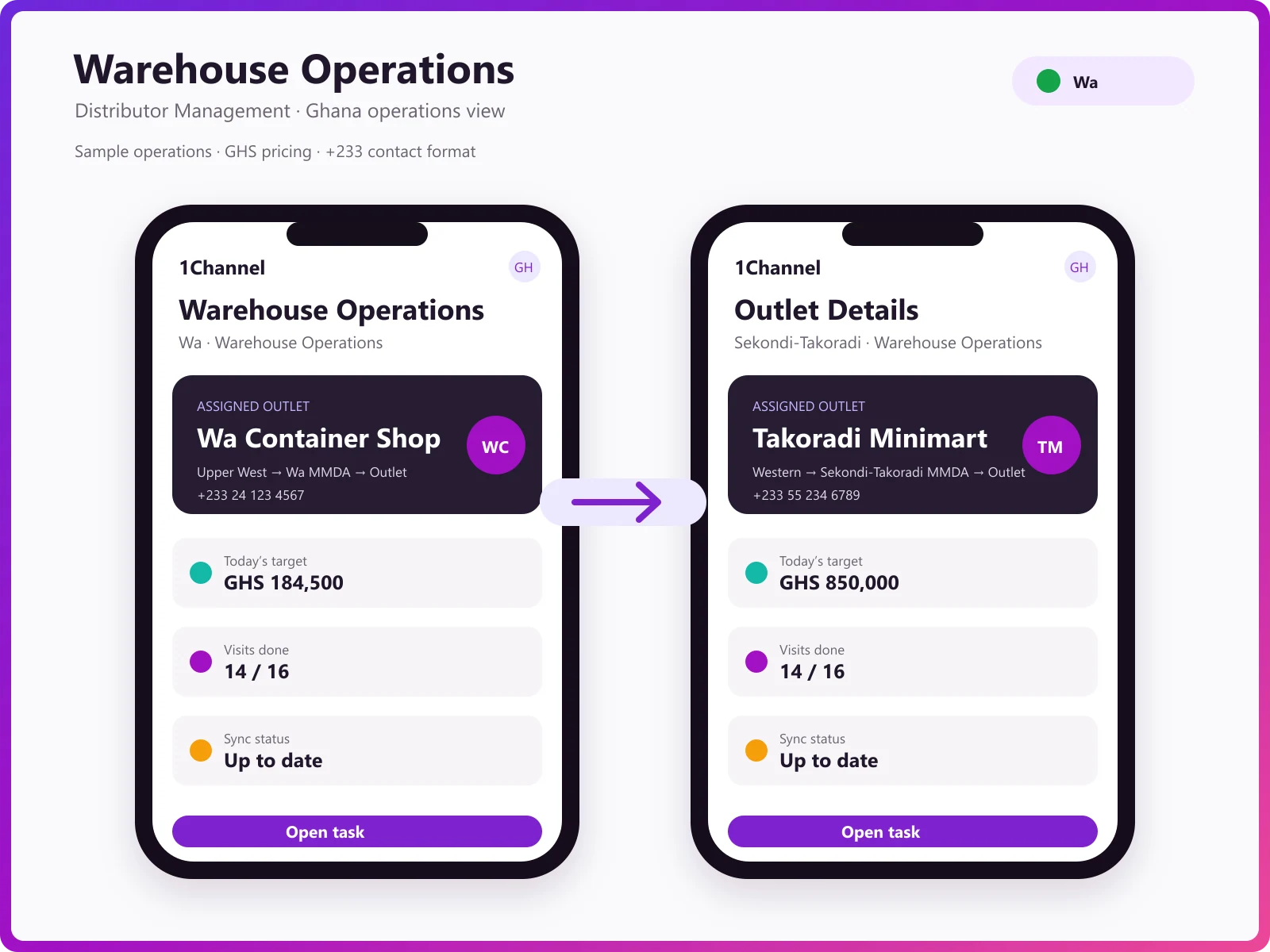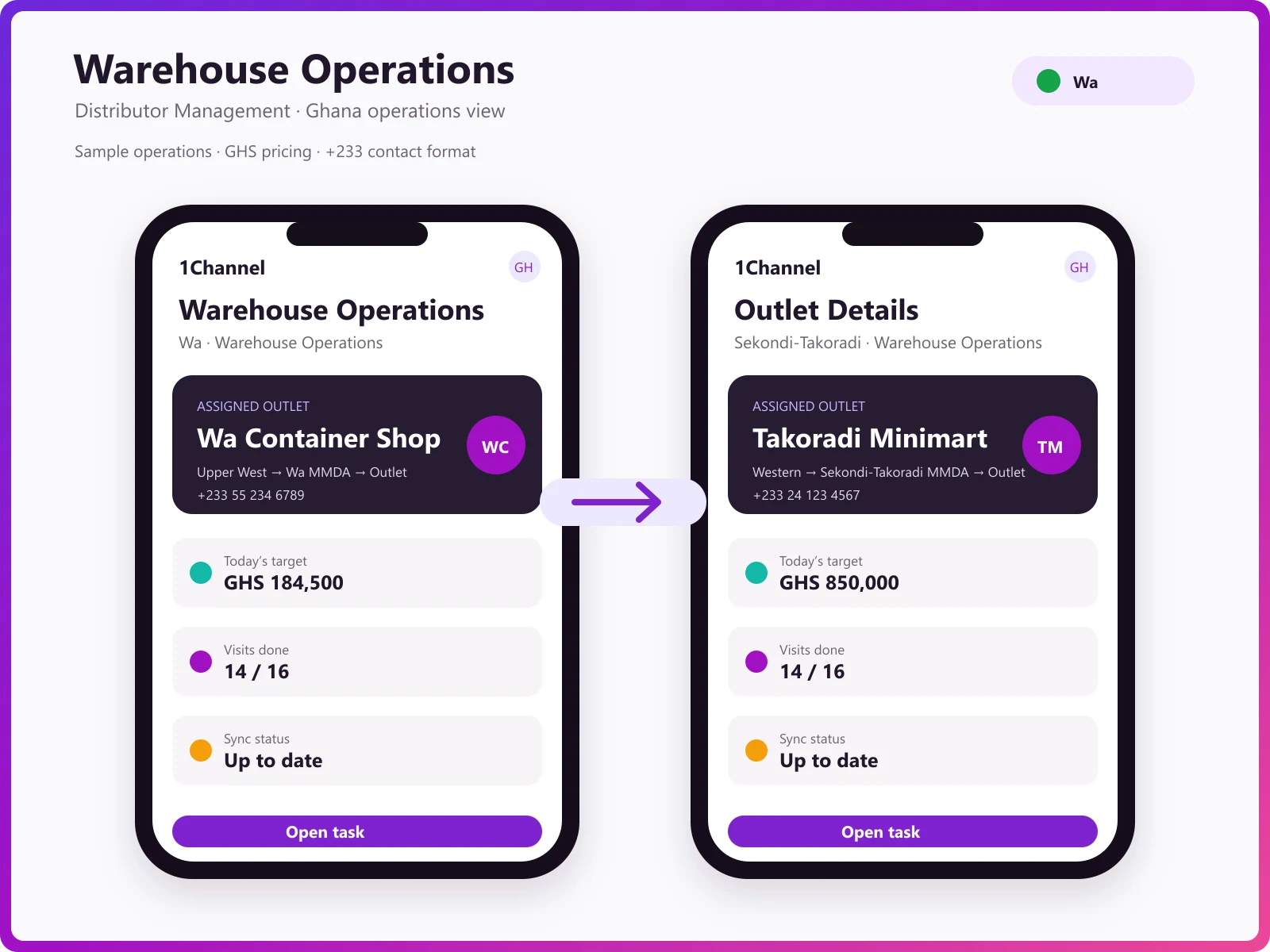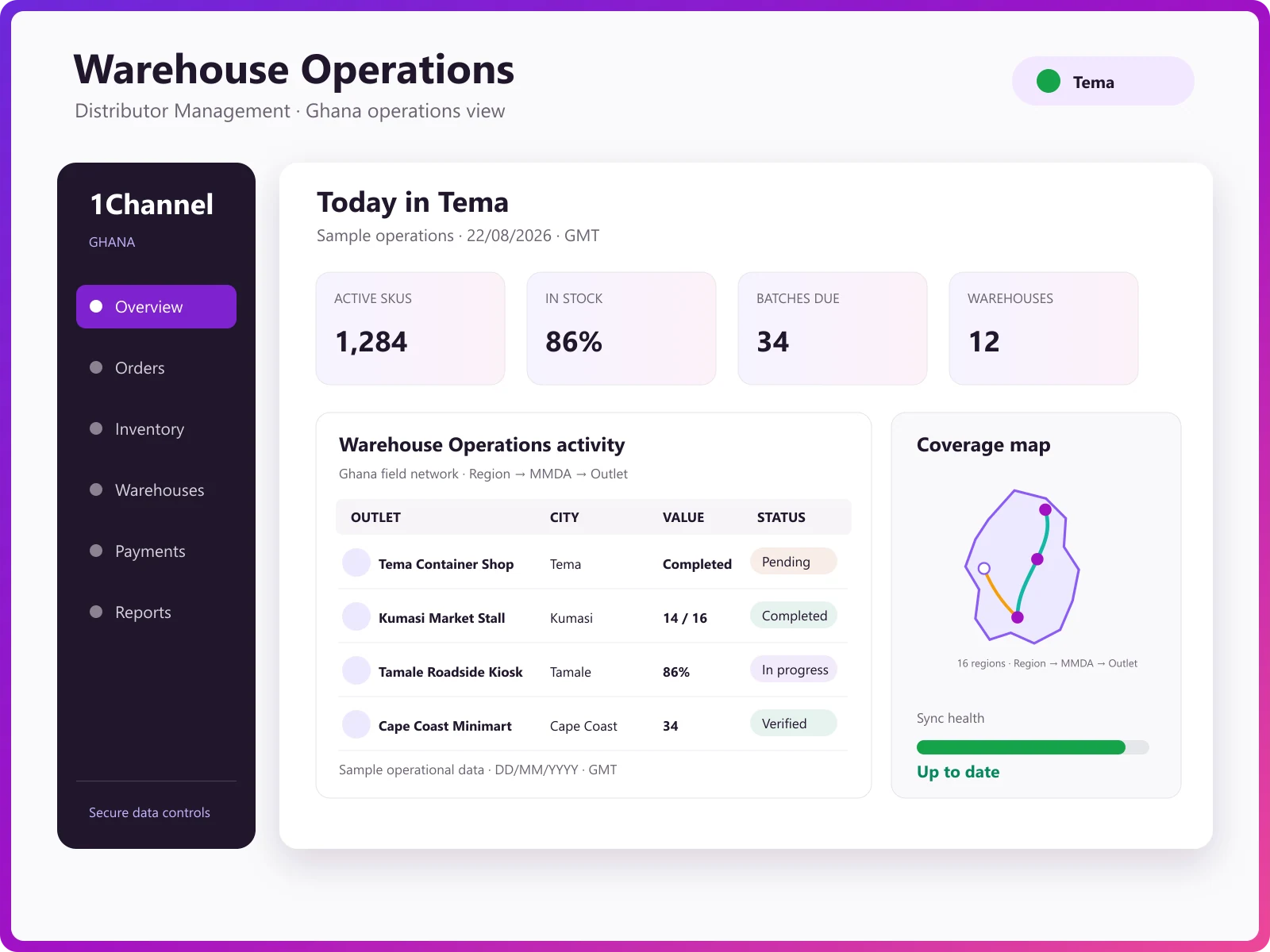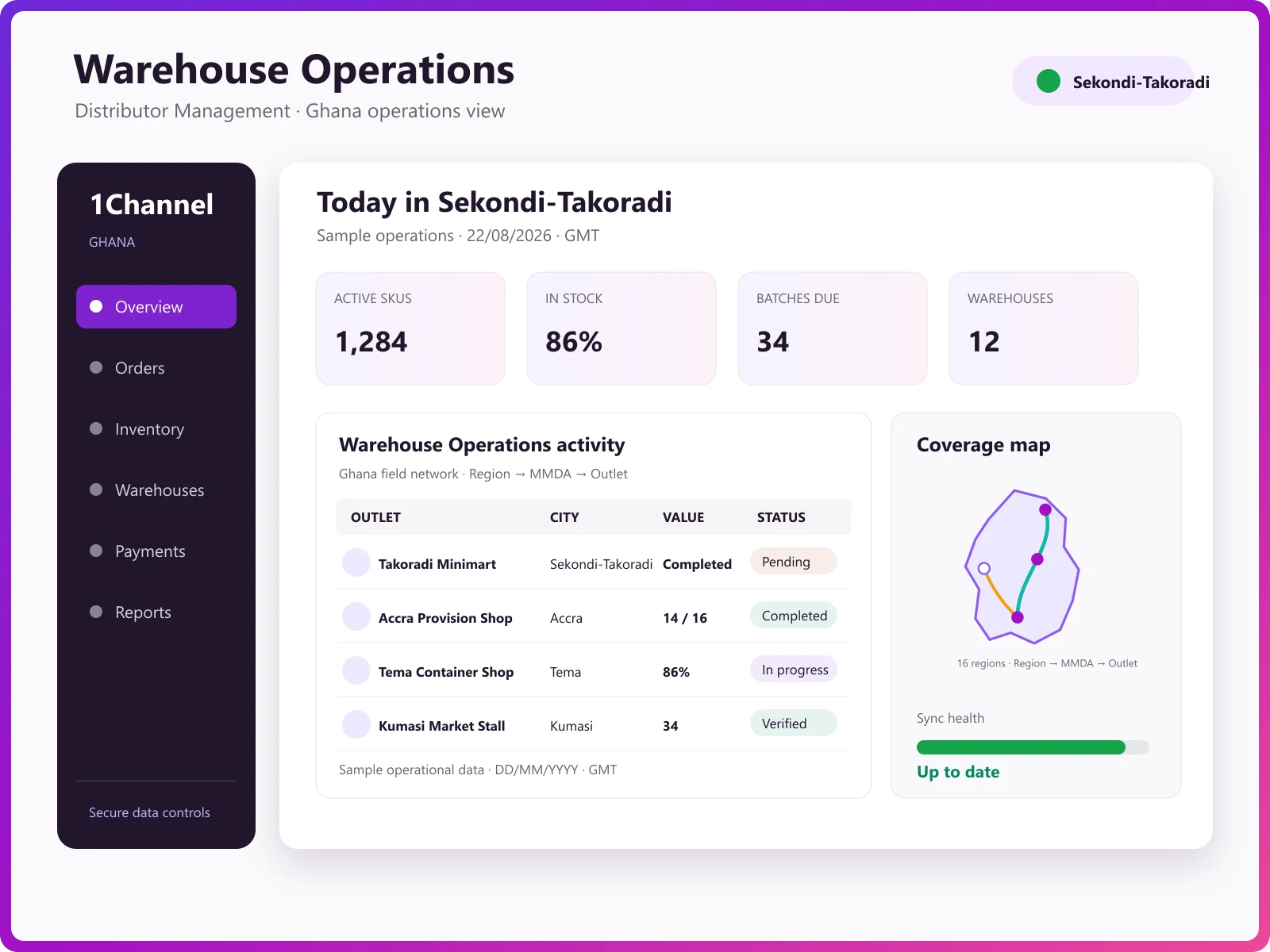
The wider DMS set that surrounds the warehouse: ordering, pricing, schemes, claims, territory and reporting, every module reading the same Ghanaian stock position
Retailer orders, approvals, inventory allocation, delivery notes, and secondary sales
Track sellable stock, warehouse inventory, transit stock, and automate replenishment
Batch-level tracking, FEFO/FIFO/LIFO allocation, expiry monitoring, and stock rotation
Value-based, volume-based, and free goods schemes with auto-application
Customer-specific, geography-based pricing with validity dates and auto-application
Product catalogue with Brand, Category, Product, SKU hierarchy and UOM conversions
Configurable geography hierarchy, beat planning, outlet mapping, and user assignment
No-code workflows with conditions, triggers, notifications, and multi-level approvals
24+ default reports, real-time dashboards, sales trends, and Excel export
Outstanding tracking, credit limits, invoice payment allocation, and credit notes
Multi-level returns, damage claims, credit note generation, and GRN discrepancy
Goods receipt notes, ordered vs received validation, and batch tracking
B2B ordering platform for distributors with self-service ordering and payments
Order booking app with GPS attendance, market visits, beat execution, and AI assistant
Conversational AI assistant, auto order validation, intelligent FIFO/FEFO, and automation
Set-up happens once in the admin portal: the warehouses, who owns the stock in each, the picking rule, the cycle-count schedule and who is allowed to approve what. From then on the work sits on the app. A storekeeper receives against the purchase order and records the batch, a supervisor raises a transfer to a depot that is running short, and the pick list resolves itself by expiry date. Head office no longer waits for a reconciliation call to see live quantities, transit float and GHS value by location.


Practical guides for selling and distributing across the Ghanaian market.
Our recognitions constantly motivate us to push the envelope of excellence and empower our customers with winning ideas each day.
Each depot keeps its own ledger, its own named owner and its own GHS valuation, while head office reads one consolidated position over the whole network.
Features
Why It Matters
A variance can only be investigated once the stock behind it belongs to somebody, which is why attribution comes first.
Shift stock from an Accra or Tema mother warehouse out to Kumasi, Takoradi or Tamale without losing sight of what is currently on the road.
Features
Why It Matters
Goods on the road belong to neither end until they are confirmed, and that is exactly where double-counting used to begin.
Receive against the purchase order, record batch and expiry as the pallet lands, and raise the short-supply flag before the driver pulls away.
Features
Why It Matters
Capturing the batch at receipt is what makes a later variance investigable at all, and a mis-keyed receipt is one of the quieter sources of loss.
Send the earliest expiry first for medicines and short-life food, or first-in-first-out for general lines, then issue the delivery note and invoice from the same action.
Features
Why It Matters
Expiry write-offs are a loss channel in their own right, and the cheapest way to shrink them is to stop leaving batch choice to the picker.
Count a slice of the racks on a schedule instead of closing the depot once a year, and read what the count did to GHS value by location.
Features
Why It Matters
Picking errors, unrecorded returns, damages, mis-keyed receipts and expiry write-offs each leave a different trace, and a rolling count finds them while the cause is still recoverable.
At 1Channel, we celebrate every step of our new customers journey, market of geography, or higher customer satisfaction score to become the preferred Field Sales CRM leader.