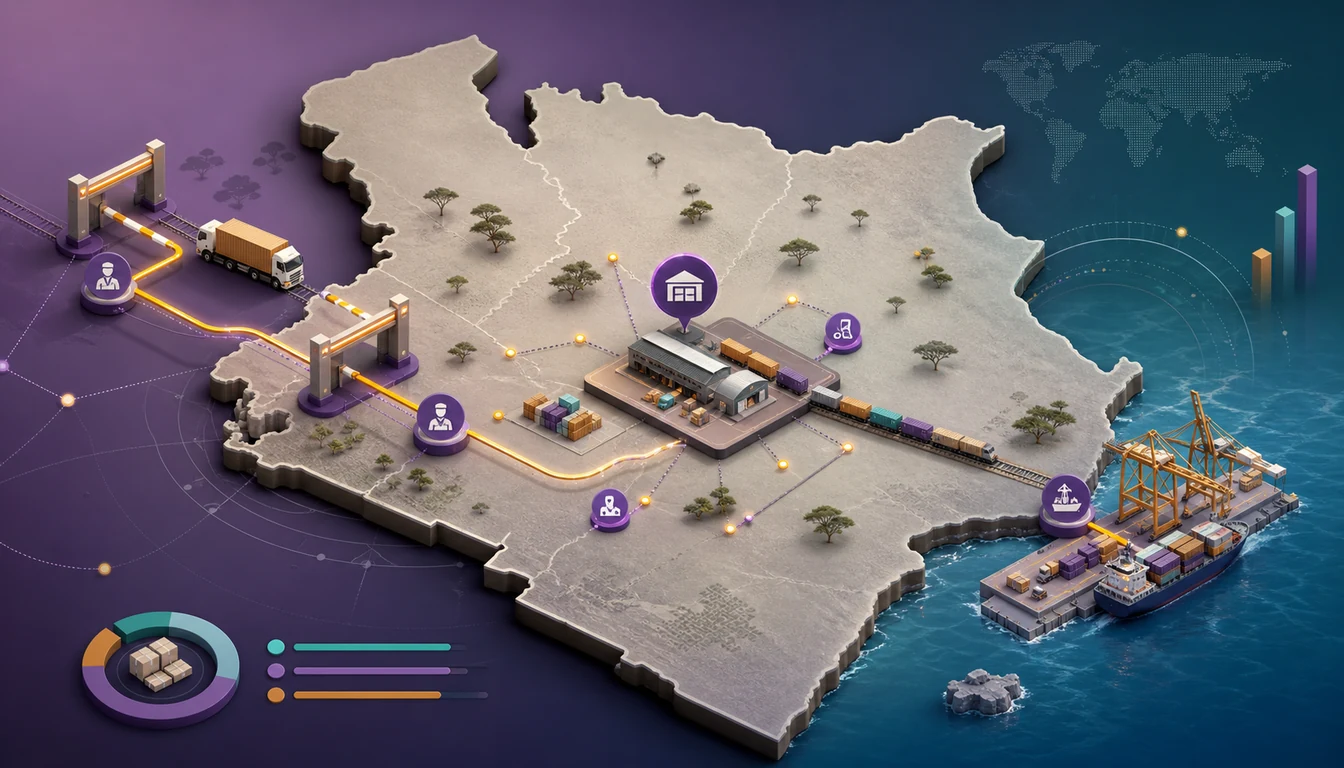
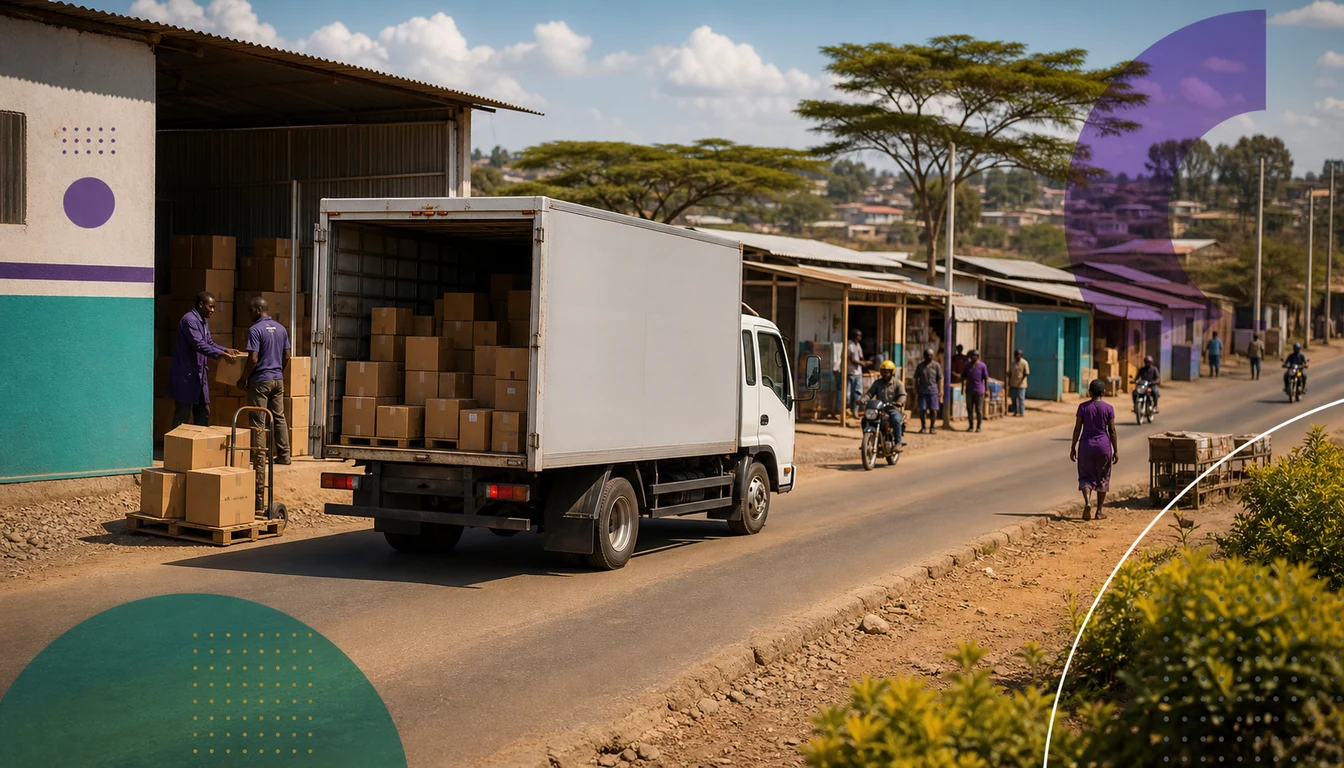
A carton leaves a distributor depot on the edge of Nairobi shortly after five in the morning. By early afternoon its contents sit on the counters of dozens of separate shops, most of them smaller than the vehicle that delivered them. Almost none of those shops bought a full carton.
That journey — depot to duka — is Kenyan fast-moving consumer goods distribution compressed into a single morning. Everything commercial happens inside it: how stock is financed, who carries the risk, and how many outlets a crew can genuinely serve before call quality collapses.
This piece walks that route end to end — the distributor tier, the wholesaler layer beside it, van sales versus pre-sales, what a route costs to run, coverage against depth, and why the Kenyan last mile is built on small, frequent, cash-first purchases rather than large planned ones.
The Shape Of Kenyan Retail
Start with the outlets, because everything upstream is shaped by them. The large majority of retail outlets in Kenya are independently owned and physically small: the duka on a residential lane, the kiosk at a matatu stage, a roadside stall, a stall inside an open-air market, an agrovet on the edge of town, a mini-mart on a busy junction. Most retail volume moves through this base, not around it.
In Nairobi especially, the informal shop is how the ordinary household buys nearly everything it consumes in a week. That is not a segment to be converted later. It is the market. Any route-to-market design treating it as the overflow channel after modern trade has been served will underperform, because the volume is not where the plan assumes it is.
Modern trade matters — chains such as Naivas, Quickmart and Carrefour are where launches get visibility and where shelf standards can be enforced — but it is the secondary motion. It sets perception; the informal base sets tonnage. So Kenyan distribution is a high-frequency, low-ticket business: not a few hundred large orders, but a great many small ones, repeated constantly.
The Distributor Tier
The distributor is the pivot of the system. They take title to stock from the manufacturer, hold it in a depot, finance it, and push it across an assigned territory using their own vehicles and people. They carry the working capital, the storage cost, the damage risk and, increasingly, the credit risk on the outlets they serve.
A depot in Nakuru or Thika is a working building rather than a logistics park: goods receiving at one end, a picking face in the middle, and a loading area that must clear several vehicles before the traffic builds.
That margin is thin by design. The business earns on throughput, not mark-up, which has two consequences. Anything that slows rotation — a badly chosen range, an over-ordered promotion, an idle vehicle — costs more than it appears to. And the manufacturer's view of the market is only as good as the secondary sales data the distributor sends back. Primary dispatch tells you what left the factory; it says nothing about what reached a shelf.
Where The Wholesaler Fits
Between the distributor and the small outlet sits a layer most route plans would prefer did not exist: the wholesaler. Wholesalers cluster around the open-air markets and trading streets of Nairobi, Kisumu, Eldoret and Mombasa, buying in bulk and breaking bulk for whoever walks in.
Duka and kiosk owners use them constantly, for good reasons. A shopkeeper who runs out on a Saturday cannot wait for Tuesday's van, and a wholesaler is open, close by and will sell any quantity asked for. Many combine the trip with other errands, which makes self-collection cheaper than it looks on paper.
The awkward part is that the wholesaler is at once customer and competitor. Volume sold to one leaves the distributor's line of sight, and may resurface in an adjacent territory at a price that undercuts the route, absorbing a trade promotion meant for retail rather than arbitrage. You cannot design this layer away. Plan around it — know which outlet clusters are genuinely wholesaler-served, and put route effort where a van call offers something a wholesaler cannot.
Van Sales Versus Pre-Sales
There are two basic ways to serve the last mile, and Kenyan distributors commonly run both.
Van sales puts stock on the vehicle. The crew arrives, sells, delivers and collects in one call, which suits dense informal routes where the ticket is small and payment immediate. Its limits are physical: a van holds a restricted range, day-end stock reconciliation is real work, and every unsold unit has been carried around all day at the distributor's cost.
Pre-sales separates the order from the delivery. A representative walks the route selling from the full catalogue, and a delivery vehicle follows the next day. It supports a wider range, larger outlets and credit accounts, and makes the sales call about selling rather than counting stock. It also fails loudly: if deliveries slip, the shopkeeper stops believing the order and buys from a wholesaler instead.
What decides the split is usually the route itself:
- Outlet density and drop size — tightly packed small outlets favour van sales; spread-out larger outlets favour pre-sales.
- Range width — a broad catalogue cannot be carried, so it has to be sold from a list.
- Payment behaviour — immediate cash and mobile money suit van sales; account terms suit pre-sales.
- Delivery reliability — pre-sales only works where the follow-up vehicle genuinely turns up.
- Terrain and travel time — long rural legs make a second trip expensive.
Route Economics: What A Day Costs
A route is an economic unit and deserves to be treated as one. The cost side is fixed and stubborn — fuel, the crew, the vehicle and its maintenance, depot handling, damages and returns — and it is incurred whether or not the calls convert. Returns in particular get absorbed as an irritation rather than priced into the route.
The revenue side is four numbers that multiply together: calls made in a day, the share of calls producing an order, lines on each order, and value per line. Weakness in one cannot be fixed by strength in another. A crew making many calls but selling one line at each is running an expensive delivery service, not a sales route.
The most common mistake is adding outlets to a route without adding time. The crew simply shortens each call to fit. Order quality falls, the shopkeeper is never asked about the lines they are missing, and the route covers more outlets while selling less. Coverage rose; the route got worse.
Coverage Versus Depth
Coverage is how many outlets you reach. Depth is how much of your range each stocks, and how consistently. They are different objectives, and pursuing one hard usually damages the other.
The useful distinction is between three outlet counts: the universe that exists in a territory, the outlets that bought anything in a period, and the outlets that bought the core lines repeatedly. The third predicts next quarter; the first two flatter presentations.
Depth is built on a must-stock list defined per outlet class, not per territory. A kiosk at a stage, a duka on a residential street, an agrovet and a mini-mart on a main road are different businesses with different shoppers and shelf space. Asking all four to carry the same range guarantees dead stock in some and gaps in the rest.
Consistent availability of a small core range beats breadth almost every time here. A shopkeeper let down twice on a line stops asking for it, and a shelf position lost to something else costs far more to win back than it would have cost to hold.
Cash, M-Pesa And Credit At The Duka Door
Money at the last mile moves in small amounts and moves fast. M-Pesa is the default rail rather than an alternative to one — payment to a till or paybill number is simply how a transaction is completed, alongside cash and, for larger accounts, bank transfer or Pesalink.
That default creates its own administrative work. Route collections arrive as a stream of mobile money receipts that must be matched back to specific invoices. References get mistyped, part payments arrive against a full invoice, one payment covers two, and money sent from a family member's handset carries no outlet name. Reconciliation is a daily task with real cash consequences, not a formality.
Van crews also carry float, which has to be issued, tracked, banked and accounted for against the day's sales and returns. Where credit is extended, exposure often lives in informal ledgers rather than as a limit enforced when the order is taken. Credit limits set in KSh per outlet, visible before the order is confirmed, are one of the quiet differences between a route that ages cleanly and one that does not.
A Morning On A Nakuru Route
Take a route running out of a depot on the Nakuru side of the A104. Loading starts before first light so the crew reaches the first cluster of outlets before the town properly wakes, to a plan built the previous evening from the last cycle's orders.
The first calls are the dukas on the residential streets near the market. The shopkeeper is already open and sweeping, and knows exactly what sold over the weekend without consulting anything written down. She orders in units, not cartons — enough to fill the visible gaps on two shelves and no more, because her cash is working hard and her storage is a cupboard behind the counter. She pays to a till before the order is finished.
By mid-morning the route is into the kiosks near the stage, where footfall is heavier and the basket smaller: single-serve packs bought and consumed within the hour. Then the roadside stalls out towards Naivasha, spaced further apart, where travel time starts to eat the day. One outlet is closed with no explanation. Another wants a line the van is not carrying, and the crew records a lost sale rather than promising what they cannot deliver.
Two things about that morning are structural rather than incidental. It is market day in a nearby trading centre, which pulls shoppers between outlets, so the crew adjusts the sequence. And at one point the mobile signal thins enough that anything depending on a live connection would simply have stopped — which is why order capture in Kenya has to survive without one and synchronise later.
Invoices, eTIMS And The Paper The Route Carries
The document handed over at the door is no longer just a delivery note. The Kenya Revenue Authority has required electronic tax invoices through eTIMS since January 2024, and the requirement reaches businesses broadly, including traders and distributors not registered for VAT. This is in force, not on a roadmap.
What changed more recently matters even more. KRA now validates income and expenses declared in income-tax returns against eTIMS data, and an expense unsupported by a valid eTIMS invoice is not deductible. That makes invoicing a commercial issue rather than a back-office one: a business buying from you needs a valid invoice for its own return, so a hand-written receipt from a van crew creates a problem for the buyer as much as the seller.
Penalties for non-compliance are material, and the rules are administered by KRA rather than settled once and for good — take current advice from a tax adviser or from KRA directly. The operational point is simpler: if invoices are raised on a route, the process must work offline, produce a document the customer can actually use, and reconcile with what the depot dispatched.
Where These Programmes Go Wrong
Most route-to-market programmes in Kenya do not fail on strategy. They fail on a handful of recurring, avoidable errors.
- Designing for modern trade and bolting on the informal base. A process built around chain planograms and scheduled deliveries does not survive contact with a duka that orders in units and pays before the paperwork is finished.
- Measuring activity instead of outcomes. Visit counts and time on route are easy to collect and tell you little. Lines per order and repeat purchase of core lines are harder and worth far more.
- Assuming a live connection. Rural coverage is patchy and power interruption is a genuine factor — Kenya experienced a nationwide outage in 2026 and electricity costs remain high. Anything requiring connectivity at the moment of sale will fail on the routes that need it most.
- Pretending the wholesaler is not there. Territory volume that leaks through wholesale and reappears at an undercut price distorts every coverage number you report until you account for it.
- Ignoring language. Field teams work in English and Kiswahili, and often in a third community language with the shopkeeper. A system or training module that exists in only one of those will be half-used.
- Starting without a clean outlet master. Duplicate records, outlets closed months ago and outlets with no usable location make route planning guesswork, and no software fixes a bad list.
How 1Channel Supports FMCG Distribution In Kenya
1Channel builds field sales and distribution software for exactly this shape of route-to-market: many small outlets, high call frequency, mixed van sales and pre-sales, and a field force working away from a desk.
On the route, that means order capture and invoicing at the point of sale, van stock and load management with day-end reconciliation, route and beat planning with journey adherence, retail execution checks covering availability and merchandising, and an offline-first design so a call completes and synchronises later rather than stalling when signal or power drops.
Behind the route, it means distributor management — secondary sales visibility, stock and claims, scheme and promotion tracking across a territory — plus collections matched against invoices with per-outlet credit limits held in KSh, and multilingual capability so the same content reaches a bilingual field team. Invoicing is designed to support the electronic tax invoice obligations Kenyan businesses operate under; 1Channel holds no certification and issues none, and any compliance position should be confirmed with KRA or a tax adviser.
To be clear about what 1Channel is not: there is no 1Channel office, team or named customer in Kenya. Teams evaluating the platform are served through the shared contact channels on this site.
Key Takeaways
Kenyan FMCG distribution rewards operators who design for the outlet that actually exists — small, frequent-buying, cash-first — rather than the one that would be convenient to serve.
- The informal base is the market, not a segment. Dukas, kiosks, roadside stalls, open-air market traders and agrovets carry the volume; modern trade sets perception. Plan the route around the former.
- Van sales and pre-sales solve different problems. Dense, small-ticket, cash routes suit van sales; wider range, larger outlets and credit accounts suit pre-sales — which collapses the moment delivery reliability slips.
- A route is an economic unit. Calls, strike rate, lines per order and line value multiply together, so adding outlets without adding time reduces all of them at once.
- Depth beats coverage. Consistent availability of a small must-stock range, defined per outlet class, is worth more than a longer list of outlets that bought once.
- Money and paper are operational work. M-Pesa collections must reconcile to invoices, float and credit need limits that bite at the point of order, and eTIMS has made the route invoice a document the buyer genuinely needs.
None of this is exotic. It is the ordinary discipline of a market where the last mile is thousands of small decisions made at a shop counter, most settled in seconds and paid for on the spot. The operators who win are those whose depot, route and paperwork are built for that reality rather than working around it.