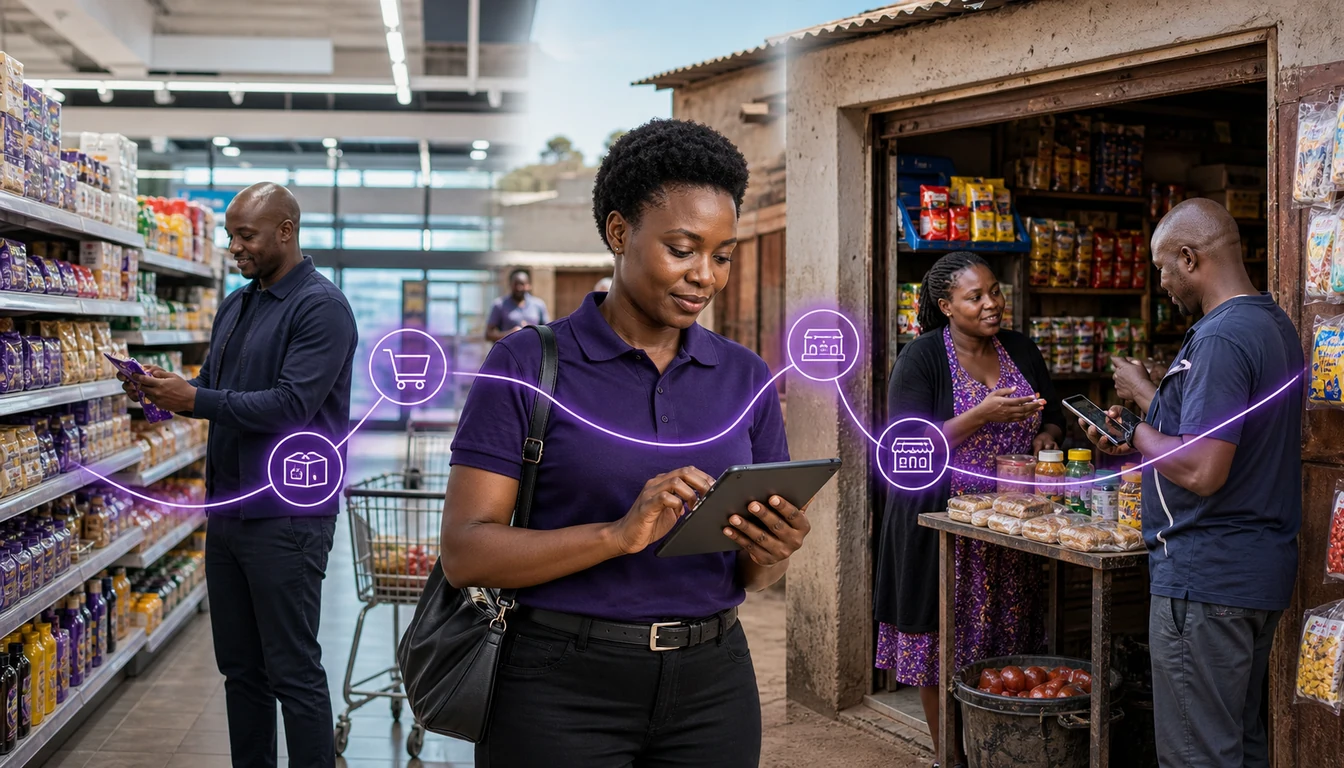
A rep finishes a call at a spaza shop in Tembisa. In the ten minutes that visit took, the phone in their hand quietly gathered personal information about at least two people.
The owner's name, a mobile number, a photograph of the permit taped behind the counter. The rep's own location trail, their check-in time and the selfie that proved they were standing there. None of it feels like a governance event. All of it is.
POPIA, the Protection of Personal Information Act overseen by the Information Regulator, treats that material exactly as it treats a customer database sitting in head office. The difference is that field data is captured by dozens of people, on handsets spread across nine provinces, a long way from anyone whose job title mentions compliance.
This is a practical guide for South African brands and distributors: what a field force genuinely collects, how to keep that collection purposeful and bounded, and how to answer calmly on the day somebody asks what you hold about them.

What POPIA Changes for a Field Sales Operation
The principles behind POPIA are not exotic. Collect information for a purpose you can state plainly. Collect no more than that purpose needs. Keep it accurate and protected. Keep it only while it is still useful. Be able to tell a person what you hold about them.
Nobody argues with any of that in a boardroom. It gets awkward the moment collection moves into the field, because the people doing the collecting are also selling, merchandising, chasing coverage and trying to finish the beat before the traffic thickens on the N1.
Two terms decide who carries the obligation:
- The responsible party is the business that decides why information is collected and what happens to it afterwards.
- The operator is a supplier that processes that information on the responsible party's behalf.
In most field-force setups the brand or the distributor is the responsible party for whatever its reps capture, and the software carrying those records acts as an operator. Accountability for what gets collected, and why, therefore sits squarely with you.
Which is why tooling matters more than policy here. A privacy notice filed on a shared drive changes nothing at a counter in Mdantsane. A capture screen that asks for four fields instead of nine changes everything, on every visit, without anyone having to remember a rule.
The Personal Data a Field Team Actually Collects
Most teams underestimate the volume, because it arrives in small ordinary pieces rather than as a database anyone deliberately built. The useful first step is simply writing the list down.
It falls into three groups, and each carries a different weight.
Information about the people you sell to
Outlet onboarding is where the bulk of it enters. A new spaza shop, tuck shop or independent store is added by a rep standing at the counter, and the record that gets created is about a person as much as about a shopfront.
A single outlet record can therefore carry:
- An owner's name, a mobile number and often an alternate contact for the shop.
- A photograph of a municipal registration or trading permit gathered while the outlet was being verified.
- Identity and trading details behind a credit account, plus a signature where the account runs on terms.
Information about the people who work for you
The same app collects at least as much about your own team. Location traces along the beat, check-in and check-out times, attendance photographs, leave and expense records, and in some setups the documents gathered during onboarding or for provident-fund administration.
Reps are data subjects too, and location is the part they feel most sharply. It is also the part most likely to sour a team when it turns up unannounced in a review meeting rather than being explained on day one.
Information about shoppers
Consumer activations, competition entries and sign-ups collected at a forecourt or outside a store add a third category to the phone. This is the material most often written on paper, photographed for safekeeping and then left sitting in a gallery, which is precisely the habit the Act exists to discourage.
Three Questions to Ask of Every Field You Capture
The strongest control available is the one applied before anything is stored: deciding, field by field, whether the app should be asking for it at all. That decision is made once, by whoever configures the capture screen, and it then holds on thousands of visits.
Run everything the app collects through the same short test:
| What the field team captures | Where it is captured | The question to settle before you keep it |
|---|---|---|
| Owner name and mobile number | Outlet onboarding at the counter | Which roles need to see it, and does any export carry it further than intended? |
| Photograph of a registration or trading permit | Township trade and independent onboarding | Where does that image live, and what deletes it once verification is done? |
| Storefront and shelf photographs | Merchandising and audit visits | Do people need to be in the frame at all, or only the fixture? |
| Rep location trail and attendance check-in | The beat, every working day | Is capture bounded to working hours, and was it explained before it started? |
| Shopper sign-up for a loyalty programme | Consumer activation outside a store | Was consent recorded with the record, in a language the person actually reads? |
Anything that cannot survive those questions probably should not be captured at all. Collecting less is the cheapest control there is, and the only one that never quietly stops working.
Say what it is for, in a sentence the person can read
A field force here works across several of the country's official languages, and the person at the counter may not be reading their first. One plain line stating what the information will be used for, offered in the languages your territory genuinely uses, does more real work than a paragraph of legal wording in English that nobody finishes.
Record the consent against the record
Consent that lives in a rep's memory is evidence of nothing. The capture screen should store what was agreed, when it was agreed and which outlet or person it attaches to, so the answer already exists on the day it is asked for.
When Someone Asks What You Hold About Them
Picture a rep who leaves the business and, a month later, asks for everything held about them. Or a shop owner in Mitchells Plain who simply wants their number off the promotional list.
Where field records are under control, the answer is short and specific:
- The person is found through one identifier instead of a hunt across six systems.
- Every record tied to them surfaces together: visits, orders, photographs, attendance, consent.
- Each record shows when it was captured, by whom, and for the purpose that was stated at the time.
- The correction, restriction or deletion is applied once, and the change is logged.
Without that control, the same request becomes a week of asking managers to check their own spreadsheets, a trawl through a shared drive of untitled photographs, and a reply nobody is confident is complete. The request was never the difficult part. Being unable to answer it is.
Who Can See It, and How Long You Keep It
Two controls do most of the protective work here, and neither is glamorous. One decides who can see a record. The other decides how long it goes on existing.
Start with access, scoped three ways:
- By territory so a rep holds the details for the outlets they serve, rather than a national list they will never call.
- By role so finance sees credit records and merchandising sees shelf photographs, and neither inherits the other by default.
- By action so viewing a record, editing it and exporting a list are separate rights instead of one blanket permission.
Then retention, which is where field systems quietly betray you. Permit photographs, credit applications that were declined, records for outlets that shut two winters ago, images from a promotion long since closed. Deciding up front how long each category should live, and letting the platform enforce it, stops a slow drift into holding material nobody ever chose to hold.
Where records travel outside South Africa, say to a regional team supporting distributors across SADC markets, or into a reporting tool hosted elsewhere, that movement should be a deliberate decision taken up front rather than something discovered later in an architecture diagram.
Where field data protection usually breaks
- Collecting because the form has a field is how a spouse's phone number ends up in a distribution database. Take the field out.
- Photographs as a catch-all means documents, handwritten lists and faces all arrive as images nobody classified. Capture structured fields wherever a picture is not genuinely needed.
- Everyone seeing everything turns one compromised login into the whole contact base. Scope access to the territory a person actually works.
- Records living on personal handsets spreads outlet numbers into private phonebooks and group chats where no rule reaches them. Keep the record inside the app.
- No retention rule at all means nothing is ever removed, and the volume you would have to search grows with every quarter you trade.
Making It Work on the Ground: Thin Coverage and Many Languages
A data-protection design that assumes a connected handset and a single language will not survive a real beat. Two conditions shape everything.
Offline capture still has to be controlled capture
Mobile coverage thins out along rural routes and drops into dead pockets inside township trade and dense transport-hub trading, from Warwick Junction in Durban to the streets around the Bree taxi rank.
Field apps have to keep working in those pockets, which means personal information sits on the handset until sync. That waiting period is a design question rather than an afterthought.
Records held for sync should be protected on the device, tied to a login that can be withdrawn centrally, and cleared once they have landed, so a handset left behind at an outlet is an inconvenience rather than an incident.
Notices and consent in the languages the team works in
Reps switch languages through the day depending on who is behind the counter, and in plenty of areas they find outlets by landmark rather than street name, because street addressing is inconsistent.
Purpose statements, consent prompts and privacy notices belong in the same languages, and so does the training that explains why any of it matters. A rep who understands the reason asks for less, not more.
How 1Channel Supports POPIA-Aligned Field Data Handling
Field data stays controlled when collection, permissions and retention are configured in one place instead of being left to individual habit. 1Channel keeps outlet, rep and visit records in a single platform, and supports the POPIA-aligned handling a South African responsible party is expected to be able to demonstrate.
It records outlet details as structured fields rather than loose photographs, limits what each user can reach, and carries on working where route coverage runs thin.
On this subject, the platform lets you:
- Capture outlet and retailer details as structured fields, with any supporting document attached to one verified record.
- Scope visibility by role and by territory, so a user reaches only the accounts they actually work.
- Keep an audit trail of who created or changed a record, and when they did it.
- Pull together every record tied to one outlet or one user in a single place when a request arrives.
- Carry on capturing offline and sync once signal returns, so records land in the platform instead of staying on a phone.
Bring Outlet and Field Records Under One Roof
See how 1Channel's Cloud AI Outlet & Store Management Software captures verified outlet records as structured data, scopes access by role and territory, keeps an audit trail, and supports POPIA-aligned handling of what your field team collects.
Explore Outlet & Store Management →FAQs
Does POPIA apply to the outlet contact details my reps collect?
A shop owner's name, mobile number and any document image tied to them are personal information, whether they were typed into a system at head office or captured on a phone at a counter in Katlehong. The obligation travels with the data, not with the place it was collected.
Can we track our reps' location during the working day?
Location data about an employee is personal information, so treat it as such: state the purpose, bound the capture to working hours and to what coverage management genuinely needs, explain it before it starts rather than after, and limit who can view the trail. Tracking that was explained and bounded is far easier to stand behind than tracking discovered by accident.
How should consent be captured while a rep is standing at the counter?
Say what the information will be used for in one plain sentence, in a language the person reads, and store what was agreed against the record itself. Consent that exists only in a rep's recollection cannot be produced later, which in practice is the same as never having it.
What happens to personal data while the app is offline?
It waits on the device, which is exactly why offline behaviour is a data-protection question and not only an engineering one. Records queued for sync should be protected on the handset, tied to a login that can be withdrawn centrally, and cleared once they reach the platform, so a lost phone does not become a lost set of records.