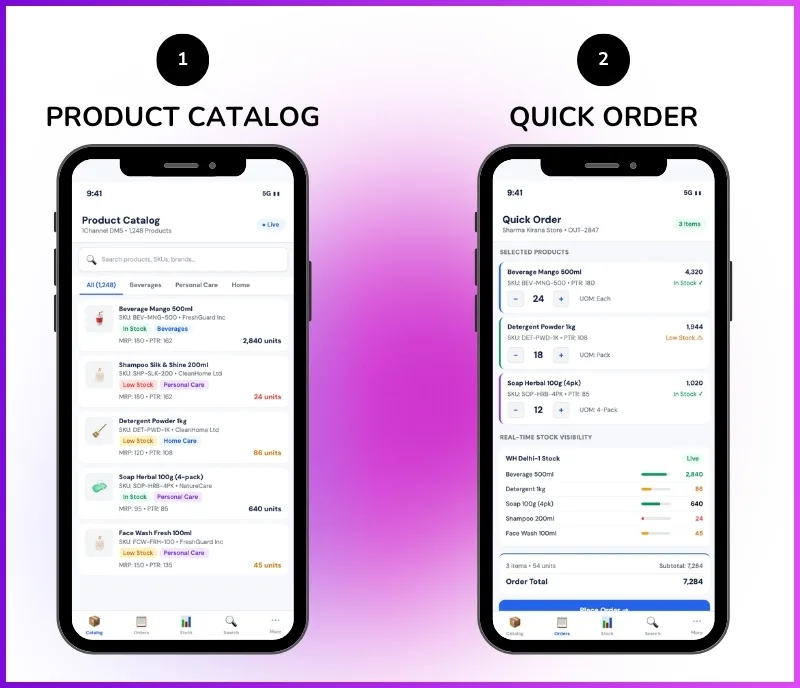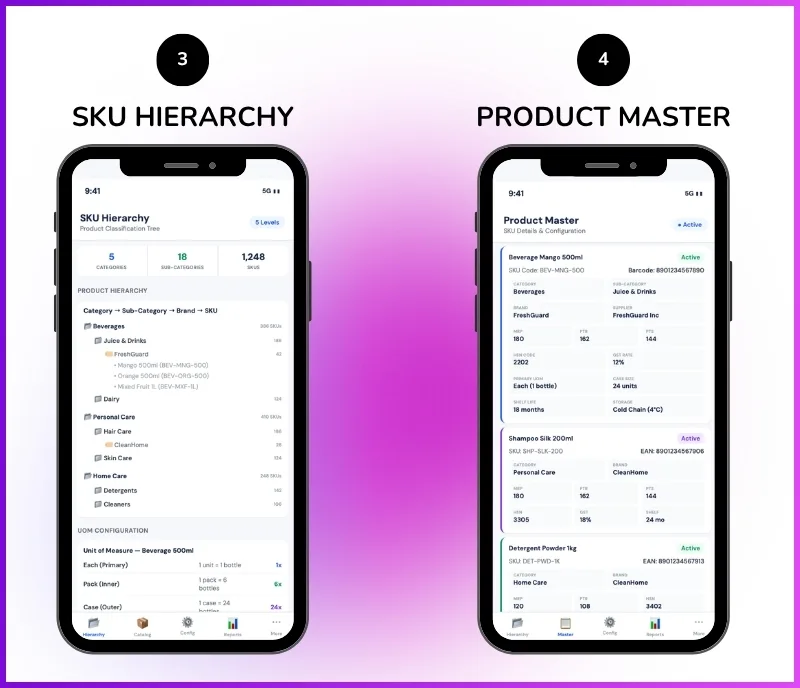
Complete distribution management tools to streamline distributor operations, order processing, inventory control, and secondary sales across your distribution network
Retailer orders, approvals, inventory allocation, delivery notes, and secondary sales
Track sellable stock, warehouse inventory, transit stock, and automate replenishment
Multi-warehouse inventory, stock transfers, batch tracking, GRN, and dispatch
Batch-level tracking, FEFO/FIFO/LIFO allocation, expiry monitoring, and stock rotation
Value-based, volume-based, and free goods schemes with auto-application
Customer-specific, geography-based pricing with validity dates and auto-application
Configurable geography hierarchy, beat planning, outlet mapping, and user assignment
No-code workflows with conditions, triggers, notifications, and multi-level approvals
24+ default reports, real-time dashboards, sales trends, and CSV export
Outstanding tracking, credit limits, invoice payment allocation, and credit notes
Multi-level returns, damage claims, credit note generation, and GRN discrepancy
Goods receipt notes, ordered vs received validation, and batch tracking
B2B ordering platform for distributors with self-service ordering and payments
Order booking app with GPS attendance, market visits, beat execution, and AI assistant
Conversational AI assistant, auto order validation, intelligent FIFO/FEFO, and automation
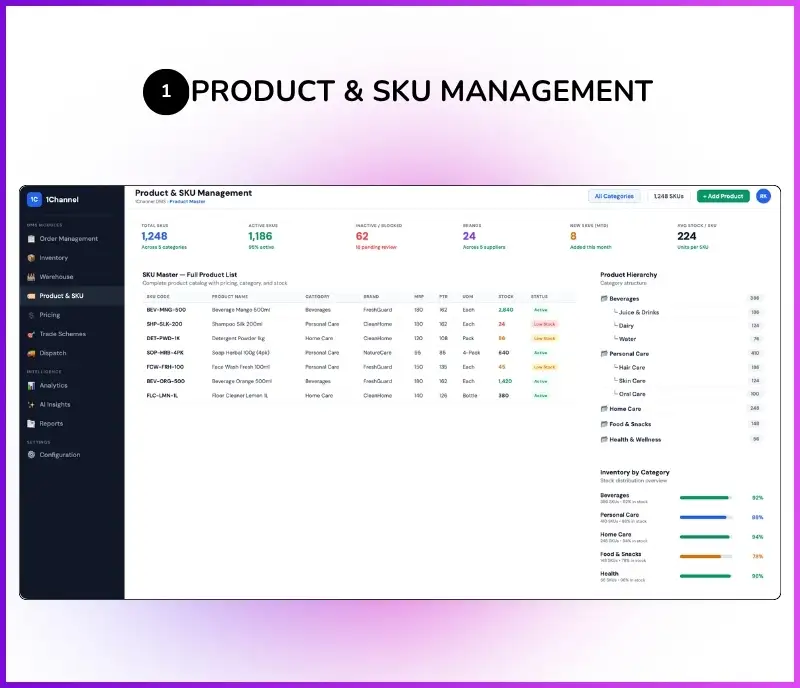
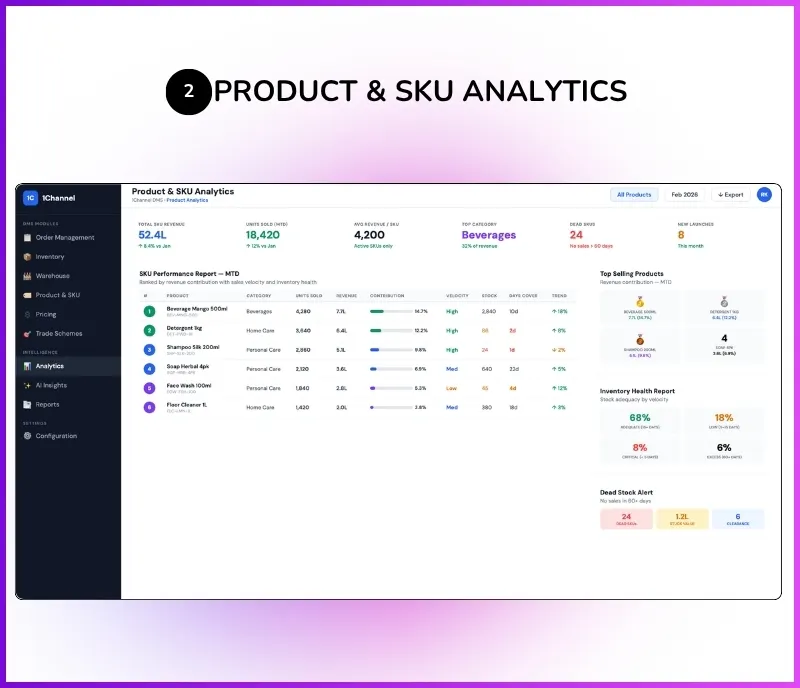
Admins set up the product hierarchy by defining brands, categories, products, and SKUs through the Product Hub. Unit of measurement conversions are configured with factors like 1 box equals 10 packets, 1 packet equals 4 pieces. Products can be added one at a time or imported in bulk via templates. Each SKU can have variants for size, color, or weight. All product data automatically flows into ordering, pricing, inventory, schemes, and reporting modules across the entire system.


Our recognitions constantly motivate us to push the envelope of excellence and empower our customers with winning ideas each day.
Define the complete catalog structure as Brand to Category to Product to SKU, tailored to how your business organizes products.
Features:
Why It Matters:
A flexible hierarchy that adapts to each organization's product structure ensures the catalog works for any industry, from fragrances to electronics to building materials.
Define units with conversion factors so the system calculates order quantities accurately across different packaging levels.
Features:
Why It Matters:
Accurate UOM conversions prevent quantity errors during ordering. When a distributor orders 5 boxes, the system knows that equals 50 packets or 200 pieces automatically.
Each product can have multiple SKU variants with different sizes, colors, weights, or custom attributes, each with its own code.
Features:
Why It Matters:
Variant-level management ensures each product configuration is tracked independently for accurate inventory, pricing, and order fulfilment across the network.
Import entire catalogs through templates or add products individually, with validation to prevent duplicates and maintain quality.
Features:
Why It Matters:
Bulk import reduces catalog setup time for businesses with hundreds or thousands of SKUs while validation prevents data quality issues from affecting downstream operations.
Product data from the Hub flows into ordering, pricing, inventory, schemes, targets, and reports automatically.
Features:
Why It Matters:
A centralized product master eliminates data silos. Every module in the system references the same product data, ensuring consistency from order to delivery to reporting.
At 1Channel, we celebrate every step of our new customers journey, market of geography, or higher customer satisfaction score to become the preferred Field Sales CRM leader.